 Back
BackFinance, Saving, and Investment: Macroeconomics Study Guide
Study Guide - Smart Notes
 Tailored notes based on your materials, expanded with key definitions, examples, and context.
Finance, Saving, and Investment
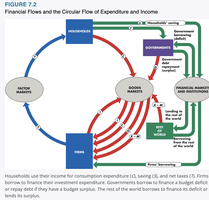
Financial Markets and Institutions
Financial markets and financial institutions are essential for channeling funds from savers to borrowers, transforming saving into investment, and investment into capital, which drives long-run economic growth.
Financial markets include loans, bonds, and stocks.
Financial institutions facilitate the matching of borrowers and lenders, reduce risk, and improve efficiency.
Without well-functioning financial markets, saving would remain idle, firms could not finance new capital, and productivity and real GDP growth would slow.
Capital, Investment, and Depreciation
Investment is spending on new capital goods that increase the economy’s productive capacity, while depreciation is the reduction in the value of capital due to wear, obsolescence, or damage.
Gross investment: Total spending on new capital, including replacement of worn-out capital.
Net investment: Change in the quantity of capital. Formula:
If net investment is positive, capital stock grows; if zero, it remains constant; if negative, it shrinks.
Wealth, Income, and Saving
Income: A flow—earnings received during a period.
Wealth (Net Worth): A stock—market value of assets minus liabilities.
Saving: Income not spent on consumption or taxes; adds to wealth and enables investment.
Key identity:
National wealth increases by national saving, which must be transformed into investment for GDP to grow.
Interest Rates and Asset Prices
The interest rate on an asset is the interest received as a percentage of the asset’s price.
Inverse relationship: Asset price ↑ → interest rate ↓; Asset price ↓ → interest rate ↑.
Formula:
Example: A bond pays $5 per year. If price = $50, interest rate = 10%. If price = $200, interest rate = 2.5%.
Sources of Funds for Investment
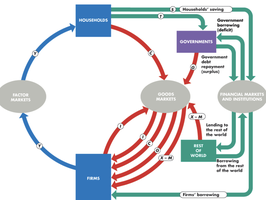
Investment is financed by three main sources:
Household saving (S)
Government budget surplus (T − G)
Borrowing from the rest of the world (M − X)
Income identities:
From household income:
From aggregate expenditure:
Setting equal and rearranging:
Nominal vs. Real Interest Rates
Nominal interest rate: The stated rate in dollars, not adjusted for inflation.
Real interest rate: Adjusted for inflation; measures true cost of borrowing. Formula:
The real interest rate is the opportunity cost of borrowing and saving, and is the price in the loanable funds market.
The Loanable Funds Market
Definition and Function
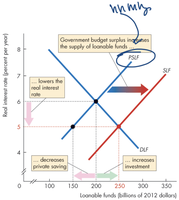
The loanable funds market is the aggregate of all financial markets where savers supply funds and borrowers demand funds. It determines the real interest rate, the quantity of saving, and the quantity of investment. 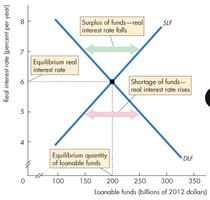
Demand for Loanable Funds
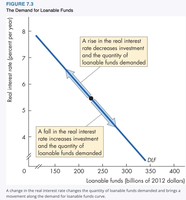
The quantity of loanable funds demanded is the total funds firms want to borrow to finance investment.
Key determinants: Real interest rate and expected profit.
Law of demand: Real interest rate ↑ → quantity demanded ↓; Real interest rate ↓ → quantity demanded ↑.
Demand curve (DLF) is downward sloping; a change in interest rate causes movement along the curve, while a change in expected profit shifts the curve.
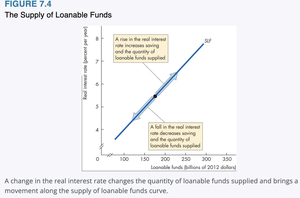
Supply of Loanable Funds
The quantity supplied of loanable funds is the total saving available for lending.
Key determinants: Real interest rate, disposable income, expected future income, wealth, default risk.
Law of supply: Real interest rate ↑ → saving ↑; Real interest rate ↓ → saving ↓.
Supply curve (SLF) is upward sloping; higher real interest rates encourage more saving.
Equilibrium in the Loanable Funds Market
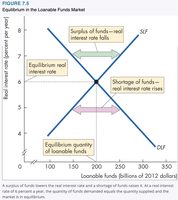
Equilibrium occurs where the quantity supplied equals the quantity demanded.
At equilibrium, there is no surplus or shortage; saving plans match investment plans.
If interest rate is too high, surplus of funds causes rate to fall; if too low, shortage causes rate to rise.
Changes in Demand and Supply
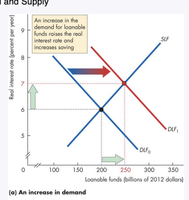
Increase in demand: Caused by higher expected profits; raises real interest rate and quantity of funds, lowers asset prices.
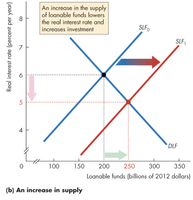
Increase in supply: Caused by higher saving; lowers real interest rate and raises quantity of funds, increases asset prices.
Government in the Loanable Funds Market
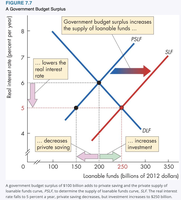
Budget surplus: Increases supply of loanable funds, lowers real interest rate, increases investment, reduces private saving.
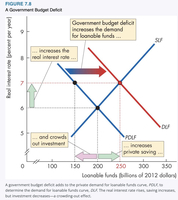
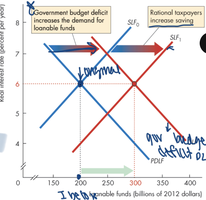
Budget deficit: Increases demand for loanable funds, raises real interest rate, reduces private investment (crowding out), increases private saving.
The Crowding-Out Effect
A government budget deficit raises interest rates and reduces private investment.
Not full crowding out, as higher interest rates encourage more saving.
The Ricardo–Barro Effect
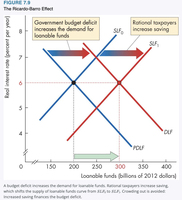
Rational taxpayers anticipate future taxes from deficits, increase saving today, supply of loanable funds increases, interest rate does not change, investment unchanged.
Most economists see this as extreme; partial offset may occur, but full neutrality is unlikely.
Summary Table: Loanable Funds Market Effects
Scenario | Effect on Supply/Demand | Interest Rate | Investment |
|---|---|---|---|
Increase in Saving | Supply ↑ | ↓ | ↑ |
Increase in Budget Deficit | Demand ↑ | ↑ | ↓ (crowding out) |
Ricardo-Barro Effect | Supply ↑ (offsets deficit) | No change | No change |
Exam-Level Connections
The loanable funds market links saving, investment, government budgets, and interest rates.
The real interest rate coordinates decisions of savers and investors.
Government deficits affect growth through investment, not just debt.
Financial markets affect long-run GDP, not just short-run cycles.
One-Sentence Exam Gold
The loanable funds market determines the real interest rate by balancing saving and investment, and government deficits can crowd out private investment by increasing the demand for loanable funds and raising interest rates.
