 Back
BackFiscal Policy: Concepts, Applications, and U.S. Federal Budget Structure
Study Guide - Smart Notes
 Tailored notes based on your materials, expanded with key definitions, examples, and context.
Fiscal Policy
Definition and Objectives
Fiscal policy refers to changes in federal taxes and government purchases designed to achieve macroeconomic policy objectives such as high employment, price stability, and robust economic growth. Both taxation and government spending influence aggregate demand (AD) in the economy:
Taxes affect AD indirectly by altering disposable income, which in turn impacts consumption and investment.
Government spending is a direct component of real GDP, as shown in the national income identity:
Where Y is real GDP, C is consumption, I is investment, G is government purchases, and NX is net exports.
Some economists argue that government spending may shift employment between sectors rather than increase total employment, referencing the Broken Window Fallacy—the idea that not all government spending creates net new jobs.
U.S. Federal Government Spending and Revenue
Federal Expenditures
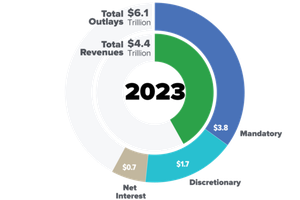
Federal government expenditures are divided into several categories:
Defense spending
Other purchases (e.g., salaries of federal employees, national parks, scientific research)
Transfer payments (e.g., Social Security, Medicare, unemployment insurance)
Grants to state and local governments
Interest payments on the federal debt
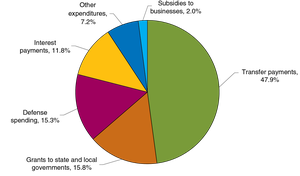
Approximately half of federal expenditures are transfer payments, with the remainder allocated to other spending categories.
Federal Revenue Sources
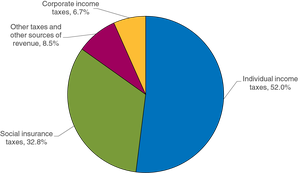
Federal revenues primarily come from:
Individual income taxes and payroll taxes (for Social Security and Medicare)
Corporate income taxes (about 6.7% of receipts)
Excise taxes, tariffs, and other fees
How Fiscal Policy Affects Aggregate Demand
Expansionary and Contractionary Fiscal Policy
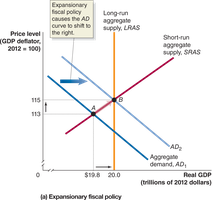
Fiscal policy can be used to stabilize the economy by influencing aggregate demand:
Expansionary fiscal policy: Increasing government purchases or decreasing taxes to boost AD when real GDP is below potential GDP, aiming to reduce unemployment.
Contractionary fiscal policy: Decreasing government purchases or increasing taxes to reduce AD when real GDP exceeds potential GDP, aiming to lower inflation.
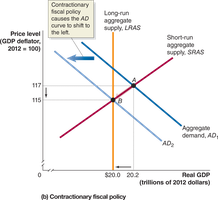
It is important to note that contractionary policy does not cause prices to fall, but rather slows the rate of inflation compared to what it would have been otherwise.
Fiscal Policy vs. Monetary Policy
Fiscal policy is managed by the government and involves changes in spending and taxation.
Monetary policy is managed by the central bank and involves changes in interest rates and the money supply.
Though both aim for economic stability, their mechanisms and direct effects differ.
Types of Federal Spending
Discretionary Spending
Discretionary spending is subject to annual appropriations by Congress and includes programs such as national defense, transportation, science, environment, education, and veterans' benefits.
Mandatory Spending
Mandatory spending is governed by permanent laws and includes entitlements like Medicare, Social Security, and interest on the national debt. Changes require new legislation.
Automatic and Discretionary Stabilizers
Automatic Stabilizers
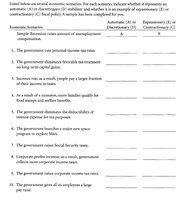
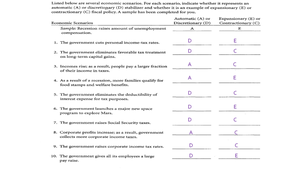
Automatic stabilizers are government spending and tax mechanisms that automatically adjust with the business cycle, without new legislative action. They help moderate fluctuations in real GDP:
Examples: Unemployment benefits, progressive income taxes, welfare payments, capital gains taxes
Discretionary Stabilizers
Discretionary stabilizers require new laws or executive actions to change government spending or tax policies:
Examples: New education funding, infrastructure projects, changes in national defense spending
Social Security and Medicare: Long-Term Challenges
Fiscal Time Bombs
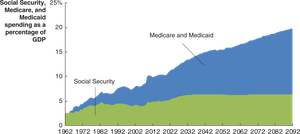
Social Security and Medicare have significantly reduced poverty among the elderly and improved health outcomes for low-income individuals. However, demographic trends and rising healthcare costs threaten the long-term sustainability of these programs. The projected budget shortfall through 2092 is nearly $14 trillion (in present value terms).
Policy Responses and Concerns
Congress has raised the retirement age and increased payroll taxes to address shortfalls.
Medicare faces greater long-term challenges due to rising costs and an aging population.
Declining birthrates have reduced the number of workers supporting each retiree.

Deficits, Surpluses, and Public Debt
Key Definitions
Budget deficit: Annual government spending exceeds tax revenues.
Budget surplus: Annual tax revenues exceed government expenditures.
Public debt: The cumulative total of past deficits minus surpluses.
Current figures for the federal deficit and debt can be found on the Congressional Budget Office website.
Practice and Application
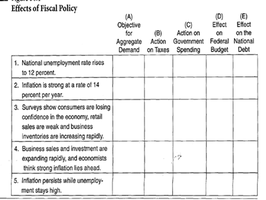
Effects of Fiscal Policy
Students are often asked to analyze economic scenarios and determine the appropriate fiscal policy response, including the effects on aggregate demand, taxes, government spending, the federal budget, and the national debt.
Additional info: Fiscal policy is a central tool for macroeconomic stabilization, but its effectiveness depends on timing, the structure of the economy, and coordination with monetary policy. Long-term fiscal sustainability is a growing concern due to demographic changes and rising entitlement costs.
