 Back
BackFiscal Policy, Incentives, and Secondary Effects: An Advanced Macroeconomics Study Guide
Study Guide - Smart Notes
 Tailored notes based on your materials, expanded with key definitions, examples, and context.
Alternative Views of Fiscal Policy
Keynesian vs. Modern Perspectives
Fiscal policy refers to government decisions regarding taxation and spending, which are used to influence aggregate demand (AD) and overall economic activity. The Keynesian approach emphasizes the effectiveness of fiscal policy in stabilizing the economy, while modern economists focus on the role of incentives and secondary effects that may undermine fiscal policy's impact.
Keynesian View: Fiscal policy is a powerful tool for maintaining AD at a level consistent with full employment.
Modern Critique: Incentive effects and secondary consequences, such as changes in private sector behavior, can reduce the effectiveness of fiscal interventions.
Secondary Effects: These include the impact of fiscal policy on interest rates, investment, and future tax expectations.
Fiscal Policy, Borrowing, and the Crowding-Out Effect
The Crowding-Out Effect
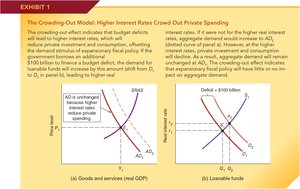
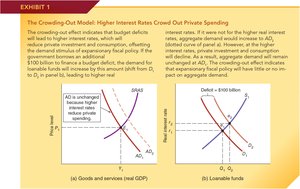
The crowding-out effect describes how increased government borrowing to finance budget deficits can lead to higher interest rates, which in turn reduce private investment and consumption. This effect can neutralize the intended expansionary impact of fiscal policy on aggregate demand.
Mechanism: Government borrowing increases the demand for loanable funds, raising interest rates.
Result: Higher interest rates discourage private investment and consumption, offsetting the increase in government spending.
Aggregate Demand: The net effect may be little or no change in AD, despite increased government expenditure.
Crowding-Out in an Open Economy
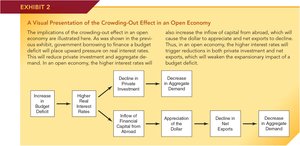
In an open economy, the crowding-out effect is amplified by international capital flows. Higher domestic interest rates attract foreign capital, leading to currency appreciation and a reduction in net exports, further offsetting the expansionary effects of fiscal deficits.
Capital Inflows: Foreign investors buy domestic assets, increasing demand for the domestic currency.
Currency Appreciation: The stronger currency makes exports more expensive and imports cheaper, reducing net exports.
Aggregate Demand: Both private investment and net exports decline, weakening the impact of fiscal expansion.
Fiscal Policy, Future Taxes, and the New Classical Model
The New Classical View of Fiscal Policy
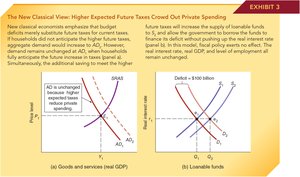
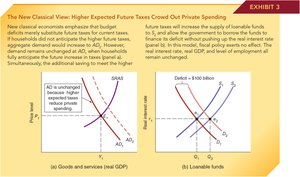
New Classical economists argue that rational households anticipate future taxes required to pay off government debt. As a result, they increase savings in response to budget deficits, which offsets the effects of fiscal expansion on aggregate demand, output, and interest rates.
Ricardian Equivalence: The idea that government deficits are viewed as future tax liabilities by households, leading them to save more.
Interest Rates: Increased savings supply offsets the increased demand for loanable funds, keeping interest rates stable.
Aggregate Demand: No net change, as increased government spending is matched by reduced private spending.
Political Incentives and Discretionary Fiscal Policy
Public Choice Analysis
Political incentives often lead legislators to favor budget deficits over surpluses, as spending programs provide visible benefits to constituents while tax increases are unpopular. This dynamic makes counter-cyclical fiscal policy less likely and contributes to persistent deficits.
Deficits vs. Surpluses: Deficits are more common due to political reluctance to raise taxes.
Policy Implications: Discretionary fiscal policy may not be effectively used for economic stabilization.
Supply-Side Effects of Fiscal Policy
Tax Rate Effects and Supply-Side Economics
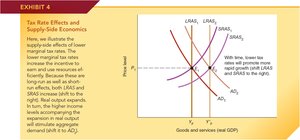
Supply-side economics examines how changes in marginal tax rates affect incentives to work, save, and invest. Lower marginal tax rates can increase aggregate supply (AS) by encouraging productive activity, potentially shifting both short-run and long-run AS curves to the right.
Incentives: Lower tax rates increase the reward for productive behavior.
Aggregate Supply: Both SRAS and LRAS can shift right, increasing output and potentially lowering the price level.
Aggregate Demand: If tax cuts are deficit-financed, AD may increase more than AS, raising the price level.
Distributional Effects: Taxes Paid by the Rich
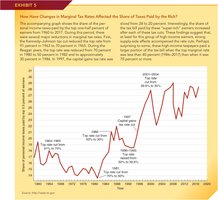
Despite reductions in top marginal tax rates since the 1980s, the share of total income taxes paid by the highest earners has increased. This suggests strong supply-side responses among high-income taxpayers.
Historical Trend: The top 0.5% of earners have paid a growing share of income taxes, even as their rates have fallen.
Policy Debate: Lower rates may broaden the tax base and increase compliance or economic activity among the wealthy.
Fiscal Policy and Recovery from Recessions
Keynesian vs. Non-Keynesian Views
There is debate over whether increases in government spending or tax cuts are more effective in stimulating economic recovery. Keynesians argue that government spending has a larger multiplier effect, while others note that tax cuts can also boost supply and demand, and that the issue is more complex than simple multiplier analysis suggests.
Government Spending: Directly increases AD, but may be offset by crowding-out or supply-side effects.
Tax Cuts: Can increase both AD and AS, but some of the benefit may be saved or spent abroad.
U.S. Fiscal Policy: 1990-2019
Trends in Federal Spending and Deficits
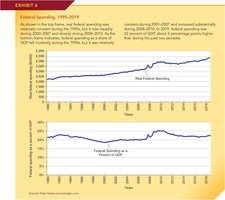
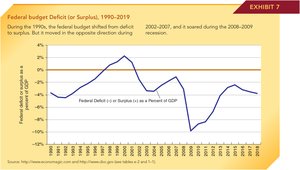
Analysis of U.S. fiscal policy over recent decades shows significant variation in government spending and budget balances. The 1990s saw fiscal restraint and a move to surplus, while the 2000s and the period following the 2008-2009 recession were characterized by increased spending and large deficits.
Federal Spending: Rose steadily after 2000, especially during and after the Great Recession.
Budget Balance: Shifted from surplus in the late 1990s to persistent deficits in the 2000s and 2010s.
Key Terms and Formulas
Aggregate Demand (AD): The total demand for goods and services in an economy at a given overall price level and in a given period.
Aggregate Supply (AS): The total supply of goods and services that firms in a national economy plan on selling during a specific time period.
Loanable Funds Market: The market where savers supply funds for loans to borrowers.
Multiplier Effect: The ratio of a change in national income to the change in government spending that causes it.
Key Equations
Government Spending Multiplier: where is the marginal propensity to consume.
Tax Multiplier:
Additional info: The above equations are fundamental to understanding the impact of fiscal policy on aggregate demand.
