 Back
BackFiscal Policy: Mechanisms, Effects, and Policy Debates
Study Guide - Smart Notes
 Tailored notes based on your materials, expanded with key definitions, examples, and context.
Chapter 16: Fiscal Policy
Introduction to Fiscal Policy
Fiscal policy refers to the use of government spending and taxation to influence the economy's aggregate demand, output, and price level. Policymakers use fiscal policy to address macroeconomic issues such as recessions, inflation, and long-term growth challenges.
Expansionary and Contractionary Fiscal Policy
Expansionary Fiscal Policy
Expansionary fiscal policy is implemented when the economy is in recession or experiencing below-potential output. The government increases aggregate demand by raising government purchases or cutting taxes, which boosts real GDP and the price level.
Key Point 1: Expansionary fiscal policy shifts the aggregate demand curve to the right, increasing output and prices.
Key Point 2: Cutting individual income taxes raises household disposable income, leading to higher consumption spending.
Example: If real GDP is $14.2 trillion and the price level is 98, expansionary policy can increase GDP to $14.4 trillion and the price level to 100.
Contractionary Fiscal Policy
Contractionary fiscal policy is used when the economy is overheating, with real GDP above potential and rising inflation. The government decreases aggregate demand by reducing government purchases or increasing taxes, which lowers real GDP and the price level.
Key Point 1: Contractionary fiscal policy shifts the aggregate demand curve to the left, reducing output and prices.
Key Point 2: Policymakers use contractionary policy to prevent or reduce inflationary pressures.
Example: If real GDP is $14.6 trillion and the price level is 102, contractionary policy can reduce GDP to $14.4 trillion and the price level to 100.
Fiscal Policy and Social Programs
Social Security and Medicare: Fiscal Challenges
Social Security and Medicare are major federal programs that support the elderly and the poor. However, demographic changes and rising healthcare costs threaten their long-term sustainability, creating significant fiscal challenges for the government.
Key Point 1: The projected budget shortfall for Social Security and Medicare through 2092 is nearly $14 trillion (present value).
Key Point 2: Congress has responded by raising the retirement age and increasing payroll taxes, but long-term concerns remain, especially for Medicare.
Example: As the population ages and birthrates fall, the number of workers per retiree declines, straining the system.

Deficits, Surpluses, and the National Debt
Key Fiscal Definitions
Budget Deficit: The amount by which annual government spending exceeds tax revenues.
Budget Surplus: The amount by which annual tax revenues exceed government expenditures.
Public Debt: The total amount owed by the government, accumulated from past deficits.
Understanding whether the government is running a deficit or surplus is crucial for evaluating fiscal sustainability.
Analyzing Fiscal Policy Decisions
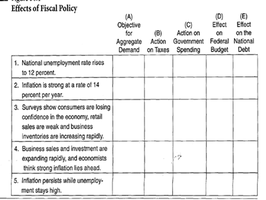
Effects of Fiscal Policy: Decision Table
Fiscal policy decisions depend on economic conditions such as unemployment, inflation, and business confidence. Policymakers must choose appropriate actions on taxes and government spending to achieve macroeconomic objectives.
The Multiplier Effect
Government Purchases and Tax Multipliers
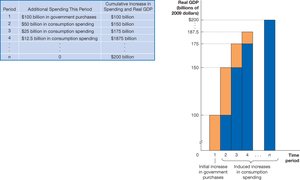
The multiplier effect describes how an initial change in government spending or taxes leads to a larger change in aggregate demand and real GDP. The size of the multiplier depends on the marginal propensity to consume (MPC) and other leakages in the economy.
Key Point 1: An increase in government purchases induces further increases in consumption spending, amplifying the impact on GDP.
Key Point 2: The spending multiplier is typically between 1 and 2, while the long-run tax multiplier may be higher due to persistent effects on disposable income.
Formula:
Example: A $100 billion increase in government purchases can result in a total increase in GDP greater than $100 billion due to induced consumption.
The Crowding-Out Effect
Interest Rates and Aggregate Demand
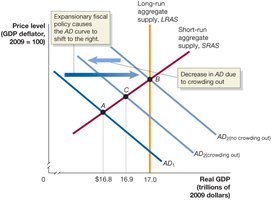
Expansionary fiscal policy can lead to higher interest rates, which may reduce private investment, consumption, and net exports—a phenomenon known as crowding out. This effect can partially offset the initial increase in aggregate demand.
Key Point 1: Higher government spending increases the demand for money, raising interest rates.
Key Point 2: The resulting decrease in private spending reduces the net effect of fiscal expansion on GDP.
Example: The aggregate demand curve shifts right due to fiscal policy, but then partially shifts back left due to crowding out.
Supply-Side Fiscal Policies
Long-Run Growth and Tax Policy
Supply-side fiscal policies aim to increase the economy's productive capacity by shifting the long-run aggregate supply (LRAS) curve to the right. These policies often focus on tax reform, investment incentives, and regulatory improvements.
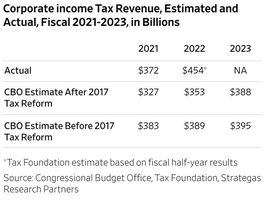
Key Point 1: Lowering tax rates can increase incentives to work, save, and invest, potentially boosting long-run real GDP.
Key Point 2: The magnitude of supply-side effects is uncertain and may depend on labor market constraints and other factors.
Example: Tax reform may encourage greater labor force participation, but only if workers are able to adjust their hours.
Modern Growth Theory and Government's Role
Governments can foster economic growth by providing infrastructure, ensuring a fair legal system, maintaining financial stability, investing in human capital, and encouraging technological innovation.
Key Point 1: Effective supply-side policies create an environment conducive to long-term growth.
Key Point 2: These policies typically take longer to affect the economy than demand-side measures.
Monetary and Fiscal Policy Combinations
Coordinating Policy Tools
Monetary and fiscal policies can be combined to achieve macroeconomic objectives. For example, decreasing government spending and increasing the discount rate both reduce aggregate demand in the short run.
Key Point 1: The effectiveness of policy combinations depends on the economic context and the responsiveness of aggregate demand and supply.
Key Point 2: Not all economic problems can be solved with fiscal policy alone; some require monetary interventions or structural reforms.
