 Back
BackFiscal Policy: Structure, Effects, and Limitations in Macroeconomics
Study Guide - Smart Notes
 Tailored notes based on your materials, expanded with key definitions, examples, and context.
Fiscal Policy in Macroeconomics
What Is Fiscal Policy?
Fiscal policy refers to the use of government spending and taxation to influence the economy. It is a central tool for achieving macroeconomic objectives such as economic growth, low unemployment, and stable prices. Fiscal policy can be categorized as either discretionary (intentional changes in taxes or spending) or automatic stabilizers (programs that adjust automatically with the business cycle, such as unemployment insurance).
Discretionary Fiscal Policy: Deliberate actions by the government to change spending or taxes.
Automatic Stabilizers: Programs that increase or decrease spending/taxes automatically in response to economic conditions.
Example: Unemployment insurance payments rise during recessions, providing automatic stabilization.
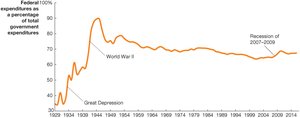
Federal Government Expenditures and Revenue
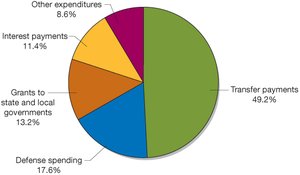
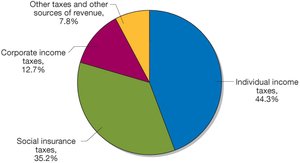
The federal government’s role in total government expenditures has grown significantly since the Great Depression. Today, federal expenditures constitute a large share of GDP, with spending divided among defense, transfer payments, grants, and interest payments. Revenue is primarily sourced from individual income taxes and payroll taxes.
Expenditures: Defense, transfer payments (Social Security, Medicare), grants, interest payments.
Revenue: Individual income taxes, payroll taxes, corporate income taxes, excise taxes, tariffs.
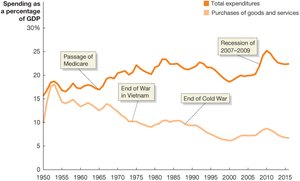
Social Security, Medicare, and Fiscal Sustainability
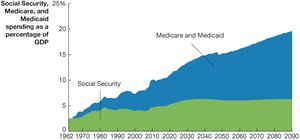
Social Security and Medicare are major components of federal spending, helping reduce poverty among the elderly. However, demographic changes and rising healthcare costs threaten their sustainability, with projected budget shortfalls.
Challenges: Aging population, rising healthcare costs.
Potential Solutions: Increasing taxes, decreasing benefits, reducing eligibility, controlling medical costs.
The Effects of Fiscal Policy on Real GDP and the Price Level
Fiscal Policy and Aggregate Demand
Fiscal policy affects aggregate demand through changes in government purchases and taxes. An increase in government purchases directly raises aggregate demand, while tax changes affect disposable income and thus consumption.
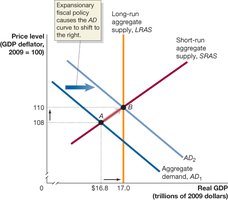
Expansionary Fiscal Policy: Increasing government purchases or decreasing taxes to boost aggregate demand and reduce unemployment.
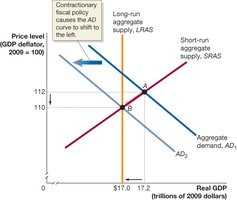
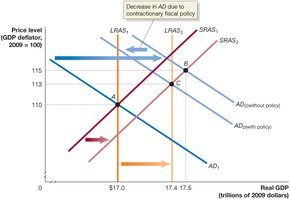
Contractionary Fiscal Policy: Decreasing government purchases or increasing taxes to lower aggregate demand and reduce inflation.
Dynamic Aggregate Demand and Aggregate Supply Model
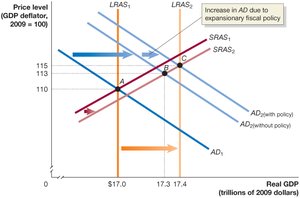
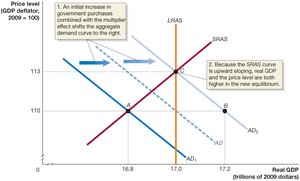
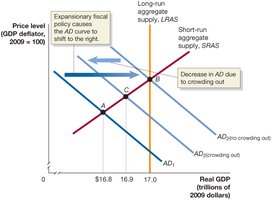
The dynamic model incorporates changes in potential GDP and the price level, providing a more realistic analysis of fiscal policy effects. Expansionary policy shifts aggregate demand right, raising both real GDP and the price level. Contractionary policy shifts aggregate demand left, reducing inflationary pressures.
The Government Purchases and Tax Multipliers
Multiplier Effect
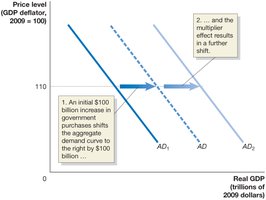
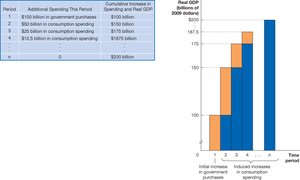
The multiplier effect describes how an initial change in autonomous spending (such as government purchases) leads to a greater overall change in real GDP due to induced increases in consumption. The size of the multiplier depends on the marginal propensity to consume (MPC).
Government Purchases Multiplier: Measures the total change in GDP from a change in government spending.
Tax Multiplier: Measures the total change in GDP from a change in taxes; typically smaller in absolute value than the government purchases multiplier.
Multiplier Formulas
Government Purchases Multiplier:
Tax Multiplier:
Balanced Budget Multiplier: Equal increase in government purchases and taxes increases GDP by the same amount as the increase in purchases.
Multiplier in an Open Economy
When imports are considered, the multiplier is reduced because some spending leaks abroad.
Open Economy Multiplier: where MPI is the marginal propensity to import.
Multiplier and Aggregate Supply
An increase in aggregate demand also raises the price level due to the upward-sloping short-run aggregate supply curve.
Limits to Using Fiscal Policy to Stabilize the Economy
Difficulties in Implementation
Fiscal policy faces several limitations, including legislative and implementation delays, and the risk of crowding out private spending.
Legislative Delay: Time required for Congress to approve fiscal measures.
Implementation Delay: Time required to execute spending projects.
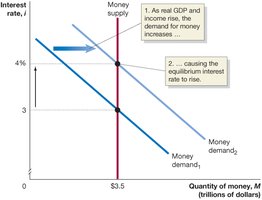
Crowding Out: Increased government spending may reduce private investment and consumption.
Deficits, Surpluses, and Federal Government Debt
Budget Deficit and Debt
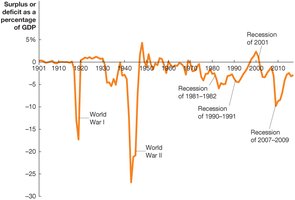
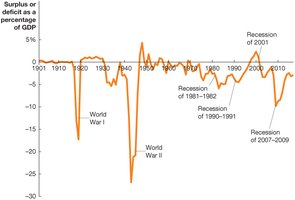
A budget deficit occurs when government expenditures exceed tax revenue; a surplus is the opposite. Persistent deficits contribute to the federal government debt, which is the total value of outstanding Treasury securities.
Automatic Stabilizers: Budget deficits often increase during recessions due to falling tax receipts and rising transfer payments.
Cyclically Adjusted Budget Deficit: The deficit if the economy were at potential GDP, separating policy effects from automatic stabilizers.

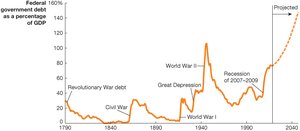
Should the Federal Budget Be Balanced?
Most economists agree the budget should be balanced at potential GDP, but not during recessions. Deficits can be justified for long-term investments, especially when borrowing costs are low.
Long-Run Fiscal Policy and Economic Growth
Supply-Side Effects
Long-run fiscal policy aims to increase potential GDP by enhancing aggregate supply. This is often achieved through tax policy changes that incentivize work, saving, investment, and entrepreneurship.
Tax Wedge: The difference between pretax and posttax returns, which can distort economic incentives.
Marginal Tax Rates: Higher rates can reduce labor supply, investment, and capital formation.
Tax Simplification: Simplifying the tax code can increase economic efficiency.
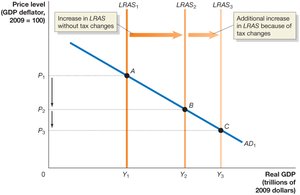
Explaining Long-Run Increases in Real GDP
Growth rate of real GDP:
Policy Proposals and Economic Growth
Recent policy proposals aim to increase real GDP growth by boosting hours worked and labor productivity, though their effectiveness is debated among economists.
Appendix: A Closer Look at the Multiplier
Equilibrium GDP Model
Equilibrium GDP is determined by the sum of consumption, investment, and government purchases. The consumption function incorporates the marginal propensity to consume and disposable income.
Consumption Function:
Equilibrium Condition:
Government Purchases and Tax Multipliers
Government Purchases Multiplier:
Tax Multiplier:
Balanced Budget Multiplier
Balanced Budget Multiplier: If government purchases and taxes both increase by the same amount, GDP increases by that amount in the short run.
Incorporating Tax Rates and Open Economy
Tax Rate Effect: Lower tax rates lead to larger multipliers.
Open Economy Multiplier:
Summary Table: Key Fiscal Policy Concepts
Concept | Definition | Formula |
|---|---|---|
Government Purchases Multiplier | Total change in GDP from government spending | |
Tax Multiplier | Total change in GDP from tax changes | |
Balanced Budget Multiplier | Change in GDP from equal changes in spending and taxes | Equal to change in government purchases |
Open Economy Multiplier | Multiplier with imports considered |
Additional info: Academic context was added to clarify formulas, definitions, and the role of fiscal policy in macroeconomic stabilization and growth.
