 Back
BackFiscal Policy: The Keynesian View and the Historical Development of Macroeconomics
Study Guide - Smart Notes
 Tailored notes based on your materials, expanded with key definitions, examples, and context.
Fiscal Policy: The Keynesian View and the Historical Development of Macroeconomics
The Great Depression and the Rise of Keynesian Economics
The Great Depression of the 1930s was a pivotal event in the development of macroeconomic theory. Prior to this period, mainstream economic thought held that markets would naturally adjust to restore full employment. However, the prolonged unemployment and economic stagnation of the Great Depression challenged this view and led to the emergence of Keynesian economics, developed by John Maynard Keynes.
Keynesian Revolution: Keynes argued that insufficient aggregate demand could lead to prolonged periods of high unemployment and economic underperformance.
Role of Fiscal Policy: Keynesian theory emphasized the use of government fiscal policy—changes in government spending and taxation—to stabilize the economy and maintain high levels of output and employment.
Historical Impact: Keynesian economics dominated macroeconomic policy from the end of World War II until the 1970s, when it was challenged by the phenomenon of stagflation (simultaneous high inflation and unemployment).

The Keynesian Concept of Equilibrium
In the Keynesian model, equilibrium occurs when total spending in the economy equals the value of current output. Firms adjust their production to match the level of demand they expect. If total spending is insufficient, the economy can remain stuck in a state of high unemployment and underutilized resources.
Equilibrium Condition: Total spending (aggregate demand) = Current output (aggregate supply).
Implication: If aggregate demand is too low, the economy will not automatically return to full employment without intervention.
The Multiplier Principle
The multiplier principle is a core concept in Keynesian economics. It describes how an initial change in spending (such as government expenditure) leads to a larger overall change in national income. The size of the multiplier depends on the marginal propensity to consume (MPC)—the fraction of additional income that households spend on consumption.
Marginal Propensity to Consume (MPC): The proportion of additional income that is spent rather than saved. For example, if MPC = 0.75, households spend 75% of any new income.
Multiplier Formula:
Example: If MPC = 0.75, the multiplier is .
Amplification Effect: An initial increase in spending leads to successive rounds of income and consumption, magnifying the total impact on the economy.
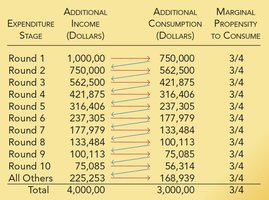
Table Purpose: This table illustrates how an initial $1,000,000 injection into the economy, with an MPC of 3/4, results in a total of $4,000,000 in additional income and $3,000,000 in additional consumption through successive rounds of spending.
The Multiplier and Economic Instability
The multiplier effect works in both directions. Just as increases in spending can boost income and output, decreases in spending can lead to amplified reductions in economic activity. This explains why market economies may experience cycles of booms and recessions.
Economic Fluctuations: Fluctuations in aggregate demand are seen as the primary source of economic instability in the Keynesian framework.
Policy Implication: Government intervention may be necessary to stabilize aggregate demand and smooth out economic cycles.
Fiscal Policy and the Keynesian Approach
Keynesian economics advocates the use of fiscal policy to counteract economic fluctuations. Rather than balancing the budget annually, Keynesians support counter-cyclical fiscal policy—running deficits during recessions and surpluses during booms.
Expansionary Fiscal Policy: Increasing government spending or cutting taxes to stimulate aggregate demand during a recession.
Restrictive Fiscal Policy: Decreasing government spending or raising taxes to reduce aggregate demand and control inflation during an economic boom.
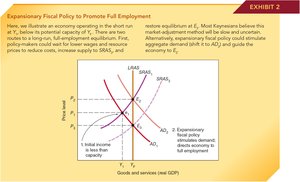
Expansionary Fiscal Policy to Promote Full Employment
When the economy is operating below its potential (Y1 < YF), expansionary fiscal policy can shift aggregate demand (AD) to restore full employment.
Mechanism: Government increases spending or reduces taxes, shifting AD rightward and moving the economy toward full employment output (YF).
Alternative Adjustment: Lower resource prices could also restore equilibrium by shifting short-run aggregate supply (SRAS) rightward, but this process may be slow.
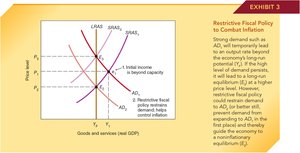
Restrictive Fiscal Policy to Combat Inflation
When aggregate demand is excessive, the economy may temporarily operate above its long-run potential, leading to inflationary pressures. Restrictive fiscal policy can help bring demand back in line with productive capacity.
Mechanism: Government reduces spending or increases taxes, shifting AD leftward and preventing the economy from overheating.
Long-Run Adjustment: If strong demand persists, SRAS may shift leftward, resulting in higher prices and a new equilibrium at a higher price level.
Challenges of Fiscal Policy: Timing and Effectiveness
While discretionary fiscal policy can stabilize the economy, its effectiveness depends on proper timing. Delays in recognizing economic conditions, enacting policy, and the time it takes for policy to affect the economy can reduce its effectiveness or even destabilize the economy further.
Timing Problems: Poorly timed fiscal policy can exacerbate economic fluctuations rather than smooth them.
Automatic Stabilizers: Features such as progressive taxes and unemployment benefits automatically help stabilize the economy without the need for new legislation.
Paradoxes of Thrift and Spending
Keynesian economics also highlights certain paradoxes related to saving and spending behavior:
Paradox of Thrift: While saving is beneficial for individuals, if everyone increases saving simultaneously, aggregate demand may fall, leading to lower income and output.
Paradox of Excessive Consumption: Excessive consumption and low saving can lead to high household debt, making the economy vulnerable to shocks and reducing long-term financial stability.
Household Debt and Macroeconomic Stability
Rising household debt relative to after-tax income can weaken the economy's ability to recover from recessions. High debt levels reduce consumers' willingness and ability to spend, limiting the effectiveness of fiscal stimulus measures.
Historical Trend: The household debt-to-income ratio in the United States increased significantly from the 1980s to 2007, peaking at around 130% before declining after the Great Recession.
Implication: High debt burdens can dampen the impact of fiscal policy and slow economic recovery.
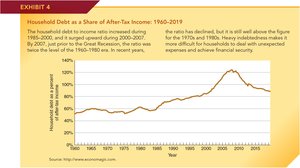
Table Purpose: This graph shows the trend in household debt as a percentage of after-tax income, highlighting the vulnerability of households during periods of high indebtedness.
Summary
Keynesian economics revolutionized macroeconomic thought by emphasizing the role of aggregate demand and fiscal policy in stabilizing the economy.
The multiplier principle explains how changes in spending can have amplified effects on income and output.
Fiscal policy can be used to combat both recessions and inflation, but its effectiveness depends on proper timing and the underlying financial health of households.
High levels of household debt can limit the effectiveness of fiscal stimulus and increase economic vulnerability.
