 Back
BackGDP: Measuring Total Production and Income – Study Notes
Study Guide - Smart Notes
 Tailored notes based on your materials, expanded with key definitions, examples, and context.
GDP: Measuring Total Production and Income
Introduction
Gross Domestic Product (GDP) is a central concept in macroeconomics, serving as the primary measure of a nation's total economic output and income. This chapter explores how GDP is calculated, its limitations, and related measures of economic activity.
Gross Domestic Product Measures Total Production
Macroeconomics and the Business Cycle
Macroeconomics studies the economy as a whole, focusing on aggregate measures such as inflation, unemployment, and economic growth.
The business cycle consists of alternating periods of economic expansion (rising output and employment) and recession (declining output and employment).
Economic growth is the ability of an economy to produce increasing quantities of goods and services over time.
The inflation rate is the percentage increase in the price level from one year to the next.
Definition and Calculation of GDP
Gross Domestic Product (GDP) is the market value of all final goods and services produced within a country during a specific period, typically one year.
GDP includes only final goods and services (purchased by final users), not intermediate goods (used as inputs in the production of other goods).
GDP measures only new production; used goods are excluded.
The Circular-Flow Diagram and Income
The circular-flow diagram illustrates the flow of goods, services, and income between firms and households.
GDP can be measured by total expenditures on final goods and services or by total income received by households.
Transfer payments (e.g., Social Security) are not included in GDP as they do not reflect production of new goods or services.
Components of GDP
Consumption (C): Household spending on goods and services, excluding new houses. Subdivided into services, nondurable goods, and durable goods.
Investment (I): Spending by firms on new factories, equipment, inventories, and by households/firms on new houses.
Government Purchases (G): Spending by federal, state, and local governments on goods and services.
Net Exports (NX): Exports minus imports.
The GDP equation is:
Value-Added Method
Value added is the market value a firm adds to a product, calculated as the difference between the sale price and the cost of intermediate goods.
Does GDP Measure What We Want It to Measure?
Shortcomings of GDP as a Measure of Production
GDP does not include household production (goods/services produced for personal use) or the underground economy (unreported or illegal transactions).
Shortcomings of GDP as a Measure of Well-Being
GDP does not account for the value of leisure.
It is not adjusted for pollution or other negative externalities.
It does not reflect changes in crime or other social problems.
GDP measures the size of the economic "pie," but not how it is divided among the population.
Alternative Measures of Welfare
Measures like the Measure of Economic Welfare (MEW) attempt to adjust GDP by subtracting "bads" (e.g., pollution), excluding some services, and adding household production and leisure.
Despite its limitations, GDP remains the best available measure of overall economic growth.
Real GDP versus Nominal GDP
Definitions and Calculation
Nominal GDP: Value of final goods and services at current-year prices.
Real GDP: Value of final goods and services at base-year prices, holding prices constant to measure changes in production.
To calculate real GDP, select a base year and use its prices for all years:
GDP Deflator
The GDP deflator measures the price level and is calculated as:
Interpreting Real and Nominal GDP
Real GDP is a better measure of changes in production over time because it removes the effects of price changes.
In the base year, real GDP equals nominal GDP; before the base year, real GDP is greater; after, nominal GDP is greater (assuming rising prices).
Other Measures of Total Production and Total Income
National Income Accounting
Gross National Product (GNP): Value of final goods and services produced by a country's residents, regardless of location.
National Income: GDP minus depreciation (consumption of fixed capital).
Personal Income: Income received by households, including transfer payments and interest on government bonds, minus retained corporate earnings.
Disposable Personal Income: Personal income minus personal taxes; best measure of income available for households to spend.
Income Approach to GDP
GDP can also be measured as the sum of income payments to households (wages, interest, rent, profit), known as gross domestic income (GDI).
Wages are typically the largest component of GDI.
Applications and Examples
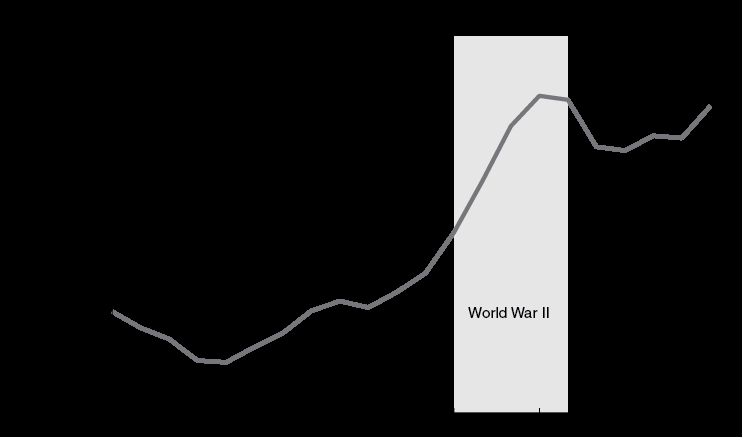
GDP and the Business Cycle: The Case of World War II
During World War II, U.S. GDP rose dramatically due to increased production of war goods, but the well-being of the average person did not necessarily improve, as consumption goods per person remained below pre-war levels. This highlights the limitations of GDP as a measure of prosperity.
GDP in Practice: The Underground Economy and Data Revisions
Developing countries often have large underground economies and may lack resources for accurate GDP measurement, leading to significant revisions when new data are collected.
For example, Nigeria's GDP nearly doubled overnight after updating its base year and including previously unrecorded sectors.
Key Terms
Business cycle: Alternating periods of economic expansion and recession.
Consumption: Household spending on goods and services.
Economic growth: Increase in the quantity of goods and services produced.
Final good or service: Purchased by the final user.
GDP deflator: Price level measure, .
Gross domestic product (GDP): Market value of all final goods and services produced within a country in a given period.
Intermediate good or service: Input into another good or service.
Investment: Spending on capital goods and inventories.
Net exports: Exports minus imports.
Nominal GDP: Value at current-year prices.
Price level: Average prices in the economy.
Real GDP: Value at base-year prices.
Recession: Period of declining output and employment.
Transfer payments: Government payments not made in exchange for goods/services.
Underground economy: Unreported or illegal economic activity.
Value added: Market value a firm adds to a product.
Summary Table: GDP and Related Measures
Measure | Definition | Key Distinction |
|---|---|---|
GDP | Market value of all final goods/services produced within a country | Location-based |
GNP | Market value of all final goods/services produced by a country's residents | Ownership-based |
National Income | GDP minus depreciation | Accounts for capital consumption |
Personal Income | Income received by households | Includes transfers, excludes retained earnings |
Disposable Personal Income | Personal income minus personal taxes | Income available for spending |
Conclusion
GDP is a vital measure for understanding the overall performance of an economy, but it has important limitations, especially as a measure of well-being. Economists use additional indicators and alternative measures to gain a fuller picture of economic welfare and growth.
