 Back
BackGDP: Measuring Total Production and Income – Study Notes
Study Guide - Smart Notes
 Tailored notes based on your materials, expanded with key definitions, examples, and context.
Gross Domestic Product: Measuring Total Production and Income
Introduction to Macroeconomics
Macroeconomics is the study of the economy as a whole, focusing on aggregate measures such as inflation, unemployment, and economic growth. It contrasts with microeconomics, which examines individual households and firms. Understanding macroeconomic indicators is essential for analyzing the overall health and performance of an economy.
Key Macroeconomic Terms
Business cycle: Alternating periods of economic expansion and recession.
Expansion: A phase where total production and employment are increasing.
Recession: A phase where total production and employment are decreasing.
Economic growth: The ability of an economy to produce increasing quantities of goods and services over time.
Inflation rate: The percentage increase in the price level from one year to the next.
8.1 Gross Domestic Product Measures Total Production
Definition and Components of GDP
Gross Domestic Product (GDP) is the market value of all final goods and services produced within a country during a specific period, typically one year. GDP is the most widely used measure of overall economic activity.
Market Value: Goods and services are valued at market prices to provide a common measurement unit.
Final Goods and Services: Only goods and services purchased by final users are counted to avoid double counting. Intermediate goods are excluded.
Produced in a Country: Only production within a country’s borders is included, regardless of the ownership of the firm.
During a Period of Time: Only goods and services produced within the specified period are counted. Used goods are excluded.
Production and Income Approaches
GDP can be measured by either the total value of production or the total income generated. Both approaches yield the same result because every expenditure by a buyer is income for a seller.
The Circular Flow Model and GDP Measurement
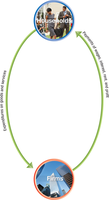
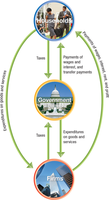
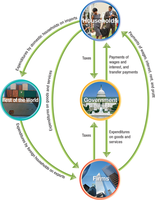
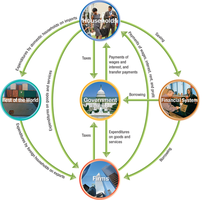
The circular flow model illustrates the movement of money, goods, and services in the economy. It shows how households, firms, the government, the rest of the world, and the financial system interact.
Expenditure Components of GDP
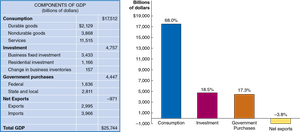
The Bureau of Economic Analysis (BEA) divides GDP into four major expenditure categories:
Consumption (C): Household spending on goods and services, excluding new houses. Subdivided into services, nondurable goods, and durable goods.
Investment (I): Spending on new factories, office buildings, machinery, inventories, and new houses. Includes business fixed investment, residential investment, and changes in business inventories.
Government Purchases (G): Government spending on goods and services, including consumption and investment, but excluding transfer payments.
Net Exports (NX): Exports minus imports. Reflects the value of goods and services sold abroad minus those purchased from abroad.
The GDP identity is:
Value Added Approach
GDP can also be measured by summing the value added at each stage of production. Value added is the market value a firm adds to a product, ensuring no double counting occurs.
8.2 Does GDP Measure What We Want It to Measure?
Shortcomings of GDP as a Measure of Total Production
Household Production: Non-market activities such as childcare and cooking are not included in GDP, even though they contribute to economic well-being.
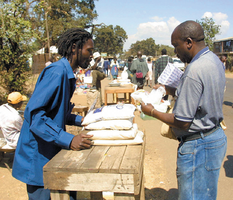
Underground Economy: Economic activity that is hidden from the government to avoid taxes or regulations, or because it is illegal, is not counted in GDP. This can be significant in developing countries.
Shortcomings of GDP as a Measure of Well-Being
GDP per capita is often used to compare living standards, but it does not account for:
The value of leisure
Pollution and negative externalities
Crime and social problems
Income distribution
Improvements in these areas may lower GDP but increase well-being.
8.3 Real GDP versus Nominal GDP
Distinguishing Real and Nominal GDP
Nominal GDP measures the value of final goods and services at current-year prices, while Real GDP measures them at base-year prices. This distinction allows economists to separate changes in output from changes in prices.
Since 1996, the BEA uses chain-weighted prices to adjust for changes in relative prices over time.
Calculating Real GDP: Example
Sum the value of output using base-year prices to find real GDP.
Compare real GDP to nominal GDP to assess the impact of price changes.
Trends in Real and Nominal GDP
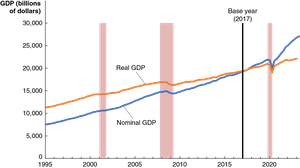
Growth rates reported in the media typically refer to real GDP. Real GDP is less than nominal GDP when prices have risen since the base year, and greater when prices have fallen.
Real GDP Movements during the Covid-19 Pandemic
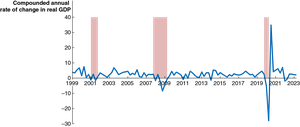
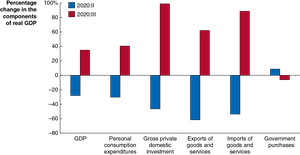
The Covid-19 pandemic caused unprecedented swings in real GDP, with a sharp decline in the second quarter of 2020 followed by a record increase in the third quarter. These changes had significant impacts on employment and business activity.
The GDP Deflator
The GDP deflator is a measure of the price level, calculated as:
The GDP deflator is 100 in the base year.
The percentage change in the GDP deflator measures the inflation rate.
Example: If the GDP deflator increases from 110.2 to 118.0, the price level has risen by 7.1% over the period.
