 Back
BackGross Domestic Product: Measuring Total Production and Income
Study Guide - Smart Notes
 Tailored notes based on your materials, expanded with key definitions, examples, and context.
Gross Domestic Product (GDP)
Definition and Importance
Gross Domestic Product (GDP) is a fundamental measure in macroeconomics, representing the total market value of all final goods and services produced within a country during a specific period, typically one year. GDP is used to gauge the economic performance of a nation, compare income and output across countries, and track changes throughout the business cycle.
Final goods and services: Products purchased by the end user, not for further processing or resale.
Intermediate goods: Goods used as inputs in the production of other goods and services.
Transfer payments: Payments by the government to individuals without receiving a new good or service in return (e.g., Social Security, scholarships).
GDP Equation:
Where: = GDP = Consumption = Investment = Government Purchases = Net Exports (Exports - Imports)
National Income Accounting
National Income and Product Accounts (NIPA) are used to measure economic performance, compare across nations, and monitor business cycles. Developed by Simon Kuznets and colleagues, these accounts include GDP, gross national product, consumer spending, and investment spending.
Business Cycles
Phases of the Business Cycle
Business cycles are fluctuations in economic activity around a long-term growth trend. The four main phases are:
Peak: Highest point of economic activity before a downturn.
Recession (Contraction): Period of declining economic activity.
Trough: Lowest point of economic activity.
Recovery (Expansion): Period of increasing economic activity leading to another peak.
Business cycles are officially dated by the National Bureau of Economic Research (NBER).

Circular Flow Diagram
Understanding Economic Aggregates
The circular flow diagram illustrates how spending in the economy becomes income for households, who supply factors of production to firms. It shows the interdependence between product and resource markets:
Product Market: Where goods and services are bought and sold.
Resource Market: Where factors of production (labor, capital, land) are bought and sold.
Income: Wages, salaries, rents, interest, and profits received by households.
Components of GDP
Expenditure Approach
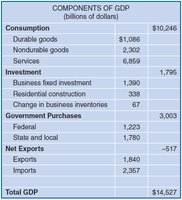
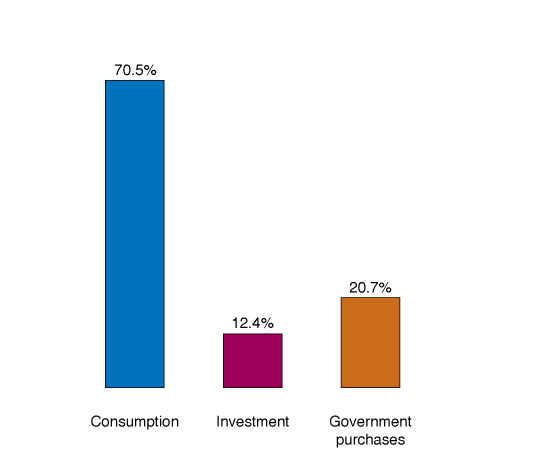
GDP can be measured by summing expenditures in four categories:
Consumption: Household spending on goods and services (excluding new houses).
Investment: Spending by firms on capital goods and inventories, and by households on new houses.
Government Purchases: Spending by federal, state, and local governments on goods and services.
Net Exports: Exports minus imports.
Key Observations
Consumption is the largest component of GDP.
Business fixed investment is the largest part of investment.
State and local government purchases exceed federal purchases.
Imports are greater than exports, making net exports negative.
Measuring GDP: Value-Added Method
Value Added
Value added is the market value a firm adds to a product. GDP can be calculated by summing the value added at each stage of production for all final goods and services.
Shortcomings of GDP as a Measure of Production and Well-Being
Limitations
Household production: Goods and services produced for personal use are not included.
Underground economy: Unreported or illegal economic activity is excluded.
Leisure: The value of leisure time is not counted.
Environmental impact: GDP does not account for pollution or negative externalities.
Social problems: GDP is not adjusted for crime or other social issues.
Distribution: GDP measures the size of the economic pie, not how it is divided among the population.
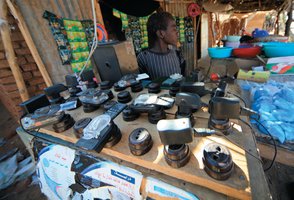
Additional info: In developing countries, the informal sector is large due to high taxes and extensive regulations, which can hinder economic growth.
Real GDP vs. Nominal GDP
Definitions
Nominal GDP: Value of final goods and services at current-year prices.
Real GDP: Value of final goods and services at base-year prices, adjusted for inflation.
To improve accuracy, the Bureau of Economic Analysis (BEA) uses chain-weighted prices, "chaining" each year's prices to minimize distortion from changing relative prices.
GDP Deflator
The GDP deflator is a measure of the price level, calculated as:
In the base year, the GDP deflator is always 100.
Growth in Real GDP
Tracking Economic Growth
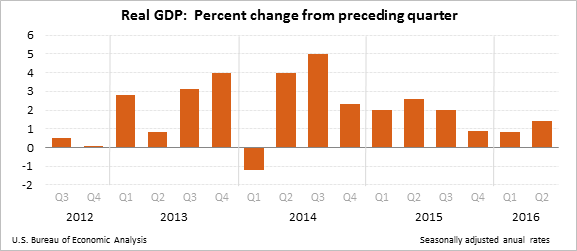
Real GDP growth rates indicate changes in economic activity and are used to assess the health of the economy. Periods of positive growth reflect expansion, while negative growth signals recession.
Summary
Macroeconomics studies the economy as a whole, focusing on growth, output, employment, inflation, and business cycles.
GDP is a key indicator of economic performance, measured by both spending and income approaches.
Business cycles are regular fluctuations in economic activity around a long-term growth trend.
GDP has limitations as a measure of well-being, failing to account for environmental impact, leisure, and income distribution.
