 Back
BackInflation, Aggregate Supply and Demand, and Monetary Policy: Core Concepts in Macroeconomics
Study Guide - Smart Notes
 Tailored notes based on your materials, expanded with key definitions, examples, and context.
Inflation: Concepts and Measurement
Definition and Impact of Inflation
Inflation is defined as a persistent rise in the average price level of goods and services, resulting in a fall in the value of money. As inflation increases, consumers must spend more to purchase the same products and services, reducing the purchasing power of money.
Consumer Price Index (CPI): The CPI measures the average prices of a fixed basket of goods and services. The base year CPI is set to 100 (currently 2002 in Canada).
Inflation Rate: The annual percentage change in the CPI.
Core Inflation Rate: The inflation rate excluding volatile categories such as food and energy.
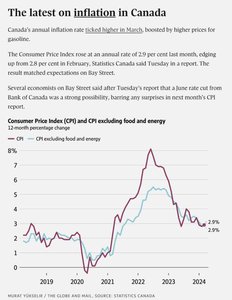
What the Inflation Rate Misses: The CPI fixes quantities in the basket to isolate price changes, but it does not account for consumers switching to cheaper substitutes or the introduction of new/improved products. Thus, the CPI-based inflation rate may overstate the true increase in the cost of living.
Consequences of Inflation
Reduced Purchasing Power: Especially affects those with fixed incomes or savings.
Nominal Interest Rate: The observed interest rate, not adjusted for inflation.
Real Interest Rate: The nominal interest rate adjusted for inflation:
Unpredictable Prices: Increase risk and discourage investment.
Inflation Expectations: Can themselves cause inflation through wage and price-setting behavior.
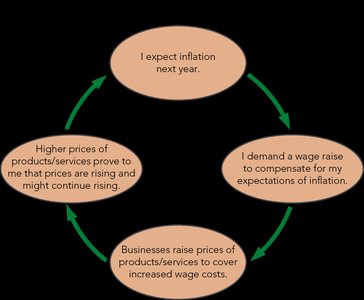
The Bank of Canada aims for predictable inflation rates between 1% and 3% to maintain economic stability.
Deflation and Disinflation
Deflation: Persistent fall in average prices (negative inflation rate), increasing the value of money. Deflation can lead to postponed spending, economic contraction, and higher unemployment. It benefits savers but hurts borrowers and is generally considered worse than low inflation.
Disinflation: A decrease in the inflation rate, meaning prices are still rising but at a slower pace.
The Quantity Theory of Money
Equation of Exchange
The quantity theory of money relates the money supply to the price level and real output:
M: Quantity of money
V: Velocity of money (number of times a unit of money is used in a year)
P: Average price level (CPI)
Q: Aggregate quantity of real output
P × Q: Nominal GDP
If V and Q are fixed, an increase in M leads to a proportional increase in P (inflation). However, when real GDP is below potential, increasing M does not always cause inflation.
Types of Inflation and the Phillips Curve
Demand-Pull vs. Cost-Push Inflation
Demand-Pull Inflation: Caused by increases in aggregate demand during economic expansions. Leads to higher prices and lower unemployment (explained by the Phillips Curve).
Cost-Push Inflation: Caused by decreases in aggregate supply (e.g., supply shocks), leading to higher prices and higher unemployment (stagflation).
Type of Inflation | Demand-Pull | Cost-Push |
|---|---|---|
Phase of business cycle | Expansion | Contraction |
Unemployment | ↓ unemployment | ↑ unemployment |
Inflation | ↑ inflation | ↑ inflation |
Relation between unemployment and inflation | Trade-off (Phillips Curve) | Combination (stagflation), shifting Phillips Curve |
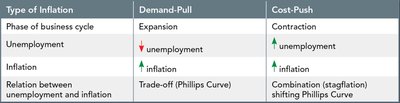
The Phillips Curve shows an inverse relationship between unemployment and inflation in the short run, but this relationship can change due to expectations and shifts in the natural rate of unemployment.
Aggregate Supply and Aggregate Demand (AS/AD) Model
Potential GDP and Long-Run Aggregate Supply (LAS)
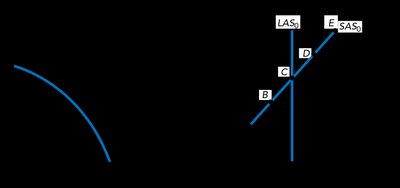
Potential GDP is the economy's full-employment output, represented by the long-run aggregate supply curve (LAS), which is vertical at potential GDP. The LAS does not shift with changes in the price level but only with changes in the quantity or quality of inputs.
In the short run, some input prices are fixed, leading to a disconnect between input and output markets. The short-run aggregate supply curve (SAS) is upward sloping: as the price level rises, the quantity of real GDP supplied increases.
Shifts in Aggregate Supply
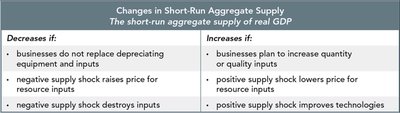
Increase in Inputs: Shifts both LAS and SAS rightward, increasing potential GDP.
Changes in Input Prices: Only shift SAS. Higher input prices shift SAS leftward; lower input prices shift SAS rightward.
Supply Shocks: Negative shocks decrease SAS (leftward shift); positive shocks increase SAS (rightward shift).
Aggregate Demand (AD)
Aggregate demand is the total quantity of real GDP demanded at different price levels by all macroeconomic players (households, businesses, government, and the rest of the world). The AD curve is downward sloping: as the price level rises, the quantity of real GDP demanded decreases.
Components of AD:
Demand Shocks: Factors other than the price level (expectations, interest rates, government policy, foreign GDP, exchange rates) that shift the AD curve.
Macroeconomic Equilibrium
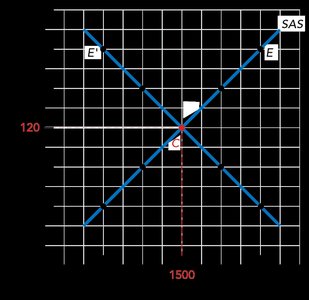
Short-run equilibrium occurs where SAS and AD intersect. Long-run equilibrium occurs where SAS, AD, and LAS all intersect, meaning real GDP equals potential GDP.
Aggregate Expenditure Model and the Multiplier
Aggregate Expenditure (AE)
The aggregate expenditure model determines equilibrium real GDP based on planned spending:
AE Equation:
Equilibrium: (real GDP)
Injections: Spending not originating from consumers (I, G, X)
Leakages: Savings, taxes, and imports (S, T, IM)
Equilibrium Condition:
Consumption and Saving
Consumption Function:
Marginal Propensity to Consume (MPC): Fraction of additional income spent on consumption (0.8 in this example).
Marginal Propensity to Save (MPS): Fraction of additional income saved (0.2 in this example).
The Multiplier
The multiplier predicts the effect on equilibrium real GDP of a change in autonomous spending:
Multiplier Formula:
For , the multiplier is 2.
Exchange Rates and the Foreign Exchange Market
Demand and Supply of Canadian Dollars
Exchange Rate: The price at which one currency exchanges for another.
Demand for C$: Driven by foreign demand for Canadian exports and assets.
Supply of C$: Driven by Canadian demand for imports and foreign assets.
Equilibrium Exchange Rate: Where quantity demanded equals quantity supplied.
Forces Affecting Exchange Rates
Interest Rate Differential: Higher Canadian rates appreciate the C$.
Inflation Rate Differential: Higher Canadian inflation depreciates the C$.
GDP Growth: Higher Canadian GDP can appreciate the C$ due to investor confidence.
Speculation: Expectations about future exchange rates can drive large fluctuations.
International Transmission Mechanism
Appreciating C$: Negative demand shock (decreases net exports, real GDP, and inflation).
Depreciating C$: Positive demand shock (increases net exports, real GDP, and inflation).
Money, Interest Rates, and Monetary Policy
Functions and Types of Money
Medium of Exchange: Used for payment.
Unit of Account: Standard for measuring prices.
Store of Value: Maintains purchasing power over time.
Types: Commodity money, convertible paper money, fiat money, deposit money.
Interest Rates and the Loanable Funds Market
Interest Rate: The price of holding or borrowing money.
Loanable Funds Market: Where savers supply funds and borrowers demand funds, determining the long-run interest rate.
Bank of Canada and Monetary Policy
Roles: Issuing currency, supervising banks, lender of last resort, managing government accounts, conducting monetary policy.
Monetary Policy Tool: The overnight rate (interest rate for one-day loans between banks).
Inflation-Control Target: 1–3% annual inflation, aiming for 2%.
Operating Band: Range between the deposit rate and the bank rate, guiding the policy rate.
Transmission Mechanisms of Monetary Policy
Domestic Transmission: Lower interest rates increase consumption and investment (positive demand shock); higher rates do the opposite.
International Transmission: Lower rates depreciate the C (decrease net exports).
Expansionary Policy: Lower rates to correct recessionary gaps (increase AD, lower unemployment, higher inflation).
Contractionary Policy: Raise rates to correct inflationary gaps (decrease AD, higher unemployment, lower inflation).
Monetary policy is about moderation: accelerating when the economy slows, braking when it overheats. Lower rates encourage borrowing and spending; higher rates encourage saving and reduce spending.
