 Back
BackInflation and the Price Level: Measurement, Effects, and Adjustments
Study Guide - Smart Notes
 Tailored notes based on your materials, expanded with key definitions, examples, and context.
Inflation and the Price Level
What is Inflation?
Inflation is a sustained increase in the overall level of prices in an economy. It is commonly described as a rise in the cost of living or a decline in the purchasing power of money. Not every price increase is inflation; changes in relative prices (such as gas spikes or peak-season flights) occur frequently and are not considered inflation unless they affect the general price level.
Definition: Inflation is the percentage change in a price index over time.
Key Effects: Inflation reduces the purchasing power of money.
Example: If the price of most goods and services rises, consumers can buy less with the same amount of money.
Measuring Inflation
Inflation is measured using price indices that track the cost of goods and services over time. The two most commonly used indices are the Consumer Price Index (CPI) and the GDP deflator.
CPI: Measures prices of goods and services purchased by consumers.
GDP Deflator: Measures prices of all domestically produced final goods and services.
Application: CPI is most relevant for questions about cost of living, wages, and purchasing power.
Consumer Price Index (CPI)
The CPI is constructed by surveying households to determine their spending patterns, assigning weights to items based on these patterns, collecting prices from stores and service providers, and computing the total cost of the basket.
Weighted Basket: The CPI uses a fixed basket of goods and services, weighted according to consumer spending.
Formula for Inflation Rate:
Example Calculation: If CPI in 2023 is 140 and CPI in 2024 is 147, then:
Substitution Bias, New Goods, and Quality Change
The CPI may overstate inflation due to substitution bias, new goods bias, and quality change:
Substitution Bias: Consumers substitute toward cheaper goods when relative prices change, but the fixed basket does not reflect this behavior.
New Goods Bias: New products increase consumer choice, but the CPI takes time to incorporate them.
Quality Change: Improvements in product quality may cause price increases that do not reflect a higher cost of living.
Both effects cause the CPI to overstate increases in the cost of living.
Different Measures of Inflation
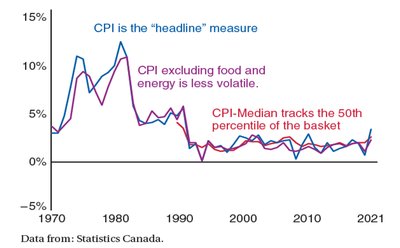
There are several ways to measure inflation, including headline CPI, CPI excluding food and energy, and CPI-Median. The headline CPI is the most commonly reported measure, but excluding volatile items like food and energy can provide a less volatile estimate. CPI-Median tracks the 50th percentile of the basket, offering another perspective on price changes.
GDP Deflator
The GDP deflator is another measure of inflation, defined as the ratio of nominal GDP to real GDP, multiplied by 100. It reflects the prices of all domestically produced final goods and services.
Formula:
The inflation rate based on the GDP deflator is:
Nominal vs Real Values
Nominal variables are measured in current dollars, while real variables are adjusted for inflation. Comparing values across time requires adjusting for inflation to reflect true purchasing power.
Example: Ontario’s Sunshine List threshold was set at $100,000 in the mid-1990s. Adjusted for inflation, this is equivalent to about $180,000–$190,000 today.
Adjustment Formulas:
Past dollars to today dollars:
Today dollars to past dollars:
Worked Example:
Real vs Nominal Growth
Nominal growth reflects changes in dollar values, while real growth adjusts for inflation. For low inflation, real growth can be approximated as:
Example: If nominal wage growth is 6% and inflation is 4%, real wage growth is approximately 2%.
Inflation and Interest Rates
Inflation affects the real return to savers and borrowers. The nominal interest rate is the stated rate on a loan or investment, while the real interest rate reflects the change in purchasing power.
Approximation:
Example: If the nominal interest rate is 5% and inflation is 2%, the real interest rate is approximately 3%.
Key Takeaways
Inflation is the percentage change in a price index.
CPI is a weighted basket of goods and services.
Always adjust nominal values for inflation.
Inflation affects real wages, real income, and real interest rates.
