 Back
BackInflation: Measurement, Causes, and Consequences
Study Guide - Smart Notes
 Tailored notes based on your materials, expanded with key definitions, examples, and context.
Inflation: Measurement, Causes, and Consequences
Introduction to Inflation
Inflation is a central concept in macroeconomics, referring to the general rise in prices throughout the economy. Understanding inflation is crucial for analyzing economic performance, policy decisions, and the well-being of different groups in society.
Inflation: A sustained increase in the general price level of goods and services in an economy over time.
Disinflation: A reduction in the rate of inflation; prices are still rising, but at a slower pace.
Deflation: A decline in the overall price level, meaning prices are falling.
Hyperinflation: An extremely high rate of inflation, typically exceeding 100% per year.
Measuring Inflation: The Consumer Price Index (CPI)
The Consumer Price Index (CPI) is the principal measure of inflation in the United States. It tracks the average change in prices paid by urban consumers for a fixed basket of goods and services.
The CPI is calculated monthly by the Bureau of Labor Statistics (BLS).
The market basket is determined by expenditure surveys of thousands of households.
The base year of a price index sets the price level at 100.

Figure: The CPI market basket shows the composition of goods and services used to calculate the CPI, based on a survey of 14,000 households.
Calculating the Inflation Rate
The inflation rate is the percentage change in the CPI from one year to the next. It is calculated as follows:
Formula:
The CPI is also used for cost of living adjustments (COLA) in wages and government benefits.
Core Inflation
Core inflation excludes food and energy prices, which are more volatile, to provide a clearer view of underlying inflation trends.
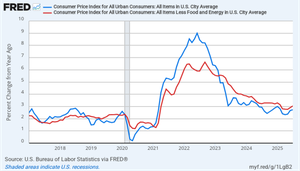
Figure: The blue line represents the overall CPI, while the red line shows the core inflation rate (excluding food and energy).
Drawbacks and Biases of the CPI
While the CPI is widely used, it has several limitations that can cause it to overstate the true rate of inflation:
Substitution Bias: The CPI uses a fixed basket of goods, not accounting for consumers substituting cheaper alternatives as prices change.
Quality Bias: Improvements in product quality are not fully reflected, so price increases may overstate inflation.
New Product Bias: New products may not be included promptly, missing their impact on consumer spending.
Outlet Bias: Changes in where consumers shop (e.g., discount stores, online) may not be captured quickly.

Figure: Quality bias occurs when improved or modified products replace older ones in the market basket.
Adjusting for Inflation: Real vs. Nominal Values
To compare monetary values over time, it is necessary to adjust for inflation using price indexes like the CPI.
Real Value: The value of money adjusted for changes in the price level.
Nominal Value: The stated value, not adjusted for inflation.
Formula for Adjusting Values:
Example: A salary of $30,000 in 1997 is equivalent to about $54,596 in 2022 dollars, accounting for inflation.
Real vs. Nominal Interest Rates
Interest rates must also be adjusted for inflation to reflect the true cost of borrowing or the real return on savings.
Nominal Interest Rate: The stated rate on a loan or investment.
Real Interest Rate: The nominal rate minus the inflation rate.
Formula:
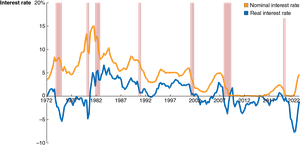
Figure: The chart shows nominal and real interest rates over time, highlighting periods of deflation when the real rate exceeded the nominal rate.
The Consequences of Inflation
Inflation affects different groups in the economy in various ways, depending on whether it is anticipated or unanticipated.
Harmed by Unanticipated Inflation: Creditors (lenders) and people on fixed incomes, as the real value of payments received declines.
Helped by Unanticipated Inflation: Debtors (borrowers), as the real value of their payments decreases.
Unaffected: Those whose incomes or payments adjust with inflation.

Figure: Creditors and debtors are affected differently by inflation, especially when loan terms are fixed.
Who Is Hurt and Helped by Unanticipated Inflation?
Group | Effect of Unanticipated Inflation |
|---|---|
Banks with fixed-rate loans | Hurt |
Farmers with fixed-rate loans | Gain |
Homebuyers with adjustable-rate mortgages | Uncertain/Unaffected |
Savers with fixed-rate accounts | Hurt |
Widows with fixed-rate bonds | Hurt |
Retirees with fixed pensions | Hurt |
Retirees with Social Security | Uncertain/Unaffected |
Retirees with stock dividends | Uncertain/Unaffected |
Federal government with debt | Gain |
State government with income tax revenue | Uncertain/Unaffected |
Deflation: Dangers and Economic Impact
Deflation, or falling prices, can be more dangerous than inflation. It may lead consumers to delay purchases, reducing demand, production, and employment, potentially causing a downward economic spiral. This was observed during the Great Depression and in Japan during the 1990s.
Summary and Key Takeaways
Inflation is a general rise in prices; disinflation is a slowing of inflation; deflation is a fall in prices; hyperinflation is an extremely high rate of inflation.
The CPI is the main measure of inflation, but it has several biases.
Adjusting for inflation is essential for comparing values over time and understanding real interest rates.
Inflation redistributes income and wealth, helping some groups while harming others.
Deflation can be particularly harmful to economic stability and growth.
