 Back
BackInterdependence and the Gains from Trade: Production Possibilities, Comparative Advantage, and Specialization
Study Guide - Smart Notes
 Tailored notes based on your materials, expanded with key definitions, examples, and context.
Interdependence and the Gains from Trade
Introduction to Trade and Interdependence
Trade is a fundamental principle in economics, emphasizing that individuals and nations can benefit by specializing in the production of goods and services in which they have an advantage and trading for others. This interdependence allows for greater overall consumption and efficiency.
Trade enables people and nations to consume beyond their own production possibilities.
Specialization and exchange are driven by differences in opportunity costs and comparative advantage.
Trade can make everyone better off, even when one party is more efficient at producing all goods.
A Parable for the Modern Economy
The Story of Frank and Ruby
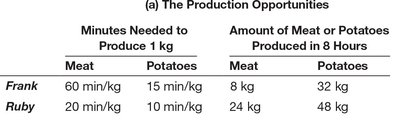
Consider two individuals, Frank (a potato farmer) and Ruby (a cattle rancher), who both consume meat and potatoes. Each has different abilities in producing these goods. By specializing and trading, both can achieve higher consumption than if they were self-sufficient.
Frank is less efficient at raising cattle, while Ruby's land is less suited for potatoes.
Specialization according to comparative advantage allows both to benefit from trade.
Production Possibilities Frontier (PPF)
The Production Possibilities Frontier (PPF) illustrates the various combinations of two goods that an economy can produce given its resources and technology. It demonstrates the concept of tradeoffs and opportunity cost.
Points on the PPF represent efficient production levels.
Points inside the PPF are inefficient; points outside are unattainable without trade.
PPF Example: Canada and Japan
Suppose Canada and Japan can produce computers and wheat using labor as the only input. The PPF for each country shows the maximum output combinations possible given their labor constraints.
Canada: 50,000 labor hours/month; 100 hours/computer; 10 hours/tonne of wheat.
Japan: 30,000 labor hours/month; 125 hours/computer; 25 hours/tonne of wheat.
Without trade, each country consumes what it produces; with trade, both can consume more.
Specialization and Trade
How Trade Expands Consumption Opportunities
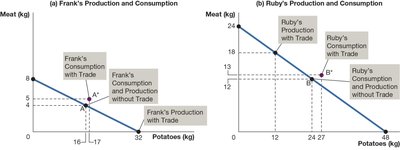
By specializing in the good for which they have a comparative advantage and trading, both parties can consume at points outside their individual PPFs.
Trade allows for consumption combinations unattainable through self-sufficiency.
Both countries or individuals can increase their total consumption of goods.
Summary Table: Gains from Trade
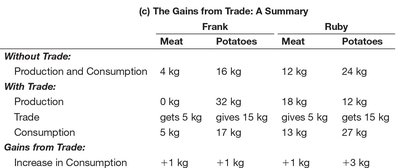
The following table summarizes the gains from trade for Frank and Ruby, showing production, trade, and consumption before and after trade.
Frank | Ruby | |||
|---|---|---|---|---|
Meat | Potatoes | Meat | Potatoes | |
Without Trade: Production and Consumption | 4 kg | 16 kg | 12 kg | 24 kg |
With Trade: Production | 0 kg | 32 kg | 18 kg | 12 kg |
With Trade: Trade | gets 5 kg | gives 15 kg | gives 5 kg | gets 15 kg |
With Trade: Consumption | 5 kg | 17 kg | 13 kg | 27 kg |
Gains from Trade: Increase in Consumption | +1 kg | +1 kg | +1 kg | +3 kg |
Comparative Advantage: The Driving Force of Specialization
Absolute vs. Comparative Advantage
Absolute advantage refers to the ability to produce a good using fewer inputs than another producer. Comparative advantage is the ability to produce a good at a lower opportunity cost than another producer. Trade is driven by comparative, not absolute, advantage.
Opportunity cost is what must be given up to obtain something else.
Each party should specialize in the good for which they have the lowest opportunity cost.

Opportunity Cost Table
1 kg of Meat | 1 kg of Potatoes | |
|---|---|---|
Frank the Farmer | 4 kg potatoes | 0.25 kg meat |
Ruby the Rancher | 2 kg potatoes | 0.50 kg meat |
Terms of Trade
The price at which trade occurs must lie between the opportunity costs of the two parties. Both can benefit if the terms of trade are set appropriately.
For both to gain, the trade price must be between their opportunity costs.
Applications of Comparative Advantage
International Trade
Nations, like individuals, benefit from trade by specializing in goods where they have a comparative advantage and importing others. This increases overall welfare and allows for greater consumption possibilities.
Imports: Goods produced abroad and sold domestically.
Exports: Goods produced domestically and sold abroad.
Each country should export goods for which it has a comparative advantage and import those for which other countries have a comparative advantage.

Specialization in Practice
Even highly skilled individuals (e.g., professional athletes) may benefit from hiring others to perform tasks for which they do not have a comparative advantage, allowing them to focus on their own area of expertise.

Key Terms and Concepts
Production Possibilities Frontier (PPF): A curve showing the maximum attainable combinations of two products that may be produced with available resources and technology.
Absolute Advantage: The ability to produce more of a good with the same amount of resources than another producer.
Comparative Advantage: The ability to produce a good at a lower opportunity cost than another producer.
Opportunity Cost: The value of the next best alternative foregone when making a decision.
Specialization: Focusing resources on the production of one or a few goods, leading to increased efficiency and gains from trade.
Summary
Trade and specialization based on comparative advantage allow individuals and nations to consume beyond their production possibilities, increasing overall welfare. The principle of comparative advantage, not absolute advantage, is the foundation for mutually beneficial trade. By understanding opportunity costs and the terms of trade, economic agents can maximize their gains from exchange.
