 Back
BackInternational Finance and the Foreign Exchange Market: Key Concepts and Mechanisms
Study Guide - Smart Notes
 Tailored notes based on your materials, expanded with key definitions, examples, and context.
International Finance and the Foreign Exchange Market
Introduction
International finance examines the flow of capital, goods, and services across national borders, focusing on the mechanisms that determine exchange rates and the balance of payments. The foreign exchange market is central to these processes, as it facilitates currency conversion and determines exchange rates through the interaction of supply and demand.
Foreign Exchange Market
Definition and Function
Foreign Exchange Market (Forex): The global marketplace for buying and selling national currencies.
Purpose: Enables international trade and investment by allowing conversion between currencies.
Participants: Includes governments, central banks, commercial banks, corporations, and individual investors.
Determinants of the Exchange Rate
Flexible Exchange Rate System
Under a flexible (floating) exchange rate system, the value of a currency is determined by market forces—specifically, the supply and demand for foreign exchange.
Demand for Foreign Exchange: Originates from domestic purchases of foreign goods, services, and assets.
Supply of Foreign Exchange: Comes from foreign purchases of domestic goods, services, and assets.
Equilibrium Exchange Rate: The rate at which the quantity of foreign exchange demanded equals the quantity supplied.
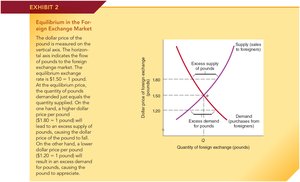
Example: If the dollar price of the English pound is $1.50, the market is in equilibrium. If the price rises to $1.80, there is excess supply (depreciation of the pound); if it falls to $1.20, there is excess demand (appreciation of the pound).
Foreign Exchange Market Equilibrium
Market Dynamics
Excess Supply: Occurs when the exchange rate is above equilibrium, leading to a fall in the foreign currency's value.
Excess Demand: Occurs when the exchange rate is below equilibrium, causing the foreign currency to appreciate.
Factors Causing Exchange Rate Changes
Income Changes and Imports
Changes in national income can shift the demand for foreign exchange. For example, an increase in U.S. income raises imports, increasing demand for foreign currency and causing the dollar to depreciate.
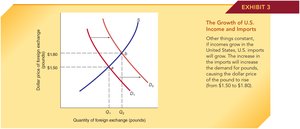
Key Point: Higher domestic income increases imports, shifting the demand curve for foreign currency to the right and raising its price.
Inflation and Exchange Rates
Relative inflation rates between countries affect exchange rates. If the U.S. experiences higher inflation than Britain, U.S. goods become relatively more expensive, increasing demand for British goods and pounds, causing the dollar to depreciate.
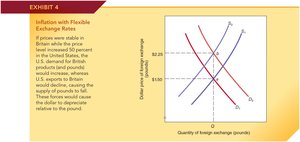
Key Point: Higher domestic inflation reduces the supply of foreign currency and increases its demand, leading to currency depreciation.
Exchange Rate Regimes
Types of Exchange Rate Regimes
Flexible (Floating) Rates: Determined by market forces without direct government intervention.
Fixed-Rate, Unified Currency: Countries adopt a common currency or peg their currency at a fixed rate to another (e.g., the euro in the European Monetary Union, the U.S. dollar in Panama).
Pegged Exchange Rates: Currencies are fixed to another currency but can be adjusted occasionally.
Implications of Fixed and Pegged Regimes
Countries with fixed or unified currencies cannot conduct independent monetary policy; they adopt the policy of the anchor currency's central bank.
Pegged regimes can face crises if domestic monetary policy diverges from the anchor currency's policy.
Balance of Payments
Definition and Structure
The balance of payments is a record of all economic transactions between residents of a country and the rest of the world. It consists of the current account and the capital account.
Current Account: Records trade in goods and services, income, and current transfers.
Capital Account: Records cross-border investments and loans.
Balance: Under a flexible exchange rate, the sum of the current and capital accounts is zero (ignoring official reserves).
Key Relationship: A current account deficit is matched by a capital account surplus, and vice versa.
Exchange Rates, Current Account Balance, and Capital Inflow
Empirical Evidence
Data for the United States show that under a flexible exchange rate system, capital inflows and outflows significantly impact the current account balance.
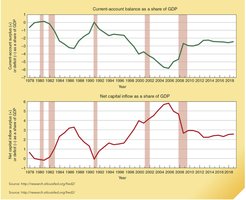
Observation: Periods of current account deficits are associated with capital account surpluses (net capital inflows).
Trade Deficits and Bilateral Trade Balances
Are Trade Deficits Bad?
Trade deficits are not inherently negative; they reflect capital inflows and can finance investment.
Under a flexible exchange rate, total purchases from foreigners balance with total sales, even if bilateral trade with individual countries does not balance.
Key Point: There is no economic necessity for trade between any two countries to balance; what matters is the overall balance of payments.
Summary Table: Types of Exchange Rate Regimes
Regime Type | Description | Monetary Policy Independence | Examples |
|---|---|---|---|
Flexible (Floating) | Exchange rate set by market forces | Yes | U.S. dollar, Japanese yen |
Fixed-Rate, Unified Currency | Common currency or fixed peg | No | Eurozone, Panama (USD) |
Pegged | Currency pegged to another, adjustable | Limited | Hong Kong dollar, Chinese yuan (historically) |
Key Equations
Exchange Rate Equilibrium:
Balance of Payments Identity:
Additional info: Official reserves are typically zero under a pure flexible exchange rate system.
