 Back
BackIntroduction to Macroeconomics: Concepts, Concerns, and Historical Context
Study Guide - Smart Notes
 Tailored notes based on your materials, expanded with key definitions, examples, and context.
Introduction to Macroeconomics
Scope and Importance
Macroeconomics is the branch of economics that studies the behavior and performance of the economy as a whole. It focuses on aggregate measures such as total national income, aggregate consumption, investment, and the overall price level. Understanding macroeconomics is crucial because it affects employment, income, and corporate profits, impacting the well-being of individuals and society.
Microeconomics: Examines individual industries and decision-making units (firms and households).
Macroeconomics: Deals with aggregates and the determinants of total national income and price levels.
Aggregate behavior: The collective behavior of all households and firms.
Sticky prices: Prices that do not adjust quickly to changes in supply and demand.

Macroeconomic Concerns
Primary Concerns
Macroeconomics centers on three major concerns: output growth, unemployment, and inflation/deflation. These factors are key indicators of economic health and stability.
Output Growth: Measures the increase in the total quantity of goods and services produced (aggregate output).
Unemployment: The percentage of the labor force that is unemployed, indicating labor market equilibrium.
Inflation and Deflation: Inflation is a rise in the overall price level; deflation is a decrease. Hyperinflation refers to extremely rapid price increases.
Output Growth and the Business Cycle
Business Cycle Dynamics
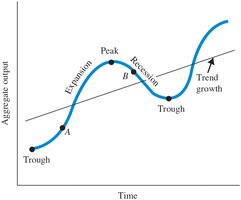
The business cycle describes the short-term fluctuations in economic activity, characterized by periods of expansion and contraction. Understanding these cycles helps explain changes in employment and output.
Expansion/Boom: Period from trough to peak with rising output and employment.
Contraction/Recession/Slump: Period from peak to trough with falling output and employment.
Depression: A prolonged and deep recession.
Aggregate Output: Total goods and services produced in a given period.
The Components of the Macroeconomy
Economic Sectors
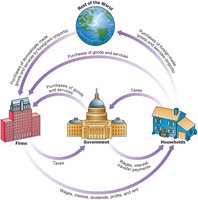
The macroeconomy consists of four main groups: households, firms, government, and the rest of the world. Their interactions form the basis of economic activity.
Households: Consumers and suppliers of labor.
Firms: Producers of goods and services.
Government: Regulator and provider of public goods.
Rest of the World: Foreign sector involved in trade.
Private Sector: Households and firms.
Public Sector: Government.
Foreign Sector: Rest of the world.
The Circular Flow Diagram
Flows of Payments and Goods
The circular flow diagram illustrates the movement of goods, services, and payments among the sectors. It highlights the interconnectedness of economic agents and the role of transfer payments.
Circular Flow: Shows income and expenditure flows between households, firms, government, and the foreign sector.
Transfer Payments: Government payments to individuals not in exchange for goods or labor (e.g., Social Security, welfare).
The Three Market Arenas
Goods-and-Services, Labor, and Money Markets
Macroeconomic activity is organized into three main market arenas, each facilitating different types of exchanges among economic agents.
Goods-and-Services Market: Where households, government, and firms purchase goods and services.
Labor Market: Households supply labor; firms and government demand labor.
Money (Financial) Market: Households and firms borrow and lend funds; government issues bonds; financial institutions coordinate lending.
Treasury Bonds, Notes, Bills: Government-issued promissory notes for borrowing.
Corporate Bonds: Issued by corporations to raise funds.
Shares of Stock: Ownership in a firm, entitling holders to dividends.
Dividends: Portion of profits paid to shareholders.
The Role of Government in the Macroeconomy
Fiscal and Monetary Policy
The government influences the macroeconomy through fiscal and monetary policy. These tools are used to regulate economic activity, control inflation, and manage unemployment.
Fiscal Policy: Government decisions on taxes and spending.
Monetary Policy: Federal Reserve's control of short-term interest rates.
A Brief History of Macroeconomics
Key Historical Events
Macroeconomic history in the United States has been shaped by major events such as the Great Depression, periods of fine-tuning, and stagflation. These events illustrate the challenges and evolution of economic policy.
Great Depression: Severe contraction and high unemployment (1929–1930s).
Fine-tuning: Government regulation of inflation and unemployment.
Stagflation: Simultaneous high inflation and unemployment.
The U.S. Economy Since 1970
Trends in Output, Unemployment, and Inflation
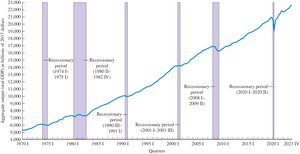
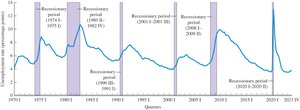
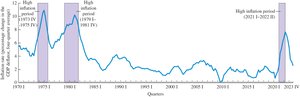
Since 1970, the U.S. economy has experienced overall growth in aggregate output, but also several recessionary periods, fluctuations in unemployment, and episodes of high inflation.
Aggregate Output: Generally rising, with six recessionary periods.
Unemployment Rate: Varies widely, increasing during recessions.
Inflation Rate: High in three periods; low or moderate between 1983 and 2020.
Review Terms and Concepts
Key Definitions
Aggregate behavior: Collective actions of households and firms.
Aggregate output: Total production in the economy.
Business cycle: Fluctuations in economic activity.
Circular flow: Movement of money and goods among sectors.
Contraction, recession, or slump: Declining economic activity.
Corporate bonds: Debt instruments issued by firms.
Deflation: Falling price levels.
Depression: Severe, prolonged recession.
Dividend: Profit share paid to shareholders.
Expansion or boom: Rising economic activity.
Fine-tuning: Government regulation of economic variables.
Fiscal policy: Tax and spending decisions.
Great Depression: Major economic downturn.
Hyperinflation: Extremely rapid inflation.
Inflation: Rising price levels.
Macroeconomics: Study of the economy as a whole.
Microeconomics: Study of individual economic units.
Monetary policy: Central bank actions.
Shares of stock: Ownership in a firm.
Stagflation: High inflation and unemployment.
Sticky prices: Slow price adjustments.
Transfer payments: Government payments not for goods or labor.
Treasury bonds, notes, or bills: Government debt instruments.
Unemployment rate: Percentage of unemployed labor force.
