 Back
BackLabour Demand in Macroeconomics: Theory, Technological Change, and Wage Inequality
Study Guide - Smart Notes
 Tailored notes based on your materials, expanded with key definitions, examples, and context.
Labour Demand
Overview of Labour Demand
Labour demand is a central concept in macroeconomics, describing how firms decide the quantity of labour to employ based on profit maximization. This section explores the standard production model, the effects of technological change, and the implications for different types of workers.
Labour demand refers to the number of workers firms are willing to hire at different wage rates.
It is derived from the firm's goal to maximize profit, considering the productivity of labour and the cost of hiring workers.
Technological change can shift labour demand, sometimes benefiting skilled workers more than unskilled workers.
Simplifying Assumptions in the Short Run
To analyze labour demand, economists often make several simplifying assumptions, especially in the short run:
The capital stock is fixed; only labour is variable.
All workers are assumed to be identical (homogeneous labour).
Wages are determined in a competitive market.
Firms hire workers to maximize profit.
Marginal Product of Labour and the Real Wage
The decision to hire an additional worker depends on the marginal benefit and marginal cost:
Marginal Product of Labour (MPN): The additional output produced by employing one more worker.
Marginal Revenue Product of Labour (MRPN): The extra revenue from hiring an additional worker, calculated as:
Where P is the price of output and MPN is the marginal product of labour.
The real wage is the nominal wage adjusted for the price level:
Firms compare the real wage to the marginal product of labour when deciding how many workers to hire.
The Labour Demand Curve
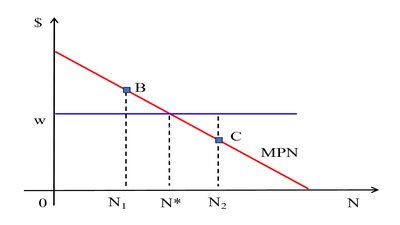
The labour demand curve shows the relationship between the real wage and the quantity of labour demanded. It is derived from the marginal product of labour curve, which is downward sloping due to diminishing returns.
Firms hire workers up to the point where:
If , firms hire more workers.
If , firms reduce employment.
The optimal number of workers is where .
Shifts in Labour Demand: The Role of Technology
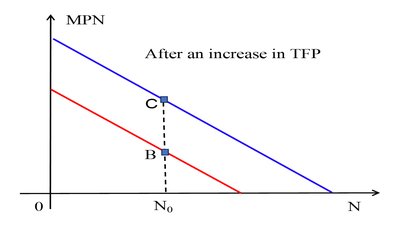
Technological progress, measured as an increase in total factor productivity (TFP), shifts the labour demand curve upward. This means that, at any given wage, firms are willing to hire more workers because each worker is more productive.
An increase in TFP raises the marginal product of labour, increasing labour demand.
This is illustrated by an upward shift of the MPN curve.
Aggregate Labour Demand
Aggregate labour demand is the sum of all individual firms' labour demand curves in the economy. It has the same properties as the individual firm's labour demand curve and shifts for the same reasons (e.g., technological change).
Aggregate labour demand determines the total employment in the economy at different real wage levels.
Example: Labour Demand Function
Suppose the marginal product of labour is given by:
Where a and b are positive constants, and N is the number of workers.
Setting and solving for N gives the labour demand curve:
This curve is downward sloping because .
An increase in a (e.g., due to higher productivity) shifts the curve upward.
Technological Change and Labour: Complements or Substitutes?
The standard model assumes that technology and labour are complements, meaning technological progress increases labour demand. However, technology can also substitute for labour, especially with advances in robotics and artificial intelligence.
Historically, technological progress has not led to a long-term increase in unemployment.
Real wages have generally grown with the economy.
Labour reallocation across sectors often leads to higher total output and employment.
The Hot Dog Parable: Illustrating Labour Reallocation
This parable demonstrates how technological improvement in one sector can lead to labour reallocation and higher overall output:
Suppose 120 workers are split evenly between two industries: buns and wieners.
Initially, it takes 2 workers to produce either a bun or a wiener, so the economy can produce 30 hotdogs at full employment (60,60).
After a technological improvement, only 1 worker is needed to produce a wiener.
Now, 30 hotdogs can be produced with only 90 workers (60 buns, 30 wieners), or the economy can reallocate workers and produce 40 hotdogs at full employment (80 buns, 40 wieners).
Wage Inequality in Canada
Technological change can affect wage inequality, especially between skilled and unskilled workers:
Between 1980 and 2000, real wages became more unequal in Canada, with skilled workers seeing wage growth and unskilled workers experiencing stagnation.
Since 2000, wage differentials have stabilized, and women's wages have grown more rapidly than men's.
Most of the rise in inequality was among males.
Skill-Biased Technological Change
Recent technological advances have disproportionately increased the productivity of skilled workers, leading to greater demand for education and training:
Examples include the replacement of assembly lines with automated processes and the rise of computerization.
In the US, there has been a marked decline in employment in routine jobs, reflecting the slow adaptation of the workforce to new skill requirements.
Summary Table: Effects of Technological Change on Labour Demand
Type of Technological Change | Effect on Labour Demand | Effect on Wage Inequality |
|---|---|---|
General Productivity Increase | Shifts labour demand up | May benefit all workers |
Labour-Substituting (e.g., automation) | Reduces demand for routine/unskilled labour | Increases wage inequality |
Skill-Biased | Increases demand for skilled labour | Raises skilled/unskilled wage gap |
Additional info: Skill-biased technological change is a key factor in explaining recent trends in wage inequality and employment patterns in advanced economies.
