 Back
BackLabour Supply and Equilibrium in Macroeconomics
Study Guide - Smart Notes
 Tailored notes based on your materials, expanded with key definitions, examples, and context.
Labour Supply and Equilibrium
Overview of Labour Supply Trends
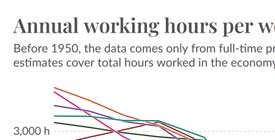
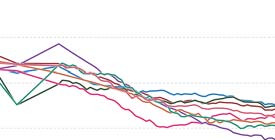
The supply of labour in an economy is a fundamental concept in macroeconomics, influencing employment, wages, and overall economic output. Over the last century, average hours worked have generally fallen while real wages have risen. During business cycles, real wages and hours worked tend to move together, reflecting the dynamic relationship between labour supply and economic conditions.
Key Point 1: Average hours worked per worker have declined over time, even as real wages have increased.
Key Point 2: Business cycles affect both real wages and hours worked, often causing them to move in tandem.
Example: Historical data shows that in countries like the United States, Canada, and the United Kingdom, annual working hours per worker have decreased significantly since 1950.
Economic Theory of Labour Supply
Economic theory posits that individuals allocate their time between work and leisure to maximize utility. The decision to supply labour is based on comparing the marginal benefit of working an additional hour with the marginal cost of sacrificing leisure.
Key Point 1: Utility is maximized when the marginal value of work equals the marginal value of leisure.
Key Point 2: The labour supply decision is influenced by real wages, which affect both the incentive to work and the ability to enjoy leisure.
Example: If real wages rise, individuals may choose to work more hours, but may also opt for more leisure if their income allows.
Real Wages and Labour Supply: Substitution and Income Effects
Changes in real wages impact labour supply through two opposing effects: the substitution effect and the income effect. The substitution effect encourages more labour supply as wages rise, while the income effect reduces labour supply because leisure becomes more affordable.
Key Point 1: Substitution effect: Higher wages make work more attractive relative to leisure, increasing labour supply.
Key Point 2: Income effect: Higher wages increase income, making leisure (a normal good) more desirable, thus reducing labour supply.
Key Point 3: The longer a wage increase is expected to last, the larger the income effect. Temporary wage changes are dominated by the substitution effect, while permanent changes are dominated by the income effect.
Example: A temporary bonus may lead workers to supply more hours, but a permanent salary increase may lead them to reduce hours worked.
The Labour Supply Curve
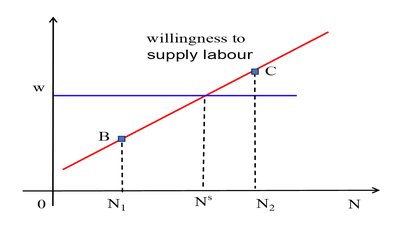
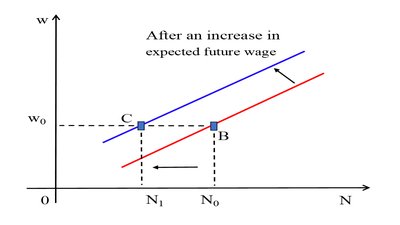
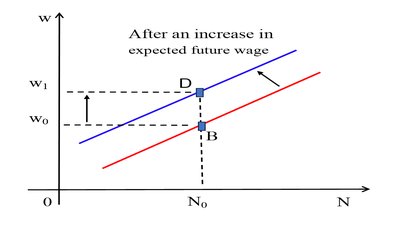
The labour supply curve illustrates the relationship between the amount of labour supplied and the current real wage, holding other factors constant. Changes in factors other than the current real wage, such as wealth or expected future wages, shift the curve.
Key Point 1: The labour supply curve slopes upward, indicating that higher real wages generally increase labour supplied.
Key Point 2: Shifts in the curve occur when factors like wealth or expected future wages change.
Example: An increase in expected future wages shifts the labour supply curve to the left, reducing current labour supplied.
Shifts in the Labour Supply Curve
Factors such as increased wealth or higher expected future wages can shift the labour supply curve. These shifts reflect changes in individuals' willingness to supply labour at any given real wage.
Key Point 1: An increase in wealth or expected future wage reduces current labour supply, shifting the curve leftward.
Key Point 2: The magnitude of the shift depends on the perceived permanence of the change.
Example: If workers expect higher wages in the future, they may choose to work fewer hours now.
Aggregate Labour Supply
Aggregate labour supply is the total labour supplied in the economy. An increase in current real wages induces higher aggregate labour supply through two margins: the intensive margin (more hours by those already working) and the extensive margin (more people entering the labour force).
Key Point 1: Intensive margin: Existing workers supply more hours.
Key Point 2: Extensive margin: New workers join the labour force.
Example: A rise in real wages may encourage part-time workers to become full-time and non-workers to seek employment.
Classical Labour Market Equilibrium
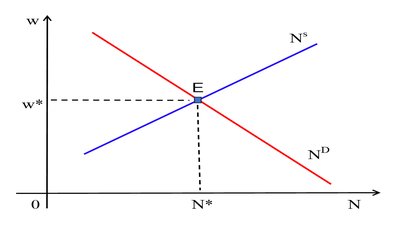
In the classical model, the real wage adjusts quickly to equate labour supply and demand. The equilibrium level of employment after adjustment is called the full-employment level, with the corresponding real wage being the market-clearing wage. Aggregate labour demand or supply curve shifters affect equilibrium wage, employment, and output.
Key Point 1: Full-employment level (\bar{N}): The equilibrium quantity of labour supplied and demanded.
Key Point 2: Market-clearing wage (\bar{w}): The real wage at which labour supply equals labour demand.
Key Point 3: Potential output (\bar{Y}): The output produced at full employment.
Example: If labour demand increases, equilibrium wage and employment rise, leading to higher potential output.
Relevant Equations
Labour Supply Function:
Labour Market Equilibrium:
Full Employment Output:
Additional info: The above equations represent the labour supply function, equilibrium condition, and the production function at full employment, where is capital.
