 Back
BackLong-Run Economic Growth: Sources and Policies
Study Guide - Smart Notes
 Tailored notes based on your materials, expanded with key definitions, examples, and context.
Long-Run Economic Growth
Introduction to Economic Growth
Economic growth refers to the sustained increase in a country’s real GDP per capita, which raises living standards and improves quality of life. Understanding the sources and policies that drive long-run growth is essential for macroeconomic analysis.
Economic growth is measured by increases in real GDP per capita.
Growth rates matter: Small differences in growth rates can lead to large differences in living standards over time due to compounding.
Historically, significant growth began after the Industrial Revolution.
The Industrial Revolution and Its Impact
The Industrial Revolution, beginning in England around 1750, marked the application of mechanical power to production, leading to sustained economic growth.
Before 1300, world economic growth was essentially zero.
The Industrial Revolution enabled countries like England, the United States, France, and Germany to achieve high living standards.

Growth Rates and Living Standards
Growth rates are crucial because economies that grow too slowly fail to raise living standards. Compounding magnifies small differences in growth rates over time.
Average annual growth rates are not the same as total percentage changes.
Example: U.S. real GDP per capita grew from $13,213 in 1950 to $42,205 in 2010, an average annual growth rate of 2.0%.
Global Distribution of GDP per Capita
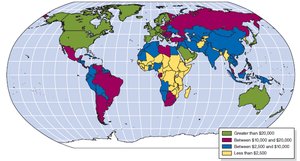
The world’s economies can be divided into high-income (industrial) and developing (poorer) countries. GDP per capita is measured in U.S. dollars, adjusted for cost of living differences.
Wealth is created, not simply divided.
Both rich and poor countries have seen increases in GDP per capita.
Decline in Global Poverty
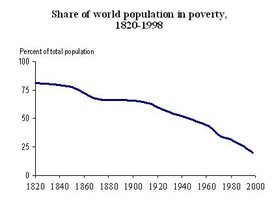
Over the past two centuries, the share of the world population living in poverty has declined significantly.
Economic growth has contributed to reductions in poverty rates worldwide.
Sources of Economic Growth
Productivity Growth
Productivity growth is the most important determinant of long-run economic growth.
Increasing the ratio of capital to labor
Growth of the labor force
Improving the quality of the labor force (human capital)
Technological progress
Human capital is the accumulated knowledge and skills acquired through education, training, and experience.
Government Policies to Promote Growth
Governments can foster economic growth by:
Protecting intellectual property with patents and copyrights
Subsidizing research and development
Subsidizing education
Innovation as a Public Good
New knowledge and innovation often benefit many firms and the economy as a whole, leading to increasing returns.
Patents and copyrights incentivize innovation by granting exclusive rights.
Trade secrets can also protect intellectual property.
Creative Destruction and Entrepreneurship
Joseph Schumpeter emphasized the role of creative destruction, where new products and technologies replace old ones, driving economic growth.
Entrepreneurs are central to growth, bringing together resources to create new firms and products.
Comparing Economic Systems
Centrally Planned vs. Market Economies
Economic systems significantly affect growth outcomes.
Centrally planned economies, such as the Soviet Union, experienced diminishing returns to capital and slow technological change.
Market economies provide incentives for innovation and competition.

Economic Growth in the United States
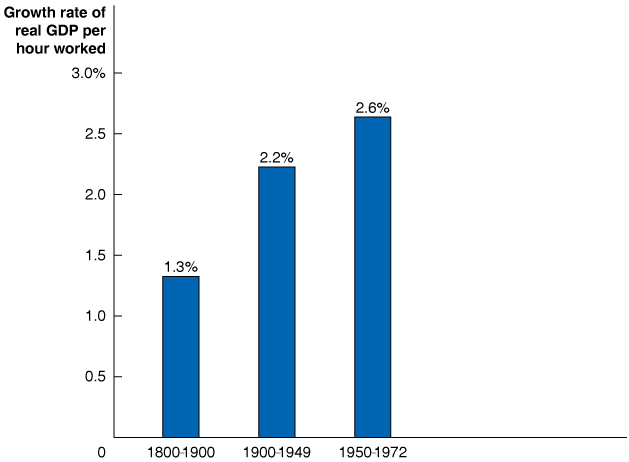
The U.S. has experienced varying growth rates in real GDP per hour worked since 1800, with technological change helping to avoid diminishing returns.
Growth accelerated after the mid-1990s due to continued technological progress.
Catch-Up and Globalization
The Catch-Up Effect
The economic growth model predicts that countries with lower initial GDP per capita should grow faster than richer countries.
Catch-up has occurred among high-income countries, but not universally among all countries.
Some low-income countries have grown rapidly, while others have stagnated or declined.
Globalization and Its Benefits
Globalization is the process of countries becoming more open to foreign trade and investment.
Foreign portfolio investment and foreign direct investment (FDI) can help developing countries access capital and technology.
Barriers to Economic Growth
Property Rights and Rule of Law
Property rights are essential for economic growth, allowing individuals and firms to use, buy, or sell property.
Rule of law ensures contracts are enforced and property is protected.
Corruption and lack of legal title can prevent capital from being used productively.
Other Barriers
Wars and revolutions disrupt capital accumulation and technology adoption.
Poor public education and health reduce productivity.
Low rates of saving and investment perpetuate poverty.
Institutions and Economic Growth
Institutions That Promote Growth
Institutions and arrangements that encourage growth include:
Open markets
Property rights
Rule of law
Entrepreneurship
Innovation
Economic Freedom Index
The Economic Freedom Index measures infrastructure and policies across ten categories, showing that countries with more economic freedom tend to have higher living standards.
Case Study: North Korea vs. South Korea
Two countries with similar culture and geography differ dramatically in wealth due to their economic systems.
North Korea: Centrally planned, low GDP per capita, limited communication and life expectancy.
South Korea: Market-oriented, high GDP per capita, advanced communication and higher life expectancy.
China’s Economic Growth and Future Prospects
China’s Transition and Challenges
China’s rapid growth has been driven by its transition from a centrally planned to a market economy, but future growth may slow due to overinvestment in physical capital and demographic challenges.
Maintaining high productivity growth is necessary for continued increases in living standards.
Political and institutional factors, such as limited freedom and rule of law, may hinder long-term growth.

Main Points about Economic Growth
Economic growth raises living standards by reducing infant mortality, increasing life expectancy, reducing hunger, improving environmental quality, and reducing disease spread.
Institutions and policies play a critical role in promoting or stifling growth.
Summary Table: Key Factors Affecting Economic Growth
Factor | Effect on Growth |
|---|---|
Technological Progress | Primary driver of productivity and long-run growth |
Human Capital | Improves labor productivity and innovation |
Property Rights & Rule of Law | Encourage investment and entrepreneurship |
Open Markets | Facilitate trade, investment, and competition |
Globalization | Provides access to capital and technology |
Political Stability | Supports sustained investment and growth |
Education & Health | Enhance workforce productivity |
