 Back
BackMacroeconomic Equilibrium, Gaps, and Fiscal Policy: Aggregate Demand and Supply Analysis
Study Guide - Smart Notes
 Tailored notes based on your materials, expanded with key definitions, examples, and context.
Aggregate Demand and Aggregate Supply Model
Overview of the AD-AS Model
The Aggregate Demand (AD) and Aggregate Supply (AS) model is a central framework in macroeconomics for analyzing fluctuations in output, employment, and the price level. It helps explain short-run and long-run economic changes, including business cycles, recessions, and expansions.
Aggregate Demand (AD): Represents the total demand for goods and services in an economy at different price levels.
Aggregate Supply (AS): Shows the total output firms are willing to produce at various price levels.
Short-Run Aggregate Supply (SRAS): Reflects output when some prices or wages are sticky.
Long-Run Aggregate Supply (LRAS): Indicates the economy's full potential output (Y*), where all resources are fully employed.
Key Variables: Real GDP, Price Level (CPI), Employment
Business Cycles and Economic Gaps
Full Potential and Output Gaps
Economic output fluctuates around its full potential (Y*) due to various shocks and policy interventions. Deviations from Y* are called output gaps:
Recessionary Gap: Actual output (Y) is below potential output (Y*), indicating underutilized resources and higher unemployment.
Inflationary Gap: Actual output (Y) exceeds potential output (Y*), leading to upward pressure on prices and lower unemployment.
Causes of Business Cycles
Changes in aggregate demand (C, I, G, NX)
Supply shocks (e.g., oil price increases, natural disasters)
Expectations about future income and prices
Shifts and Movements in the AD and SRAS Curves
Shifts of the AD Curve
The AD curve shifts due to changes in its components:
Consumption (C)
Investment (I)
Government Spending (G)
Net Exports (NX)
For example, increased household expectations or improved business outlook can shift AD rightward, increasing output and price level.
Why is the AD Curve Downward Sloping?
Wealth Effect: Higher price levels reduce real wealth, lowering consumption.
Interest Rate Effect: Higher prices increase interest rates, reducing investment.
International Trade Effect: Higher domestic prices reduce exports and increase imports.
Shifts of the SRAS Curve
The SRAS curve shifts due to changes in factor prices, productivity, and expectations:
Increase in labor force (e.g., immigration)
Improvements in education and productivity
Changes in expected future prices
Supply shocks (e.g., oil price spikes)
Why is the SRAS Curve Upward Sloping?
Sticky wages and prices due to contracts
Menu costs and slow adjustment by firms
Difficulty predicting future prices
Macroeconomic Equilibrium and Adjustment
Short-Run and Long-Run Equilibrium
Equilibrium occurs where AD intersects SRAS (short run) and LRAS (long run). The economy adjusts to shocks over time as wages and prices respond.
Adjustment to Full Potential
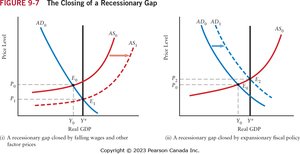
In a recessionary gap, falling wages and prices shift SRAS right, restoring equilibrium at Y*.
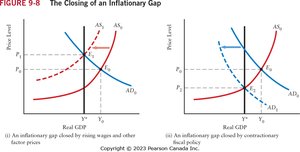
In an inflationary gap, rising wages and prices shift SRAS left, bringing output back to Y*.
Fiscal Interventions
Automatic Stabilizers: Progressive taxes and transfers that dampen fluctuations without new legislation.
Discretionary Fiscal Policy: Deliberate changes in government spending or taxes to close output gaps.
Options for Closing a Recessionary Gap
There are two main approaches to closing a recessionary gap:
Allow wages and factor prices to fall, shifting SRAS right.
Use expansionary fiscal policy to shift AD right.
Options for Closing an Inflationary Gap
There are two main approaches to closing an inflationary gap:
Allow wages and factor prices to rise, shifting SRAS left.
Use contractionary fiscal policy to shift AD left.
Phillips Curve and Tradeoffs
Unemployment and Inflation
The Phillips Curve illustrates the short-run tradeoff between unemployment and inflation. Lower unemployment often comes with higher inflation, and vice versa.
Supply Side and Economic Growth
Factors Influencing Long-Run Growth
Growth in the labor force
Technological advancements
Shifts in LRAS to the right indicate long-run economic growth
Static vs. Dynamic Models
Dynamic AD-AS Model
Dynamic models incorporate ongoing growth in real GDP, regular shifts in LRAS and AD, and changes in SRAS due to inflation expectations.
Saving Paradox
Short-Run vs. Long-Run Effects
In the short run, increased saving reduces consumption and GDP.
In the long run, higher saving boosts investment and potential GDP.
Key Equations
Aggregate Demand:
Multiplier Effect:
Output Gap:
Example: If government increases spending (G), AD shifts right, potentially closing a recessionary gap and increasing real GDP and price level.
Additional info: Academic context and definitions have been expanded for clarity and completeness. Figures included are directly relevant to the explanation of closing recessionary and inflationary gaps using the AD-AS model.
