 Back
BackMacroeconomics: GDP, Price Levels, Inflation, and Unemployment – Core Concepts and Measurement
Study Guide - Smart Notes
 Tailored notes based on your materials, expanded with key definitions, examples, and context.
What is Macroeconomics?
Definition and Scope
Macroeconomics is the study of economic aggregates, focusing on the total sum of activities across an entire economy rather than individual markets. It examines broad phenomena such as national income, overall production, price levels, and employment.
Economic Aggregates: Total output, income, and expenditure in an economy.
Key Measures: GDP, inflation, unemployment, and aggregate demand/supply.
Gross Domestic Product (GDP)
Definition and Measurement
Gross Domestic Product (GDP) is the primary measure of total production in an economy. It represents the total value of all final goods and services produced within a country during a specific period.
Nominal GDP: Measured using current market prices, reflecting both changes in quantity and price.
Real GDP: Measured using constant prices from a base year, filtering out the effects of inflation.
The GDP-Income Identity
The fundamental accounting identity in macroeconomics states that the total value of final production (GDP) is equivalent to the total income generated in the economy. This identity allows for multiple methods of GDP calculation and helps identify measurement errors.
Production = Income: Every cost incurred by one agent is income for another (the cancellation principle).
Policy Implication: GDP growth is linked to higher incomes and job creation.
Examples
Simple Island Example: If one person catches 10 fish, their income is 10 fish. If two people catch 15 fish and split the income, total income still equals total production.
Complex Economy Example: In an economy with silicon and computer industries, GDP is calculated as the value of final goods (computers), and total income is the sum of labor and profit incomes, which matches GDP.
Verification of the GDP-Income Identity
Labor Income: Sum of wages paid in all industries.
Profit Income: Revenues minus costs (excluding labor) for all firms.
Identity Holds: Total income (labor + profit) equals GDP.
Real GDP vs. Real GDI
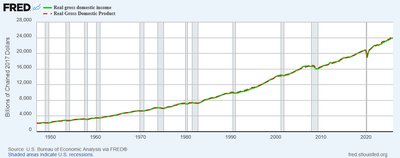
Real Gross Domestic Product (GDP) and Real Gross Domestic Income (GDI) are two ways to measure the same economic activity. In practice, they track each other closely, though minor discrepancies may arise due to measurement differences.
Measuring Price Levels and Inflation
The GDP Deflator
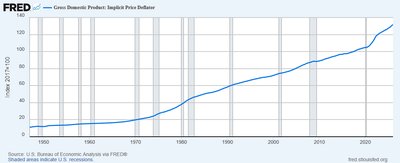
The GDP Deflator measures the overall price level of all final goods and services produced domestically. It is calculated as:
In the base year, the GDP deflator is exactly 100.
Limitation: Includes non-consumer goods (e.g., defense equipment), making it less representative of consumer cost-of-living changes.
Calculating the Inflation Rate
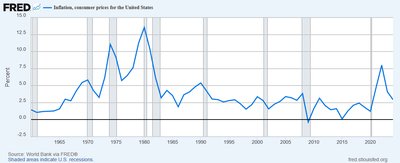
Inflation is the percentage growth rate of the overall price level. It can be calculated using the GDP deflator or other price indices:
Example: If the GDP deflator rises from 100 to 105, the inflation rate is 5%.
The Consumer Price Index (CPI)
The Consumer Price Index (CPI) measures the cost of living for a typical consumer household by tracking a fixed basket of goods and services (e.g., food, housing, transportation).
Reflects changes in the cost of living for consumers.
Biases in the CPI
New Goods Bias: The CPI basket may not immediately include new products, missing improvements in living standards.
Quality Bias: Product improvements may be misinterpreted as price increases. Hedonic pricing adjusts for quality changes.
Substitution Bias: The CPI assumes a fixed basket, ignoring consumer substitution toward cheaper alternatives when prices change.
Economic Counter-Argument: Some economists argue that substitution itself has implicit costs, which the CPI partially captures.
The Producer Price Index (PPI)
The Producer Price Index (PPI) tracks the average change in selling prices received by domestic producers for their output. It serves as an early warning system for inflation, as changes in producer prices often precede changes in consumer prices.
PPI vs. CPI: PPI measures prices at the producer level, while CPI measures prices at the consumer level.
Comparison: CPI, PPI, and GDP Deflator
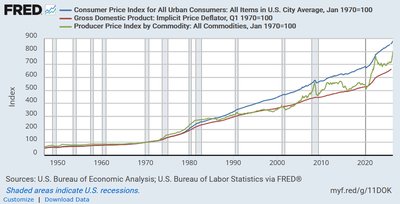
These three indices measure different aspects of price changes in the economy:
Index | What It Measures | Scope |
|---|---|---|
CPI | Consumer cost of living | Fixed basket of consumer goods/services |
PPI | Producer prices | Prices received by domestic producers |
GDP Deflator | Overall price level | All final goods/services produced domestically |
Labor Market Aggregates
Unemployment Rate
The unemployment rate is a key indicator of labor market health, calculated as:
Unemployed: Individuals without work who are actively seeking employment.
Labor Force: The sum of employed and unemployed individuals (excludes retirees, students, and those not seeking work).
Flaws of the Unemployment Rate
The official unemployment rate may understate labor market distress due to the "discouraged worker" effect. During recessions, some individuals stop searching for work and are no longer counted as unemployed, artificially lowering the unemployment rate.
Discouraged Workers: Those who have given up searching for work due to poor job prospects.
Historical Examples: Post-2008 recession and COVID-19 pandemic saw increases in discouraged workers.
Alternative Labor Market Metrics
To better capture labor market participation, economists use the Labor Force Participation Rate:
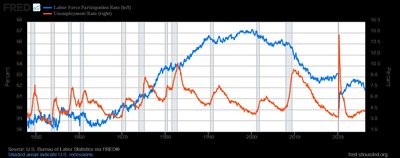
Interesting Points about the Labor Market
Labor represents about two-thirds of national income. Trends in labor productivity and compensation are important for understanding economic growth and living standards.
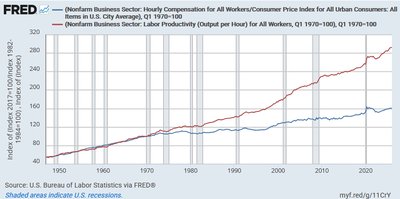
Additional info: Labor productivity growth often outpaces compensation growth, reflecting changes in technology, bargaining power, and institutional factors.
