 Back
BackMacroeconomics in an Open Economy: Study Notes
Study Guide - Smart Notes
 Tailored notes based on your materials, expanded with key definitions, examples, and context.
Macroeconomics in an Open Economy
18.1 The Balance of Payments: Linking the United States to the International Economy
The balance of payments (BoP) is a comprehensive record of a country’s economic transactions with the rest of the world. It includes trade in goods and services, as well as financial flows and transfers. Understanding the BoP is essential for analyzing how economies interact globally and the implications for fiscal and monetary policy.
Open Economy: Engages in international trade and financial transactions.
Closed Economy: No international trade or financial interactions (rare in practice).
Components of the BoP:
Current Account: Records net exports (exports minus imports), net income on investments, and net transfers.
Financial Account: Records purchases of assets abroad and foreign purchases of domestic assets.
Capital Account: Records minor transactions such as migrants’ transfers and sales/purchases of nonproduced, nonfinancial assets.
BoP Identity: The sum of the current, financial, and capital accounts must equal zero.
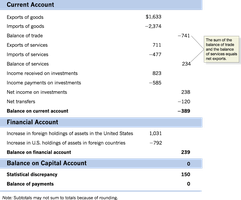
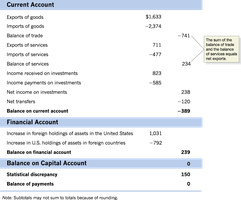
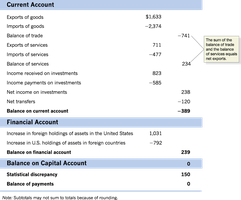
Example: In 2016, the U.S. had a current account deficit, which was offset by a financial account surplus, reflecting foreign investment in U.S. assets.
Balance of Trade: The difference between the value of exports and imports of goods. A positive value indicates a trade surplus; a negative value indicates a trade deficit.
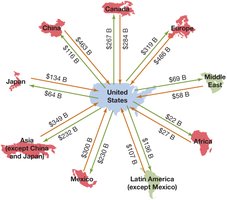
Key Point: The BoP must always balance because every international transaction is recorded as both a credit and a debit.
18.2 The Foreign Exchange Market and Exchange Rates
The foreign exchange market determines the value of one currency in terms of another, known as the exchange rate. Exchange rates affect the prices of imports and exports, influencing trade balances and economic activity.
Nominal Exchange Rate: The rate at which one currency can be exchanged for another (e.g., $1 = ¥100).
Real Exchange Rate: Adjusts the nominal rate for differences in price levels between countries.
Market Determination: Exchange rates are set by supply and demand in the foreign exchange market.
Demand for Domestic Currency: Driven by foreign demand for domestic goods, services, and assets.
Supply of Domestic Currency: Driven by domestic demand for foreign goods, services, and assets.
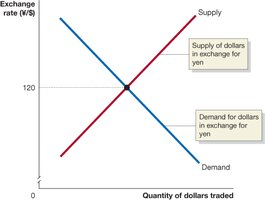
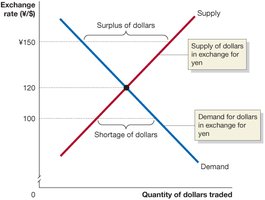
Equilibrium Exchange Rate: The rate at which the quantity of currency supplied equals the quantity demanded.
Appreciation: An increase in the value of a currency relative to others.
Depreciation: A decrease in the value of a currency relative to others.
Shifts in Demand and Supply: Factors such as changes in income, interest rates, and expectations can shift the demand and supply curves, affecting the exchange rate.
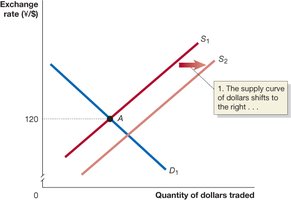
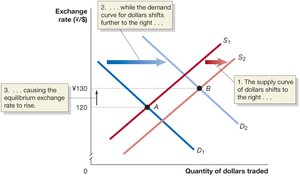
Currency Speculation: Traders buy and sell currencies to profit from expected changes in exchange rates.
Effect on Trade: When the domestic currency appreciates, exports become more expensive and imports cheaper, reducing net exports and aggregate demand.
18.3 The International Sector and National Saving and Investment
The relationship between a country’s saving, investment, and international transactions is captured by the saving and investment equation. This equation links national saving, domestic investment, and net foreign investment.
National Saving (S): The sum of private and public saving.
Private Saving:
Public Saving:
Saving and Investment Equation:
Where is net foreign investment (also equal to net exports, ).
Alternatively,
Key Point: If a country’s investment exceeds its saving, it must borrow from abroad or sell assets to foreigners, resulting in negative net foreign investment.
18.4 The Effect of a Government Budget Deficit on Investment
A government budget deficit occurs when government spending exceeds tax revenue, reducing public saving and, consequently, national saving. This affects investment and net foreign investment in an open economy.
Impact: Lower national saving leads to higher interest rates, which can crowd out private investment and attract foreign capital, causing the domestic currency to appreciate.
Twin Deficits: When a budget deficit is accompanied by a current account deficit, the situation is referred to as the "twin deficits." This was notable in the U.S. during the 1980s.
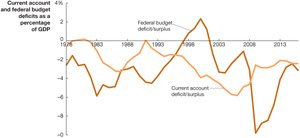
Example: The U.S. has often run both budget and current account deficits, making it the world’s largest debtor nation. However, foreign investment has also supported U.S. economic growth.
18.5 Monetary Policy and Fiscal Policy in an Open Economy
The effectiveness of monetary policy and fiscal policy can differ between open and closed economies due to the presence of international trade and capital flows.
Monetary Policy: More effective in an open economy. Lower interest rates lead to currency depreciation, boosting net exports and aggregate demand.
Fiscal Policy: Less effective in an open economy. Increased government spending or tax cuts may raise interest rates, appreciating the currency and reducing net exports. The multiplier effect is also smaller due to spending on imports.
Key Point: As economies become more open, monetary policy gains effectiveness, while fiscal policy loses some of its impact due to international leakages.
