 Back
BackMacroeconomics: Measurement, Structure, and Key Indicators
Study Guide - Smart Notes
 Tailored notes based on your materials, expanded with key definitions, examples, and context.
Introduction to Macroeconomics
Definition and Scope
Macroeconomics is the branch of economics that studies the aggregate behavior of the economy at the national level. It focuses on the performance, structure, and decision-making processes of entire economies, rather than individual markets. Key areas include the role and implications of monetary and fiscal policy, and their interaction.
Economics: The study of the allocation of scarce resources.
Microeconomics: Examines individual consumers, firms, and industries.
Macroeconomics: Aggregates across individuals to analyze national economic performance.
Key Questions Addressed
What determines an economy’s standard of living and growth?
How are economic and financial indicators interpreted?
What are the properties of business cycles?
What policies can governments use to smooth cycles or improve growth?
Why are monetary and fiscal policy related?
The Measurement and Structure of the National Economy
Scarcity and Choice
Scarcity arises because unlimited wants exceed limited resources, leading to opportunity costs and the necessity of making choices. Incentives at the margin influence these choices, and markets are generally efficient, though government intervention may be needed to address market failures.
Economic Models and Theories
Economic Theory: Organized ideas about the economy in a logical framework.
Economic Model: A simplified, often mathematical, abstraction of economic reality.
Criteria for Evaluation: Reasonable assumptions, manageability, testable implications, and consistency with real-world data.
Key Economic Indicators
Gross Domestic Product (GDP)
Inflation
Interest Rates
Employment & Unemployment
Productivity
National Income Accounting
Circular Flow of Economic Activity
The circular flow model illustrates the movement of goods, services, and money between households and firms. Households provide labor and other inputs to firms, receiving income in return, which is then used to purchase goods and services.
GDP: Three Equivalent Measures
Production: Output produced.
Spending: Purchases of output.
Income: Income received by producers.
National Income Accounting Identity:
Real vs. Nominal GDP
Real GDP: Market value of new final goods and services, measured in base-year prices.
Nominal GDP: Output measured at current-year prices.
Intermediate Goods: Not included in GDP calculation.
Flow Variable: GDP is measured over a period of time, not at a point in time.
GDP vs. GNP
Gross National Product (GNP): Output produced by domestic factors of production, regardless of location.
Gross Domestic Product (GDP): Output produced by factors located within the country.
Relationship: , where NFP is net factor payments from abroad.
Approaches to Measuring GDP
Expenditure Approach:
Product Approach: Sum of value added by all producers.
Income Approach: Sum of incomes generated by production.
Saving and Wealth
Definitions
Household Wealth: Assets minus liabilities.
National Wealth: Sum of wealth of households, firms, and government.
National Wealth Formula: Domestic physical assets + net foreign assets.
Changes in National Wealth
Value changes in assets and liabilities (e.g., price changes, depreciation).
Inflation and Price Level
Inflation Rate
The inflation rate is the percentage change in the general price level from one period to the next. It is a key indicator of macroeconomic performance.
Ex-post Inflation: Actual change in prices over a past period.
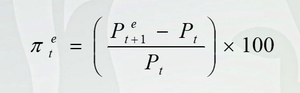
Ex-ante Inflation: Expected rate of inflation for future periods.
Formula for Expected Inflation Rate:
Measures of Price Level
Consumer Price Index (CPI): Price of a fixed basket of goods relative to a base year.
Core CPI: CPI excluding food and energy; smoother indicator.
Producer Price Index (PPI): Measures prices charged by producers at various stages.
GDP Deflator: Average price level of all goods and services in GDP.
Calculating Price Level and Inflation
Price Level:
GDP Deflator:
Example: Gadgetland
Nominal GDP and Real GDP calculated for two years using prices and quantities.
Inflation rate calculated as percentage change in price level.
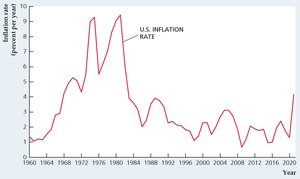
Historical U.S. Inflation Rate
The U.S. inflation rate has fluctuated significantly over time, with notable peaks in the 1970s and periods of relative stability in the 2000s.
Interest Rates
Definition and Types
Interest Rate: Rate of return promised by a borrower to a lender.
Market Rates: Determined by supply and demand; include federal funds rate, Treasury bill and bond rates.
Administered Rates: Set by institutions; include prime rate and discount rate.
Factors Affecting Interest Rates
Likelihood of default
Time to maturity
Tax status
Real vs. Nominal Interest Rates
Nominal Interest Rate: Rate at which dollar value of asset rises.
Real Interest Rate: Rate at which purchasing power of asset rises, adjusted for inflation.
Expected Real Interest Rate Formula:
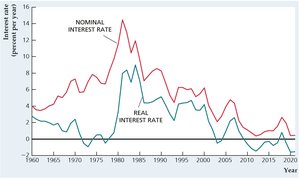
Historical U.S. Interest Rates
Nominal and real interest rates in the U.S. have shown significant variation, especially during periods of high inflation.
Summary Table: GDP Measurement Approaches
Approach | Main Concept | Formula |
|---|---|---|
Expenditure | Sum of spending on final goods/services | |
Product | Sum of value added by producers | Value added = Revenue - Cost |
Income | Sum of incomes generated by production | National income + statistical discrepancy + depreciation |
Summary Table: Price Level Measures
Measure | Definition | Application |
|---|---|---|
CPI | Price of fixed basket of goods | Consumer welfare |
PPI | Producer prices at various stages | Early warning for inflation |
GDP Deflator | Average price level of GDP goods/services | Broad inflation measure |
Summary Table: Interest Rates
Type | Definition | Example |
|---|---|---|
Market Rate | Determined by market forces | Federal funds rate, Treasury rates |
Administered Rate | Set by institutions | Prime rate, discount rate |
Additional info: Academic context and examples were added to ensure completeness and clarity for exam preparation.
