Back
BackMacroeconomics Study Guide: Efficiency, PPF, Factors of Production, and Economic Statements
Study Guide - Smart Notes
 Tailored notes based on your materials, expanded with key definitions, examples, and context.
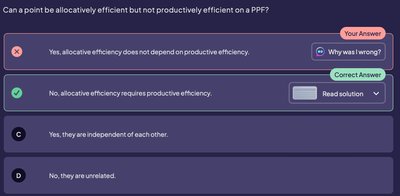
Q1. Can a point be allocatively efficient but not productively efficient on a PPF?
Background
Topic: Production Possibilities Frontier (PPF) and Economic Efficiency
This question tests your understanding of the relationship between allocative and productive efficiency on the PPF.
Key Terms:
Productive Efficiency: When an economy is producing at a point on the PPF, using all resources efficiently.
Allocative Efficiency: When the mix of goods produced matches consumer preferences.
PPF (Production Possibilities Frontier): A curve showing the maximum possible output combinations of two goods given available resources and technology.
Step-by-Step Guidance
Recall that productive efficiency means producing on the PPF curve, not inside it.
Allocative efficiency requires that the economy produces the combination of goods most desired by society.
Consider whether it is possible to achieve allocative efficiency without first achieving productive efficiency.
Think about the relationship: Is allocative efficiency dependent on productive efficiency?
Try solving on your own before revealing the answer!
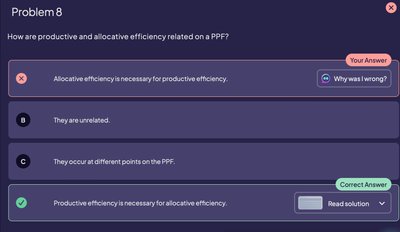
Q2. How are productive and allocative efficiency related on a PPF?
Background
Topic: Efficiency Concepts on the PPF
This question explores the logical relationship between productive and allocative efficiency.
Key Terms:
Productive Efficiency: Achieved when resources are used in the best way possible, producing on the PPF.
Allocative Efficiency: Achieved when the goods produced are those most desired by society.
Step-by-Step Guidance
Review the definitions of both types of efficiency.
Ask yourself: Can allocative efficiency occur if the economy is not productively efficient?
Consider the sequence: Does productive efficiency come before allocative efficiency?
Think about whether productive efficiency is a prerequisite for allocative efficiency.
Try solving on your own before revealing the answer!
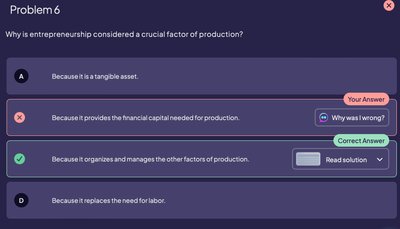
Q3. Why is entrepreneurship considered a crucial factor of production?
Background
Topic: Factors of Production
This question tests your understanding of the role of entrepreneurship in organizing and managing resources.
Key Terms:
Entrepreneurship: The ability to organize, manage, and assume the risks of a business or enterprise.
Factors of Production: Land, labor, capital, and entrepreneurship.
Step-by-Step Guidance
Recall the four main factors of production.
Think about what distinguishes entrepreneurship from the other factors.
Consider how entrepreneurship contributes to the production process.
Reflect on whether entrepreneurship is a tangible asset or a managerial function.
Try solving on your own before revealing the answer!
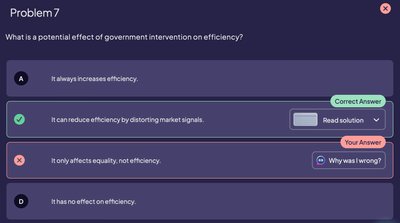
Q4. What is a potential effect of government intervention on efficiency?
Background
Topic: Government Intervention and Market Efficiency
This question examines how government actions can impact economic efficiency.
Key Terms:
Efficiency: Achieving the maximum output with given resources.
Government Intervention: Actions taken by the government to influence the economy.
Step-by-Step Guidance
Recall how markets allocate resources efficiently through price signals.
Consider how government intervention might alter these signals.
Think about whether intervention always increases efficiency or can sometimes reduce it.
Reflect on the difference between efficiency and equality.
Try solving on your own before revealing the answer!
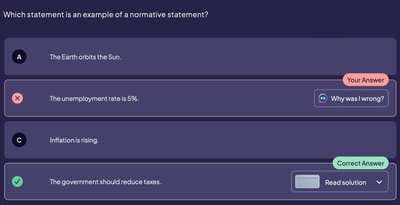
Q5. Which statement is an example of a normative statement?
Background
Topic: Positive vs. Normative Economics
This question tests your ability to distinguish between statements of fact (positive) and statements of opinion or value (normative).
Key Terms:
Normative Statement: Expresses a value judgment about what ought to be.
Positive Statement: Describes what is, without value judgment.
Step-by-Step Guidance
Identify which statements are factual and which express opinions or recommendations.
Look for words like "should," "ought," or "better" that indicate a normative statement.
Compare the options to see which one is making a value judgment.
Try solving on your own before revealing the answer!
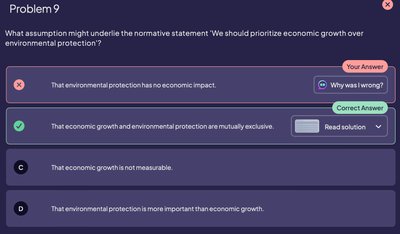
Q6. What assumption might underlie the normative statement 'We should prioritize economic growth over environmental protection'?
Background
Topic: Economic Assumptions and Normative Analysis
This question asks you to identify the implicit assumptions behind a normative economic statement.
Key Terms:
Normative Statement: A statement about what should be done, based on values.
Assumption: An underlying belief or premise that supports a statement.
Step-by-Step Guidance
Analyze the statement to see what beliefs it implies about economic growth and environmental protection.
Consider whether the statement assumes these goals are mutually exclusive or can be pursued together.
Think about the economic impact of environmental protection.
Try solving on your own before revealing the answer!
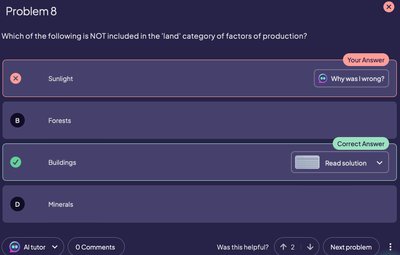
Q7. Which of the following is NOT included in the 'land' category of factors of production?
Background
Topic: Factors of Production
This question tests your knowledge of what constitutes the 'land' factor in economics.
Key Terms:
Land: All natural resources used in production, such as minerals, forests, and sunlight.
Capital: Man-made resources like buildings and machinery.
Step-by-Step Guidance
Review the definition of 'land' as a factor of production.
Identify which options are natural resources and which are man-made.
Distinguish between land and capital in the context of production.
Try solving on your own before revealing the answer!
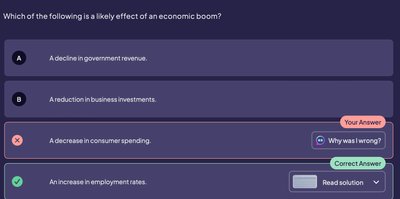
Q8. Which of the following is a likely effect of an economic boom?
Background
Topic: Business Cycles and Economic Effects
This question tests your understanding of the consequences of an economic boom.
Key Terms:
Economic Boom: A period of rapid economic growth and increased activity.
Employment Rates: The proportion of the labor force that is employed.
Step-by-Step Guidance
Recall what happens during an economic boom (growth, increased production).
Consider how this affects employment, consumer spending, and government revenue.
Identify which option best reflects the typical outcome of a boom.
Try solving on your own before revealing the answer!