 Back
BackMacroeconomics Study Guide: Exchange Rates, Monetary and Fiscal Policy, and U.S. Economic Indicators
Study Guide - Smart Notes
 Tailored notes based on your materials, expanded with key definitions, examples, and context.
Exchange Rates and the Foreign Exchange Market
The Dollar’s Exchange Rate and Net Exports
The value of the U.S. dollar in international markets affects the cost of imports and exports, influencing the net export balance. An appreciation of the dollar means it can buy more foreign currency, making imports cheaper and U.S. goods more expensive abroad, which widens the net export deficit. Conversely, a depreciation makes imports more expensive and U.S. goods cheaper abroad, narrowing the net export deficit.
Appreciation: Dollar value rises; imports cheaper; exports more expensive; net export deficit widens.
Depreciation: Dollar value falls; imports more expensive; exports cheaper; net export deficit narrows.
Market Determination of Exchange Rates
Exchange rates are determined by supply and demand in the foreign exchange market. The demand for U.S. dollars comes from foreign entities wanting to buy U.S. goods, services, or assets, while the supply comes from U.S. entities wanting to buy foreign goods, services, or assets. The equilibrium exchange rate is where the quantity of dollars supplied equals the quantity demanded.
Demand for Dollars: Foreign purchases of U.S. goods/services, investments, and currency speculation.
Supply of Dollars: U.S. purchases of foreign goods/services, investments, and currency speculation in reverse.
Equilibrium Exchange Rate: The rate at which supply equals demand.
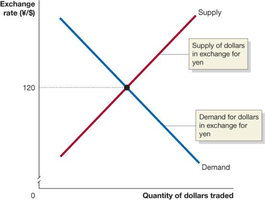
Exchange Rate Adjustments
If the exchange rate is above equilibrium, there is a surplus of dollars, leading to depreciation. If below equilibrium, there is a shortage, leading to appreciation. These adjustments restore market balance.
Surplus of Dollars: Exchange rate falls (depreciation).
Shortage of Dollars: Exchange rate rises (appreciation).
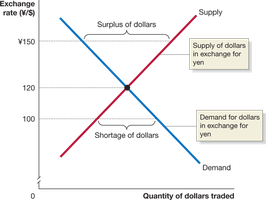
Purchasing Power Parity (PPP)
Purchasing Power Parity is the theory that, in the long run, exchange rates move to equalize the purchasing power of different currencies. The 'Big Mac Index' is a practical example, comparing the price of a Big Mac across countries. PPP does not hold exactly due to non-tradable goods and market frictions.
PPP Formula:
Limitations: Not all goods are traded internationally; transportation costs and trade barriers exist.
Monetary Policy
Goals of Monetary Policy
The Federal Reserve (Fed) pursues four main goals: price stability (targeting 2% inflation), high employment, and stability of financial markets and institutions. The first two are known as the Fed’s “dual mandate.”
Price Stability: Keeping inflation low and predictable.
High Employment: Striving for maximum sustainable employment.
Financial Stability: Ensuring the soundness of financial institutions and markets.
Measuring the Money Supply
The money supply impacts inflation, employment, interest rates, and economic growth. The narrowest measure, M1, includes currency, checking accounts, and other liquid deposits.
M1 Formula:
Liquidity: The ease with which an asset can be converted to cash at a set value.
How the Fed Conducts Monetary Policy
The Fed influences economic activity primarily by adjusting short-term interest rates. Lowering rates stimulates economic activity, while raising rates restrains it. In times of crisis, the Fed may use unconventional tools such as quantitative easing (buying long-term bonds) to lower long-term interest rates.
Federal Funds Rate: The rate banks charge each other for overnight loans.
Interest Rate on Reserve Balances (IORB): The rate paid on reserves held at the Fed.
Quantitative Easing: Buying long-term bonds to inject money and lower long-term rates.
Expansionary vs. Contractionary Monetary Policy
Expansionary policy ("loose" policy) lowers interest rates to boost GDP and employment. Contractionary policy ("tight" policy) raises rates to control inflation, even if it reduces GDP in the short run.
Expansionary Policy: Used when real GDP is below potential; increases aggregate demand.
Contractionary Policy: Used when inflation is a concern; decreases aggregate demand.
The Quantity Theory of Money
This theory links the money supply to economic activity using the equation of exchange:
Equation:
Variables: M = Money supply, V = Velocity of money, P = Price level, Y = Real output (GDP)
Implication: In the long run, rapid money supply growth leads to inflation.
Rearranged:
Fiscal Policy
Definition and Goals
Fiscal policy refers to government actions (taxes and spending) to influence economic activity. The main goals are low unemployment and low inflation. Fiscal policy is managed by Congress and the Administration, separate from the Fed’s monetary policy.
Expansionary Fiscal Policy: Increases government spending or cuts taxes to boost aggregate demand and reduce unemployment.
Contractionary Fiscal Policy: Decreases government spending or raises taxes to reduce inflation.
Fiscal Policy Tools
Automatic Stabilizers: Built-in mechanisms (e.g., unemployment insurance) that adjust automatically with economic conditions.
Transfer Payments: Payments like Social Security and Medicare, written into law.
Discretionary Stimulus/Contraction: Requires new legislation (e.g., stimulus bills).
Countercyclical Fiscal Policy
Countercyclical policy acts against the business cycle: stimulus during recessions, contraction during booms. Effects are analyzed assuming other factors (like monetary policy) are constant (ceteris paribus).
Fiscal Policy and the Federal Budget
Fiscal stimulus increases the federal budget deficit, while contraction reduces it. The U.S. has run persistent deficits, leading to a growing federal debt.
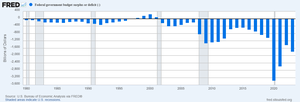
Federal Debt and Outlays
The federal debt is the sum of all past deficits. Most federal spending is mandatory (Social Security, Medicare), with discretionary spending making up a smaller share. Interest on the debt is a growing component of federal outlays.
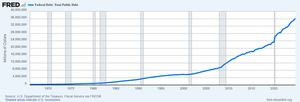
Demographic Challenges and Social Security
Workers per Social Security Retiree
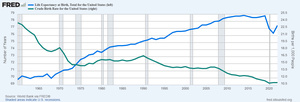
Demographic trends, such as fewer births and longer life expectancy, are straining Social Security and Medicare. The ratio of workers to retirees is declining, increasing fiscal pressure on these programs.
International Trade and Capital Flows
U.S. Net Export Balance
The U.S. has run a net export deficit since the 1980s, importing more than it exports. This deficit is financed by foreign purchases of U.S. assets, which helps keep U.S. interest rates lower and supports asset prices.
Foreign Direct Investment (FDI)
FDI occurs when firms build or buy facilities in another country. U.S. firms invest abroad, and foreign firms invest in the U.S., reflecting global economic integration.
The Flip Side of Trade Deficits
While trade deficits mean more imports than exports, the dollars sent abroad often return as investment in U.S. securities, supporting the financial system.
Summary Table: Key Macroeconomic Policy Tools
Policy Tool | Expansionary Action | Contractionary Action | Main Goal |
|---|---|---|---|
Monetary Policy | Lower interest rates, buy bonds | Raise interest rates, sell bonds | Stabilize inflation and employment |
Fiscal Policy | Increase spending, cut taxes | Decrease spending, raise taxes | Stabilize output and employment |
Additional info:
All equations are provided in LaTeX format for clarity.
Images included are directly relevant to the explanation of exchange rates, fiscal balances, federal debt, and demographic trends.
