 Back
Macroeconomics Study Guide: Key Variables, Goods Market, and Financial Markets
Study Guide - Smart Notes
 Tailored notes based on your materials, expanded with key definitions, examples, and context.
Chapter 2: A Tour of the Book
Key Macroeconomic Variables
This chapter introduces the three central variables in macroeconomics: aggregate output, the unemployment rate, and the inflation rate. Understanding these variables is essential for analyzing the overall performance and health of an economy.
Aggregate Output: The total value of goods and services produced in an economy, commonly measured by Gross Domestic Product (GDP).
Unemployment Rate: The percentage of the labor force that is unemployed and actively seeking work.
Inflation Rate: The rate at which the general level of prices for goods and services rises, eroding purchasing power.
Aggregate Output and GDP
Aggregate output is measured by GDP, which can be calculated in three ways: as the value of final goods and services, as the sum of value added, or as the sum of incomes. GDP is measured in monetary terms, but prices change over time, so economists distinguish between nominal GDP and real GDP.
Nominal GDP: GDP measured at current prices; changes reflect both price and quantity changes.
Real GDP: GDP measured at constant base-period prices; isolates changes in quantities.
The Unemployment Rate
The unemployment rate is a critical indicator of economic efficiency and output. It is calculated as:
Unemployment Rate Formula:
Types of Unemployment:
Frictional: Short-term, due to normal labor turnover.
Structural: Mismatch between skills and job requirements.
Cyclical: Due to business cycles or seasonal fluctuations.
Long-term unemployment can lead to loss of income, human capital, and social issues.
The Inflation Rate
Inflation is measured by changes in the price level, using indices such as the GDP deflator and Consumer Price Index (CPI).
GDP Deflator:
CPI: Measures the average price of a basket of consumer goods, normalized to 100 in the base period.
Inflation Rate Formula:
Inflation matters when relative prices change, affecting resource allocation and market outcomes. Expectations about inflation are also important.
Chapter 3: The Goods Market
Goods Market Equilibrium
The goods market determines real GDP (output) in the short run, holding the interest rate and price level constant. The equilibrium is illustrated by the interaction between production, income, and demand.
Key Relationship: Production generates income, which creates demand, and demand drives production.

Composition of GDP
GDP is composed of consumption (C), investment (I), government spending (G), and net exports (X-Q). In a closed economy, net exports are ignored.
GDP Identity:
Closed Economy:
Consumption Function
Consumption depends on disposable income, wealth, interest rate, and expectations. The relationship between disposable income and consumption is systematic and forms the basis of the consumption function.
Generic Consumption Function:
Linear Consumption Function:
Disposable Income:
Expanded Consumption Function:
Marginal Propensity to Consume (c1): The fraction of additional income spent on consumption.
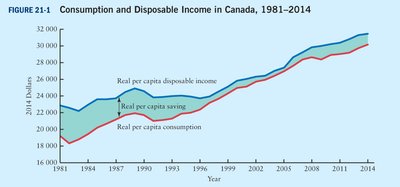
Goods Market Equilibrium: Algebra and Graphical Analysis
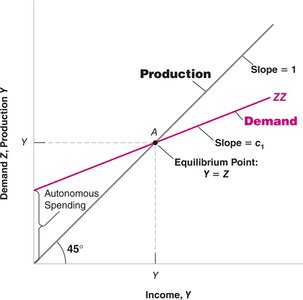
Equilibrium output is where production equals demand (). The equilibrium can be analyzed graphically or algebraically.
Equilibrium Condition:
Total Demand:
Solving for Equilibrium Output:
Substitute into the demand equation:
Solve for :
Multiplier: , greater than 1 if .
Chapter 4: Financial Markets
Money Demand and Interest Rate Determination
Financial markets determine the interest rate through monetary equilibrium, where money demand equals money supply. Individuals allocate wealth between money (liquidity) and bonds (interest-earning).
Reasons for Holding Money: Transactions, precautionary, and speculative demand.
Money Demand Function: Y \times L(-i)L(\cdot)$ decreases with the interest rate.
Determinants: Real GDP, price level, and interest rate.
Monetary Equilibrium and Policy
The central bank supplies money independently of the interest rate. The equilibrium interest rate is determined by:
Equilibrium Condition: Y L(i)$
Monetary Policy: The central bank targets the interest rate, adjusting money supply through open-market operations.
Expansionary Policy: Lowering interest rates by buying government securities.
Contractionary Policy: Raising interest rates by selling government securities.
Chapter 5: Goods and Financial Markets; The IS-LM Model
The IS-LM Model
The IS-LM model combines goods and financial markets to jointly determine output and the interest rate in the short run. The IS curve represents goods market equilibrium, and the LM curve represents money market equilibrium.
IS Relation: ,
Investment Function: , depends on output and interest rate.
LM Relation: , or
Policy Analysis in the IS-LM Model
Fiscal Policy: Changes in government spending or taxes shift the IS curve.
Monetary Policy: Changes in money supply or interest rate shift the LM curve.
Policy Mix: Combination of fiscal and monetary policies affects equilibrium output and interest rate.
Chapter 6: Financial Markets II
Nominal vs. Real Interest Rates and the Fisher Relation
Distinguishing between nominal and real interest rates is crucial for understanding the effects of inflation. The Fisher relation links nominal interest rate, real interest rate, and expected inflation.
Nominal Bond: Contract to trade money over time; nominal interest rate () is the rate of return in money terms.
Price Level and Expected Inflation:
Fisher Relation:
Approximation: (when rates are small)
Extending the IS-LM Model
The extended IS-LM model incorporates real interest rates and risk premia, making investment depend on the real borrowing rate.
Extended IS Relation:
LM Relation: (central bank targets real interest rate)
This model is used for more realistic policy analysis, though it remains a simplification.
