 Back
BackMacroeconomics Study Guide: Output, Unemployment, and the Business Cycle
Study Guide - Smart Notes
 Tailored notes based on your materials, expanded with key definitions, examples, and context.
What Macroeconomics Is All About
Long-Term Economic Trends vs. Short-Term Fluctuations
Macroeconomics examines both the long-term growth of a country's production capacity and the short-term fluctuations in economic activity, known as the business cycle. Understanding these concepts is essential for analyzing national income, employment, and overall economic health.
Long-term trends: Focus on factors that increase potential output, such as resource growth and productivity improvements.
Short-term fluctuations: Concerned with periodic changes in real output, employment, and the business cycle phases.
Potential GDP and the Output Gap
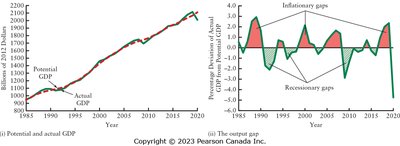
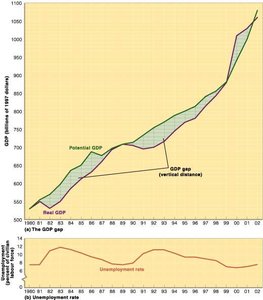
Potential GDP represents the maximum sustainable output a country can produce, given its resources and technology. The output gap measures the difference between actual GDP and potential GDP, indicating whether the economy is underperforming or overheating.
Output gap: Positive (inflationary) when actual GDP exceeds potential; negative (recessionary) when actual GDP falls short.
Economic cost: The output gap quantifies lost output due to unemployment or inefficiency.
Factors That Grow Production Capacity
Several factors contribute to the outward shift of the production possibilities curve and increase potential output:
Increase in economic resources: More labor, capital, and natural resources.
Increase in productivity: Driven by technological improvements, education, training, and international trade.
Government policies: Investment in research, infrastructure, and human resource development.
Productivity and Standard of Living
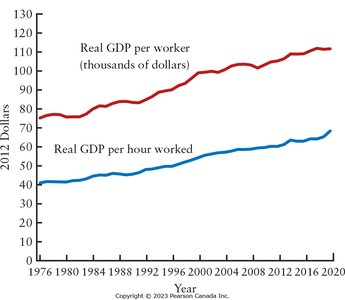
Productivity measures the output contributed by each unit of input. Labour productivity is the output per worker or per hour worked. Productivity growth is the primary driver of rising material standards of living over time.
Labour productivity: Has increased significantly in Canada over the past four decades.
Formula:
The Business Cycle
Phases of the Business Cycle
The business cycle describes periodic increases and decreases in economic activity. It consists of four main phases:
Peak: Highest level of economic activity before a decline. Characterized by strong growth, high employment, high inflation, and high confidence.
Recession: At least two consecutive quarters of negative growth. Features falling employment, low inflation, and declining confidence.
Trough: Lowest level of economic activity before recovery. Marked by low growth, low employment, and low confidence.
Recovery: Rising economic activity after a recession. Growth and employment increase, inflation starts to rise, and confidence improves.
Causes of Business Cycle Fluctuations
Business cycle fluctuations are primarily caused by changes in aggregate expenditures (AE):
Aggregate Expenditures Formula:
Key factors: Technological innovation, economic policy (monetary and fiscal), international trade partner fluctuations, financial market volatility, and major government spending changes.
Employment and Unemployment
Measurement of Unemployment
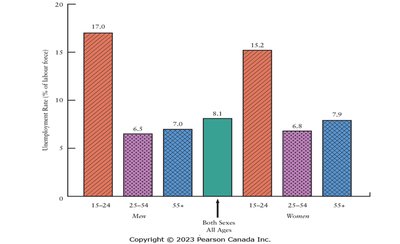
Statistics Canada measures unemployment through the Labour Force Survey, sampling approximately 54,000 households monthly. Officially unemployed persons are adults (15+) who are not institutionalized, not in the military, available for work, and actively seeking employment.
Labour Market Statistics (2024)
Labour Force: 22.1347 million
Unemployed: 1.4042 million
Population (15+): 33.8192 million
Calculating the Unemployment Rate
The unemployment rate is calculated as:
Formula:
Types of Unemployment
Economists classify unemployment to help design effective policy:
Frictional Unemployment (Uf): Includes search, wait, and seasonal unemployment.
Structural Unemployment (Us): Caused by economic changes, market inflexibilities, skill mismatches, and globalization.
Cyclical Unemployment (Uc): Results from temporary economic shocks and business cycle fluctuations.
Total Unemployment:
Full Employment and NAIRU
Full employment occurs when cyclical unemployment is zero (). The unemployment rate at full employment is called the NAIRU (Non-Accelerating Inflation Rate of Unemployment):
Formula:
Potential output:
Unemployment Gap and Output Gap
The unemployment gap is the amount by which actual unemployment exceeds the NAIRU, representing cyclical unemployment:
Formula:
The output gap is the difference between actual output and potential output:
Formula (dollars):
Formula (percentage):
Recessionary and Inflationary Gaps
The output gap can be:
Recessionary gap: ,
Inflationary gap: ,
Full employment: ,
Okun’s Law
Okun’s Law describes the relationship between the output gap and the unemployment gap. For every percentage point the unemployment rate exceeds NAIRU, output falls short of potential output by approximately 2%:
Formula:
Factors Affecting NAIRU
The NAIRU changes slowly and is influenced by:
Demographic shifts: Increased youth participation raises NAIRU.
Labour market inflexibility: Unions, government policy, minimum wage laws.
Structural change: Globalization, technological change, outsourcing.
Hysteresis: Prolonged high unemployment leads to skill loss and insider-outsider effects.
Government Policy and Unemployment
Reducing Frictional Unemployment
Government agencies facilitate job matching and provide incentives for rapid re-employment. Zero frictional unemployment is neither possible nor desirable due to unavoidable search and seasonal unemployment.

Reducing Structural Unemployment
Policies focus on education, retraining, and supporting transitions to new industries. Assistance is provided to both workers and businesses in adapting to technological and economic changes.

Reducing Cyclical Unemployment
Governments can use fiscal policy, such as increasing spending or cutting taxes, to stimulate demand and create jobs during downturns. These stabilization policies are discussed in detail in later chapters.
Additional Topics: The International Economy
International flows of goods, services, capital, and exchange rates are important macroeconomic topics, covered in detail in Chapters 17 and 19.
