 Back
BackMacroeconomics Study Notes: GDP, Economic Growth, and Measuring National Output
Study Guide - Smart Notes
 Tailored notes based on your materials, expanded with key definitions, examples, and context.
Chapter 8: Measuring a Nation's Production and Income
Gross Domestic Product (GDP): Definition and Importance
Gross Domestic Product (GDP) is the market value of all final goods and services produced within a country in a given period. It is the primary measure of a nation's overall economic activity and is used to compare economic performance across countries and over time.
Final Goods and Services: Only goods and services sold to the end user are counted to avoid double counting.
Market Value: GDP uses market prices to value production.
Within a Country: Only production within a nation's borders is included.
Given Period: GDP is measured over a specific time frame, usually a year or a quarter.
GDP Formula: Where: = Consumption = Investment = Government Purchases = Net Exports (Exports - Imports)
Example: If a country produces cars, computers, and food, the value of all these final goods and services is summed to calculate GDP.
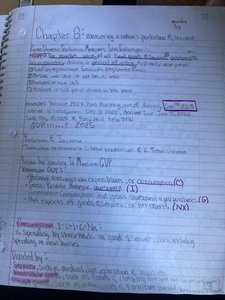
Components of GDP
Consumption (C): Spending by households on goods and services.
Investment (I): Spending on capital equipment, inventories, and structures, including new housing.
Government Purchases (G): Spending on goods and services by local, state, and federal governments.
Net Exports (NX): Exports minus imports. If imports exceed exports, NX is negative.
Example: If households buy new cars (consumption), firms build new factories (investment), the government builds roads (government purchases), and the country exports more than it imports (positive net exports), all these contribute to GDP.
Nominal vs. Real GDP
GDP can be measured in current prices (nominal GDP) or in constant prices (real GDP) to account for inflation.
Nominal GDP: Values output using current prices. It does not correct for inflation.
Real GDP: Values output using the prices of a base year. It corrects for inflation and allows comparison of economic output over time.
GDP Deflator: Measures the price level of all new, domestically produced, final goods and services in an economy.
Example: If nominal GDP increases but real GDP remains constant, the increase is due to higher prices, not more production.
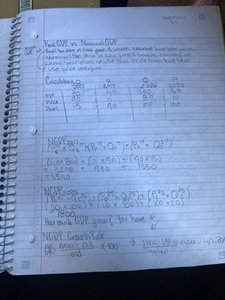
Calculating GDP: Example with Quantities and Prices
To calculate GDP, multiply the quantity of each good produced by its price and sum across all goods.
Example Table:
Good | Quantity (Year 1) | Price (Year 1) | Quantity (Year 2) | Price (Year 2) |
|---|---|---|---|---|
Burgers | 100 | $2 | 120 | $2.50 |
Fries | 200 | $1 | 220 | $1.20 |
Nominal GDP (Year 1):
Nominal GDP (Year 2):
Real GDP (Year 2, base year = Year 1):
Limitations of GDP
Nonmarket Activities: GDP does not include household production or volunteer work.
Underground Economy: Unreported transactions are not counted.
Quality of Life: GDP does not measure happiness, leisure, or environmental quality.
Distribution of Income: GDP does not reflect how income is distributed among residents of a country.
Chapter 9: Unemployment and Inflation
Measuring Unemployment
Unemployment is a key indicator of economic health. It is measured by the unemployment rate, which is the percentage of the labor force that is jobless and actively seeking work.
Labor Force: The sum of employed and unemployed individuals.
Unemployment Rate:
Types of Unemployment:
Frictional: Short-term unemployment as people move between jobs.
Structural: Mismatch between workers' skills and job requirements.
Cyclical: Caused by economic downturns.
Natural Rate of Unemployment: The normal rate of unemployment, consisting of frictional and structural unemployment.
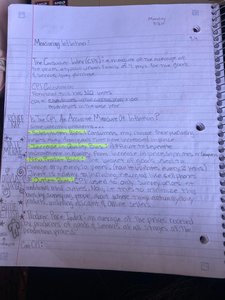
Measuring Inflation
Inflation is the rate at which the general level of prices for goods and services rises, eroding purchasing power.
Consumer Price Index (CPI): Measures the average change over time in the prices paid by urban consumers for a market basket of consumer goods and services.
Inflation Rate:
Producer Price Index (PPI): Measures the average change in selling prices received by domestic producers for their output.
GDP Deflator: Another measure of the price level, reflecting the prices of all goods and services included in GDP.
Chapter 10: Economic Growth, the Financial System, and Business Cycles
Economic Growth
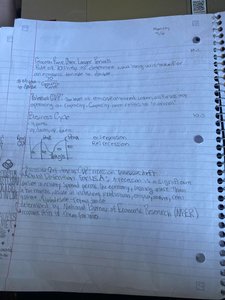
Economic growth refers to the increase in the market value of the goods and services produced by an economy over time. It is typically measured as the percentage increase in real GDP.
Long-Run Growth: Driven by increases in resources, technology, and productivity.
Short-Run Fluctuations: Reflected in business cycles, which include periods of expansion and recession.
Growth Rate Formula:
The Financial System
The financial system facilitates the flow of funds from savers to borrowers, supporting investment and economic growth.
Financial Markets: Where securities are bought and sold (e.g., stock and bond markets).
Financial Intermediaries: Institutions like banks and mutual funds that channel funds from savers to borrowers.
Role in Growth: Efficient financial systems allocate resources to their most productive uses, fostering economic growth.
Business Cycles
Business cycles are fluctuations in economic activity, such as employment and production, over time.
Phases: Expansion (rising GDP), Peak, Recession (falling GDP), Trough.
Indicators: GDP, unemployment, and inflation rates are key indicators of the business cycle.
Example: During a recession, GDP falls and unemployment rises; during an expansion, GDP rises and unemployment falls.
Appendix: Quantitative GDP and Inflation Calculations
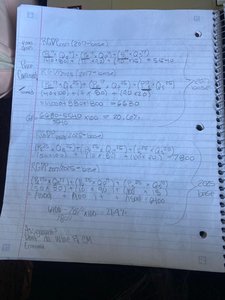
Worked Examples: Calculating Real and Nominal GDP
Calculating real and nominal GDP involves using quantities and prices from different years to distinguish between changes in output and changes in prices.
Nominal GDP:
Real GDP:
GDP Deflator:
Example Calculation: If in 2020, 100 units of a good are sold at Real GDP (2021, base year 2020) = GDP Deflator (2021) =
Comparing Real and Nominal GDP Growth
Growth Rate of Real GDP:
Growth Rate of Nominal GDP:
Interpretation: If nominal GDP grows faster than real GDP, prices are rising (inflation).
Summary Table: Key Macroeconomic Indicators
Indicator | Definition | Formula |
|---|---|---|
GDP | Market value of all final goods and services produced within a country | |
Unemployment Rate | Percentage of labor force unemployed | |
Inflation Rate (CPI) | Percentage change in consumer price index | |
GDP Deflator | Price index for all goods and services in GDP |
Additional info: These notes synthesize key macroeconomic concepts from the provided handwritten materials, expanding on definitions, formulas, and examples for clarity and exam preparation.
