 Back
BackMacroeconomics: Study Notes on Health Care, Firms, GDP, International Trade, and Unemployment & Inflation
Study Guide - Smart Notes
 Tailored notes based on your materials, expanded with key definitions, examples, and context.
The Economics of Health Care
The Improving Health of People in the United States
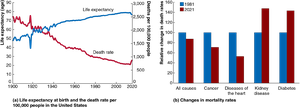
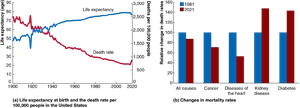
Health outcomes in the United States have improved dramatically over the past two centuries, with significant increases in life expectancy and reductions in death rates. These improvements are attributed to advances in nutrition, public health, and medical technology. However, health care expenditure in the U.S. is higher than anywhere else in the world, due to factors such as high quality of care, payment systems, and higher demand.
Health care: Goods and services intended to maintain or improve health, including prescription drugs, doctor consultations, and surgeries.
Feedback loop: Better health leads to higher incomes, which in turn supports better health.
Recent trends: Medical advances have reduced death rates from diseases like cardiovascular disease, but deaths from obesity-related illnesses have increased.
Demographics of Covid-19 Mortality
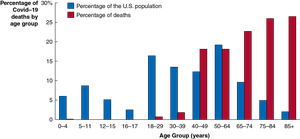
Covid-19 mortality was highest among older adults, partly due to weaker immune systems and living arrangements such as nursing homes.
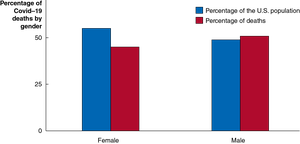
More men than women died from Covid-19, possibly due to lower vaccination rates among men.
Differences in mortality rates across racial and ethnic groups are linked to vaccination rates, access to health care, socioeconomic status, and occupational exposure.

Health Care Around the World
Health care systems differ significantly across countries in terms of provision and payment. In the U.S., most health care is provided by private firms and paid for through health insurance, which can be employer-based, government-provided, or individually purchased.
Health insurance: A contract where buyers pay premiums in exchange for coverage of medical bills.
Types of payment: Fee-for-service (payment per service) and Health Maintenance Organizations (HMOs) (flat fee per patient).
In 2021, about 49% of Americans had employer-based insurance, 37% had government insurance, and 9% were uninsured.

The Affordable Care Act (ACA) reduced the uninsured rate by providing subsidies and mandating coverage.
Reasons for being uninsured include affordability, perceived lack of need, and cost-benefit concerns.

Comparison countries:
Canada: Single-payer system, government insurance, private care providers.
Japan: Universal insurance, nonprofit societies, significant copayments.
UK: Socialized medicine, government owns hospitals and employs doctors.

Information Problems and Externalities in Health Care
The health care market is characterized by asymmetric information, where one party has more information than the other, leading to market failures such as adverse selection and moral hazard.
Adverse selection: Those most likely to use insurance are most likely to buy it, raising premiums and excluding healthier individuals.
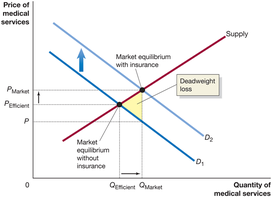
Moral hazard: Insured individuals may use more health care or take more risks, increasing costs.
Principal-agent problem: Doctors (agents) may not act in the best interest of insurance companies (principals), e.g., ordering unnecessary procedures.
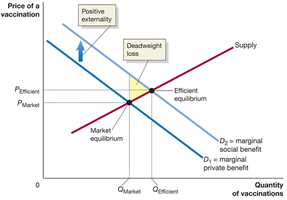
Externalities: Positive (e.g., vaccinations) and negative (e.g., unhealthy behaviors) externalities affect overall market outcomes.
The Debate Over Health Care Policy in the United States
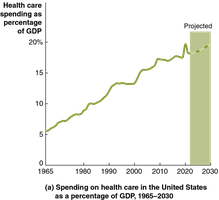
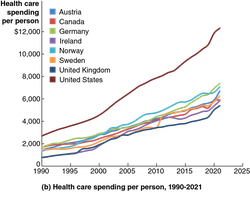
The U.S. spends more per person on health care than any other country, and costs continue to rise. Major reasons include the service sector "cost disease," an aging population, advances in medical technology, and distorted incentives from insurance systems.
Health care spending as a share of national income is rising and projected to continue increasing.
Out-of-pocket spending is declining, increasing the burden on government budgets.
Market-based reforms and government involvement are debated, with proposals ranging from "Medicare for All" to public options and changes in tax treatment of insurance.
Firms, the Stock Market, and Corporate Governance
Types of Firms
Firms in the U.S. are categorized as sole proprietorships, partnerships, or corporations. Corporations offer limited liability, making it easier to raise funds but are more expensive to organize and may face double taxation.
Sole proprietorship: Owned by one individual, unlimited liability.
Partnership: Owned by two or more, unlimited liability.
Corporation: Legal entity, limited liability for owners.
Corporate Structure and Governance
Corporations separate ownership from control, with a board of directors and top management. The principal-agent problem arises when managers' interests diverge from shareholders'. Solutions include aligning incentives through stock-based compensation.
How Firms Raise Funds
Firms raise funds through retained earnings, recruiting additional owners, or borrowing. Larger firms use indirect finance (via banks) or direct finance (issuing bonds and stocks).
Bonds: Loans with fixed payments and maturity dates; higher risk requires higher interest rates.
Stocks: Partial ownership; returns through dividends or capital gains.
Mutual funds/ETFs: Allow small investors to diversify risk.
Financial Statements
Corporations publish income statements (revenues, costs, profit) and balance sheets (assets, liabilities, equity). Accountants focus on explicit costs, while economists include opportunity costs (implicit costs) to calculate economic profit.
Present Value
The present value of future funds is calculated to determine the current worth of future payments, crucial for valuing bonds and stocks.
General formula for present value of a single payment:
For a series of payments, sum the present value of each payment.
GDP: Measuring Total Production and Income
Gross Domestic Product (GDP)
GDP is the market value of all final goods and services produced within a country in a given period, typically a year. It is the primary measure of overall economic activity.
Market value: Goods and services are valued at market prices.
Final goods/services: Only final goods are counted to avoid double counting.
Produced within a country: Only production within national borders is included.
During a period of time: Only new production in the measured period is counted.
Measuring GDP
GDP can be measured by total production or total income. The Bureau of Economic Analysis (BEA) uses four major expenditure categories:
Personal consumption expenditures (C)
Gross private domestic investment (I)
Government purchases (G)
Net exports (NX = exports - imports)
Shortcomings of GDP
Does not include household production or the underground economy.
GDP per capita does not account for leisure, pollution, crime, or income distribution.
Real vs. Nominal GDP
Nominal GDP is measured at current prices, while real GDP is measured at base-year prices to account for inflation. The GDP deflator is used to measure the price level:
Other Measures of Production and Income
Gross National Product (GNP): Production by a nation's citizens, including overseas production.
National income: GDP minus depreciation.
Personal income: Income received by households, including transfers.
Disposable personal income: Personal income minus taxes.
Comparative Advantage and the Gains from International Trade
Comparative and Absolute Advantage
Comparative advantage is the ability to produce a good at a lower opportunity cost than others. Absolute advantage is the ability to produce more of a good with the same resources. Trade allows countries to specialize and consume beyond their production possibilities.
Gains from Trade
Specialization according to comparative advantage increases total output and allows mutually beneficial trade.
Terms of trade determine the rate at which goods are exchanged internationally.
Trade Restrictions
Governments may restrict trade through tariffs, quotas, and voluntary export restraints, often to protect domestic industries. These measures typically reduce overall economic welfare by creating deadweight losses.
Unemployment and Inflation
Measuring Unemployment
The unemployment rate is the percentage of the labor force that is unemployed. Other important measures include the labor force participation rate and the employment-population ratio.
Labor force: Employed + unemployed individuals.
Unemployment rate:
Types of Unemployment
Frictional: Short-term, due to job search or seasonal factors.
Structural: Mismatch between skills and job requirements.
Cyclical: Caused by economic downturns (recessions).
Measuring Inflation
Inflation is the percentage increase in the price level, commonly measured by the Consumer Price Index (CPI) or Producer Price Index (PPI).
CPI: Measures average prices paid by consumers for a fixed basket of goods.
PPI: Measures average prices received by producers.
Nominal vs. Real Interest Rates
Nominal interest rate: Stated rate on a loan.
Real interest rate: Nominal rate minus inflation rate.
Costs of Inflation
Anticipated inflation causes menu costs, redistribution of income, and higher costs of holding cash.
Unanticipated inflation increases uncertainty, making borrowing and lending riskier.
Inflation and Income Distribution
Inflation can affect different income groups differently, depending on their spending patterns and wage growth relative to price increases.
