 Back
Measurement of Macroeconomic Data: Nominal GDP and Related Concepts
Study Guide - Smart Notes
 Tailored notes based on your materials, expanded with key definitions, examples, and context.
Gross Domestic Product (GDP): Foundations and Measurement
National Income Accounts: The Measurement Foundation
National income accounts provide a snapshot of a country's income, consumption, and output/production. These accounts are essential for understanding the overall size and health of an economy. They answer key questions such as what is being produced, who is buying it, and how earnings are distributed.
GDP is the most widely used measure of total output.
It is calculated annually or quarterly.
GDP is measured in both nominal and real terms.
Nominal GDP: Definition and Calculation
Nominal GDP is the market value of all final goods and services produced within a country during a specified period, using current market prices. It reflects both changes in output and prices.
Market Value: GDP measures the value, not the quantity, of goods and services.
Final Goods and Services: Only goods and services purchased by the end user are included; intermediate goods are excluded.
Geographic Scope: GDP includes production within a country's borders, regardless of the producer's nationality.
Time Period: Typically measured annually or quarterly.
Methods of Calculating GDP
There are two primary methods for calculating GDP:
Market Value Approach: Sum the market values (price × quantity) of all final goods produced.
Value Added Approach: Sum the value added at each stage of production for all goods and services.
Example: The value added approach is illustrated in the table below, showing the stages of producing and selling orange juice.
Activity | Cost of Inputs | Price of Output | Value Added |
|---|---|---|---|
Growing Oranges | $0 | $1 | $1 |
Making Orange Juice | $1 | $1.50 | $0.50 |
Distributing Juice to Stores (Wholesale) | $1.50 | $2.25 | $0.75 |
Selling Juice to Consumer (Retail) | $2.25 | $3.50 | $1.25 |
TOTAL | $3.50 |

Components of GDP
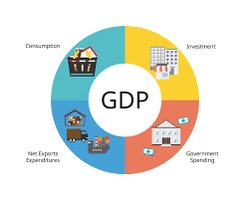
GDP is composed of four main types of expenditures:
Consumption (C): Spending by households on goods and services.
Investment (I): Spending on business capital, residential investment, and inventories.
Government Spending (G): Purchases of goods and services by the government (excluding transfer payments).
Net Exports (NX): Exports minus imports.
The GDP equation is:
GDP and Standards of Living
GDP per capita is a common measure of a nation's standard of living, but it has limitations. Real GDP per capita adjusts for price changes, and GDP-PPP (Purchasing Power Parity) accounts for differences in price levels across countries.
GDP per capita:
Real GDP per capita: Adjusts for inflation.
GDP-PPP: Adjusts for differences in purchasing power.
Limitations of GDP
GDP is a narrow measure and does not capture all aspects of economic well-being:
Excludes household production and the shadow/underground economy.
Does not account for leisure, environmental degradation, or income distribution.
Market values do not measure total value or happiness.
The Underground Economy
The shadow or underground economy is not officially reported and is difficult to measure. It is larger in developing countries and can lead to overestimation of GDP growth as economies develop.
Reasons for existence: Illegal activities, tax avoidance, regulatory structures.
Consequences: Uncertainty in ownership rights, corruption, and distorted investment incentives.
Digital Economy and GDP Measurement
GDP struggles to capture the value of free digital goods and services, such as search engines, email, and social media. Surveys estimate the compensation required to give up these services, highlighting their economic value.
Search engines: $17,530/year
Email: $8,414/year
Maps: $3,648/year
Video: $1,170/year
E-commerce: $842/year
Social media: $322/year
Music: $168/year
Messaging: $155/year
Green GDP
Green GDP is an alternative measure that adjusts GDP for environmental degradation and resource depletion.
GDP, GNP, and GDI: Comparisons
Gross National Product (GNP): Measures the value of output produced by a country's citizens, regardless of location.
Gross Domestic Product (GDP): Measures the value of output produced within a country's borders.
Gross Domestic Income (GDI): Sum of income payments; theoretically equal to GDP.
Example: Angola has high GDP but low GNP due to foreign production; Pakistan has low GDP but high GNP due to remittances from citizens abroad.
GDP and Income Distribution
GDP measures the size of the economic pie but not its distribution. The share of income paid to labor has declined in the U.S., with more income going to capital.
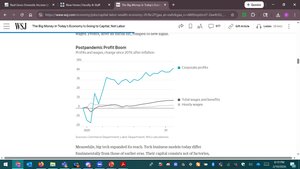
"Superstar" companies contribute to this trend by generating high revenues with fewer employees.
Summary: GDP as an Economic Indicator
While GDP is a critical measure of economic activity, it does not capture all aspects of well-being, happiness, or income distribution. Real GDP per capita and GDP-PPP are better indicators of living standards, but even these have limitations. Understanding the components, calculation methods, and limitations of GDP is essential for interpreting macroeconomic data.
