 Back
Measuring a Nation's Production and Income: GDP and Its Components
Study Guide - Smart Notes
 Tailored notes based on your materials, expanded with key definitions, examples, and context.
Gross Domestic Product (GDP): Definition and Importance
What is GDP?
Gross Domestic Product (GDP) is a fundamental measure in macroeconomics, representing the total value of all final goods and services produced within a country's borders in a given year. It is widely used to assess the economic performance and well-being of nations.
Final goods and services: Only goods and services purchased by the end user are counted, avoiding double-counting intermediate products.
Annual measurement: GDP is calculated for a specific time period, usually one year.
Economic indicator: GDP is used to compare economic activity across countries and over time.
Approaches to Measuring GDP
Expenditure Approach
The expenditure approach calculates GDP by summing all expenditures made in the economy on final goods and services. The formula is:
C (Consumption): Spending by households on goods and services.
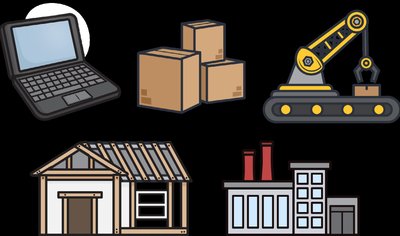
I (Investment): Spending on capital equipment, inventory, and structures.
G (Government Purchases): Spending by government on goods and services.
NX (Net Exports): Exports minus imports.
Example: If households spend $5,000, businesses invest $2,000, government spends $3,000, and net exports are $500, then GDP = $5,000 + $2,000 + $3,000 + $500 = $10,500.
Government Purchases (G)
Government purchases include spending by local, state, and federal governments on goods and services. Transfer payments (such as welfare) are not included, as they do not reflect production.

Consumption (C)
Consumption is spending by households on goods and services. It includes durable goods (lasting more than three years), nondurable goods (lasting less than three years), and services (intangible acts for which consumers are willing to pay).
Durable goods: Cars, appliances
Nondurable goods: Food, clothing
Services: Healthcare, education, entertainment

Investment (I)
Investment refers to spending on new capital goods, such as equipment, structures, and inventory. It does not include financial transactions like stocks and bonds.
Business Fixed Investment: Spending by firms on factories, buildings, and equipment
Residential Investment: Spending by households and firms on residential construction
Changes in Inventory: Goods produced but not yet sold
Net Exports (NX)
Net exports are calculated as exports minus imports. Exports are goods produced domestically and sold abroad, while imports are goods produced abroad and sold domestically.

Income Approach
The income approach calculates GDP by summing all incomes earned in the production of goods and services, including wages, rents, interest, and profits. Adjustments are made for taxes, depreciation, and net foreign factor income.
Compensation of employees
Rents
Interest
Proprietors’ income
Corporate profits
Taxes on production and imports
Adjustments: Net foreign factor income, consumption of fixed capital, statistical discrepancy
Example: If total income is $12,288 billion, adjustments are made to arrive at GDP ($14,256 billion in the 2009 U.S. example).
Value-Added Approach
The value-added approach measures GDP by summing the value added at each stage of production. Value added is the difference between a firm's sales and its purchases of inputs.
Example: A farm sells wheat for $2, a mill turns it into flour worth $5, and a bakery makes bread worth $7.50. The value added at each stage is the difference between the sale price and the input cost.
Practice: If a clothing company buys fabric for $3 and sells a t-shirt for $7, the value added is $4.
Nominal GDP vs. Real GDP
Definitions and Calculation
Nominal GDP is measured using current prices, while Real GDP is measured using constant base-year prices to account for inflation.
Nominal GDP:
Real GDP:
Example: If Clutchtopia produces pizza, caffeine pills, and exam reviews, calculate nominal and real GDP using the provided quantities and prices.
GDP Deflator
The GDP deflator measures the overall price level in the economy and is calculated as:
It is used to monitor inflation and changes in price levels.
Business Cycles and Their Characteristics
Definition and Phases
The business cycle describes periodic fluctuations in production, income, and employment. It consists of four main phases: expansion, peak, contraction, and trough.
Expansion: Production, income, and employment rise.
Peak: The highest point before a downturn.
Contraction (Recession): Production, income, and employment fall.
Trough: The lowest point before recovery begins.
Causes of Business Cycles
Productivity changes: Unexpected changes in productivity can cause booms or busts.
Monetary factors: Central bank policies can shock the economy.
Political events: Wars, peace, and terrorism can affect economic activity.
Financial instability: Bubbles and bursts in sectors can impact the whole economy.
Irregular innovation: Revolutionary technologies lead to booms, but growth slows once absorbed.
Unemployment and Inflation in the Business Cycle
Unemployment: Rises during recessions, falls during expansions.
Inflation: Falls during recessions, rises during expansions.
Jobless recovery: Periods of expansion where unemployment remains high.
Shortcomings of GDP
Limitations as a Measure of Well-Being
While GDP is a useful proxy for national income and economic activity, it does not capture all aspects of well-being.
Distribution of income: GDP does not reflect how income is distributed among individuals.
Leisure: GDP does not account for the value of leisure time.
Non-market production: Activities such as home production are not included.
Underground economy: Unreported or illegal transactions are excluded.
Negative byproducts: Environmental pollution and other negative externalities are not subtracted from GDP.






Summary Table: GDP Calculation Methods
Approach | Main Components | Example Calculation |
|---|---|---|
Expenditure | C, I, G, NX | GDP = $5,000 + $2,000 + $3,000 + $500 = $10,500 |
Income | Wages, rents, interest, profits, taxes | Sum all incomes and adjust for taxes, depreciation, etc. |
Value-Added | Value added at each stage | Sum value added by each firm in production chain |
Additional info: Chain-weighted prices are used in advanced GDP calculations to address changes in relative prices over time, but this is beyond the scope of introductory macroeconomics.
