 Back
BackMeasuring GDP, Real GDP, and Economic Growth: Principles of Macroeconomics Study Notes
Study Guide - Smart Notes
 Tailored notes based on your materials, expanded with key definitions, examples, and context.
Measuring Gross Domestic Product (GDP)
Ways to Measure GDP
Gross Domestic Product (GDP) is a fundamental indicator of a country's economic activity, representing the total value of all final goods and services produced within a nation's borders in a given period. There are three main approaches to measuring GDP:
Expenditure Approach: Calculates GDP as the sum of consumption expenditure, investment, government purchases, and net exports (exports minus imports).
Income Approach: Measures GDP by summing all incomes earned by households and firms, including wages, interest, rent, and profits.
Value Added Approach: Computes GDP by summing the value added at each stage of production, avoiding double-counting of intermediate goods.
Expenditure Approach Formula
GDP = C + I + G + (X - M)
Where: C = Consumption, I = Investment, G = Government Purchases, X = Exports, M = Imports
Income Approach Formula
GDP = Compensation of Employees + Net Interest + Rental Income + Corporate Profits + Proprietors’ Income + Indirect Taxes - Subsidies + Depreciation
Value Added Approach Example
A farmer sells wheat to a miller, the miller sells flour to a baker, and the baker sells bread to a consumer. GDP is the sum of value added at each stage, not the total sales, to avoid double-counting.
Components of GDP (2020Q1 Snapshot)
Consumption: ~67.6% of US GDP, includes durable goods (similar to investment).
Investment: ~17% of GDP, includes private and public investment, inventory accumulation.
Government Consumption: ~14.4% of GDP, total public spending (including investment) ~17.9%.
Exports: ~11.2% of GDP.
Imports: ~13.7% of GDP (subtracted in net exports).
Real GDP and the Price Level
Nominal vs. Real GDP
Nominal GDP is the value of goods and services produced in a given year, measured at current prices. Real GDP is the value of goods and services produced in a given year, measured at constant prices (base year prices), allowing for comparison across years by removing the effects of inflation.
Nominal GDP:
Real GDP:
Base Year Prices Method
Values each year’s output at the prices of a base year.
Example: If 2020 is the base year, real GDP in 2021 is calculated using 2020 prices.
Chain-Weighted Output Index Method
Uses prices of two adjacent years to calculate real GDP growth rate.
Steps:
Value production at last year’s prices and calculate growth rate.
Value production at this year’s prices and calculate growth rate.
Average the two growth rates.
Repeat for each pair of adjacent years to link real GDP back to the base year.
GDP Deflator
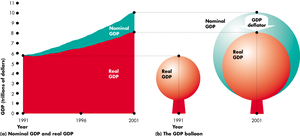
The GDP Deflator is a measure of the average level of prices of all goods and services included in GDP. It is calculated as:
Example: In 2020, if Nominal GDP = $200 and Real GDP = $200, GDP Deflator = 100. In 2021, if Nominal GDP = $575 and Real GDP = $250, GDP Deflator = 230.
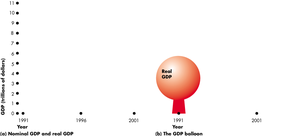
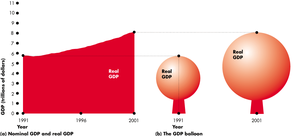
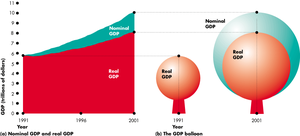
Illustration: Deflating the GDP Balloon
Nominal GDP increases due to both increased production (real GDP) and rising prices. The GDP deflator helps distinguish between these effects.
GDP per Capita
Definition and Calculation
GDP per capita is the value of all goods and services produced per person in the economy. It is a useful measure for comparing economic performance across countries with different population sizes.
Example: Norway’s GDP per capita is much higher than India’s, despite India’s total GDP being larger.
Measuring Economic Growth
Economic Growth Rate
The economic growth rate is the percentage change in real GDP from one year to the next. It is used for welfare comparisons, international comparisons, and business cycle forecasts.
Reasons for Measuring Economic Growth
Economic Welfare Comparisons: Real GDP is used to assess the nation’s economic well-being, but it is imperfect due to factors such as quality improvements, household production, underground economy, health, leisure, environment, and social justice not being included.
International Comparisons: Real GDP must be converted to a common currency and valued using the same prices, which can be problematic due to price differences and exchange rates.
Business Cycle Forecasts: Real GDP is used to measure business cycle fluctuations, though it may overstate changes in production and welfare.
Review Questions
What are the two approaches to calculating GDP? What formula depicts these two approaches?
For each approach, what items have to be added up to calculate GDP?
What adjustments need to be made to total income to make it equal to GDP?
What is the difference between nominal and real GDP? Why would we want to calculate real GDP?
How is real GDP calculated by the base year prices method? What is the intuition behind calculating real GDP this way?
What are some problems with calculating real GDP by the base year prices method?
What are the four steps involved in calculating real GDP by the chain-weighted method?
What is the GDP Deflator? How is it calculated?
What are some of the reasons for calculating real GDP?
For each reason, explain some of the problems associated with using real GDP for that purpose.
Additional info: These notes expand on brief lecture points to provide full academic context, including definitions, formulas, and examples. Images included directly illustrate the GDP balloon concept and the distinction between nominal and real GDP, as well as the GDP deflator.
