 Back
BackMeasuring National Income and Output: GDP Concepts and Methods
Study Guide - Smart Notes
 Tailored notes based on your materials, expanded with key definitions, examples, and context.
5a National Output and Value Added
Understanding Value Added and Avoiding Double Counting
When measuring a nation's total output, it is crucial to avoid counting the same production multiple times. This is known as the double-counting problem. To address this, economists distinguish between intermediate goods (used as inputs in further production) and final goods (purchased by end users). The concept of value added ensures that only the net contribution of each producer is counted in GDP.
Intermediate products: Goods used as inputs by other producers (e.g., flour purchased by a baker).
Final products: Goods purchased by final users, including consumers, governments, foreigners, and firms for investment (e.g., a baker buying an oven).
Value Added Formula:
GDP as Sum of Value Added:
Example: A Canadian farmer pays $100 for seeds and sells beets for $1,000 to a distributor, who sells them to a restaurant for $1,300. The restaurant sells beet salads for $2,500. The value added at each stage is the difference between sales and the cost of inputs, ensuring no double counting.
5b The Expenditure Approach
Calculating GDP by Summing Expenditures
The expenditure approach measures GDP as the total value of all final goods and services purchased in the economy. It categorizes expenditures into four main groups:
Consumption (C): Spending by households on new goods and services, excluding used goods and residential housing.
Investment (I): Includes business spending on new plant and equipment, new residential construction, and changes in inventories. Gross investment is used (no deduction for depreciation).
Government Purchases (G): All levels of government spending on currently produced goods and services, including salaries and investment, but excluding transfer payments.
Net Exports (NX): The value of exports minus imports. Imports are subtracted because they are included in C, I, and G.
GDP Formula (Expenditure Approach):
Example Applications:
Aunt Jane buys a new house: Investment (I) increases.
Buying a new car produced last year: Not included in current GDP (inventory adjustment may apply).
Buying imported wine: Consumption (C) increases, Net Exports (NX) decreases.
Honda expands factory: Investment (I) increases.
Buying shares of stock: Not included in GDP.
City pays library employees: Government Purchases (G) increases.
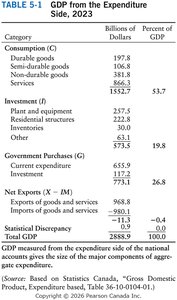
Table Purpose: Table 5-1 summarizes the main expenditure components of GDP for 2023, showing their dollar values and shares of total GDP.
5c The Income Approach
Calculating GDP by Summing Incomes
The income approach measures GDP by summing all incomes earned by factors of production in the economy. This includes wages, interest, rents, and profits. The total value added in production is distributed as income to households and firms.
Factor incomes: Wages, interest, rents, and profits.
Net Domestic Income at Factor Cost: Sum of all factor incomes.
Adjustments: Add indirect taxes (less subsidies) and depreciation to obtain GDP at market prices.
GDP Formula (Income Approach):
Why All Approaches Are Equal: The value of production (output), expenditure, and income must be equal in the circular flow of the economy, as every dollar spent on goods and services becomes income for someone.
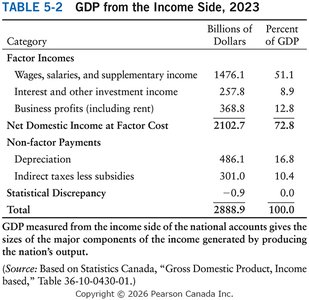
Table Purpose: Table 5-2 shows the breakdown of GDP by income components for 2023, including factor incomes and necessary adjustments.
5d Other GDP Accounting Issues
Real vs. Nominal GDP and the GDP Deflator
Nominal GDP measures output using current prices, while real GDP uses base-year prices to remove the effects of inflation. The GDP deflator is a price index that reflects the change in the overall price level of all goods and services included in GDP.
GDP Deflator Formula:
GDP Deflator vs. CPI: The GDP deflator covers all goods and services produced, while the Consumer Price Index (CPI) covers only consumer goods.
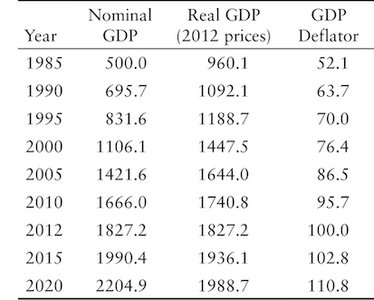
Table Purpose: This table compares nominal GDP, real GDP (in 2012 prices), and the GDP deflator for selected years, illustrating how the deflator tracks changes in the price level over time.
Omissions from GDP
GDP does not capture all economic activity. Notably, it omits:
Illegal activities
Underground economy
Leisure
Home production
Negative economic effects (e.g., pollution)
Despite these omissions, GDP remains a useful measure because:
It is difficult to correct for these omissions.
Changes in GDP reliably indicate changes in economic activity.
GDP data are essential for policy-making, especially for inflation control.
GDP and Living Standards
While GDP is not a complete measure of well-being, it is closely related to material living standards. Other factors, such as health, leisure, and relationships, also contribute to overall well-being. For broader measures, indices like the World Happiness Report are used.
