 Back
BackMonetary Policy: Goals, Tools, and Effectiveness
Study Guide - Smart Notes
 Tailored notes based on your materials, expanded with key definitions, examples, and context.
Monetary Policy: Goals, Tools, and Effectiveness
Introduction to Monetary Policy
Monetary policy refers to the actions undertaken by a nation's central bank—in the United States, the Federal Reserve (the Fed)—to manage the money supply and interest rates in pursuit of macroeconomic objectives. Since its creation in 1913, the Fed's responsibilities have expanded from preventing bank panics to promoting maximum employment, stable prices, and moderate long-term interest rates. The effectiveness of monetary policy is a central topic in macroeconomics, especially in times of economic crisis.
The Goals of Monetary Policy
The Federal Reserve pursues four main goals through its monetary policy actions. These goals are designed to foster a stable and growing economy.

1. Price Stability
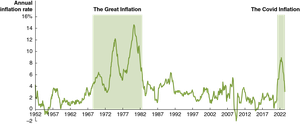
Price stability means keeping inflation—an overall increase in the price level—at a low and predictable rate. High inflation erodes the purchasing power of money, while deflation (falling prices) can lead to economic stagnation. Since 2012, the Fed has targeted a 2% inflation rate. Policymakers monitor inflation data closely and adjust policy to keep inflation within the target range.
Key Point: High inflation (as seen in the 1970s and 2020s) prompts contractionary policy, while negative inflation (deflation) leads to expansionary policy.
Key Point: The Consumer Price Index (CPI) is a common measure of inflation used by the Fed.
Example: In the early 1980s, the Fed raised interest rates to combat double-digit inflation, which eventually restored price stability.
2. High Employment
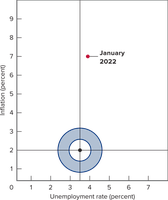
High employment, or maximum sustainable employment, is another primary goal. The Employment Act of 1946 established the federal government's responsibility to promote conditions for useful employment. The Fed aims to keep the unemployment rate near the natural rate (typically 4–5%).
Key Point: The "dual mandate" refers to the Fed's simultaneous pursuit of price stability and high employment.
Key Point: Achieving both goals can be challenging, as policies that reduce unemployment may increase inflation, and vice versa.
Example: In the early 1980s, the Fed prioritized reducing inflation, which temporarily increased unemployment.

3. Stability of Financial Markets and Institutions
Stable financial markets and institutions are essential for economic growth. The Fed acts as a "lender of last resort" to banks during crises, providing liquidity to prevent bank failures and maintain confidence in the financial system.
Key Point: The Fed provided emergency loans to investment banks during the 2008 financial crisis and again during the COVID-19 pandemic.
Key Point: Financial stability supports the other goals of monetary policy by ensuring the smooth functioning of credit markets.
Example: The Fed's actions in 2008 and 2020 helped prevent a collapse of the financial system.

4. Economic Growth
Economic growth refers to the increase in the economy's capacity to produce goods and services over time. While the Fed can influence growth through its other goals, long-run growth is also shaped by fiscal policy and private investment decisions.
Key Point: Stable growth encourages investment and raises living standards.
Key Point: The Fed's role is to create a stable environment for growth, but Congress and the President may have more direct tools to promote saving and investment.
Example: By keeping inflation and unemployment low, the Fed supports conditions favorable to long-term growth.

The Dual Mandate and Policy Trade-Offs
The Fed's dual mandate—price stability and high employment—can sometimes lead to trade-offs. For example, reducing inflation may require higher interest rates, which can increase unemployment. Conversely, lowering unemployment may risk higher inflation. The Fed must balance these objectives, often prioritizing one over the other depending on economic conditions.
Key Point: The dual mandate is unique to the U.S. central bank and shapes its policy decisions.
Example: In 2023, the Fed managed to reduce inflation without increasing unemployment, achieving both goals simultaneously.
Evaluation of Monetary Policy: Strengths and Weaknesses
Advantages of Monetary Policy
Speed and Flexibility: The Federal Open Market Committee (FOMC) can meet and implement policy changes quickly, with little implementation lag.
Isolation from Political Pressure: Fed officials are insulated from direct political influence, allowing them to make data-driven decisions.
Subtlety: Monetary policy is less direct and more politically acceptable than fiscal policy, which involves government spending and taxation.
Limitations of Monetary Policy
Recognition and Operational Lag: It can be difficult to quickly identify economic problems, and policy effects may take 3–6 months to materialize.
Cyclical Asymmetry: Expansionary policy may be less effective during recessions if banks and borrowers are unwilling to lend or borrow, while restrictive policy is usually effective in slowing inflation.
Liquidity Trap: When interest rates are very low, further monetary easing may not stimulate borrowing or investment—a situation known as a liquidity trap.
Example: During the Great Recession, the Fed lowered interest rates to near zero, but lending and investment remained subdued for an extended period.
Summary Table: The Four Goals of Monetary Policy
Goal | Description | Example |
|---|---|---|
Price Stability | Maintain low and predictable inflation | Fed targets 2% inflation rate |
High Employment | Keep unemployment near the natural rate (4–5%) | Fed acts to reduce unemployment during recessions |
Financial Stability | Ensure stable financial markets and institutions | Fed acts as lender of last resort in crises |
Economic Growth | Promote long-run increases in output and living standards | Fed supports conditions for investment and growth |
Additional info: The effectiveness of monetary policy depends on the economic environment, the responsiveness of banks and borrowers, and the presence of other policy tools such as fiscal policy.
