 Back
BackMonetary Policy: Mechanisms, Effects, and the Financial Crisis
Study Guide - Smart Notes
 Tailored notes based on your materials, expanded with key definitions, examples, and context.
Monetary Policy
How Interest Rates Affect Aggregate Demand
Monetary policy, conducted by the Federal Reserve (the Fed), primarily influences the economy through changes in interest rates. These changes affect three key components of aggregate demand: consumption, investment, and net exports. Government purchases are not directly affected by interest rates.
Consumption: Lower interest rates reduce the cost of borrowing, encouraging households to spend more on durable goods and housing.
Investment: Lower rates make it cheaper for firms to finance capital projects, increasing investment spending.
Net Exports: Lower domestic interest rates can lead to a depreciation of the currency, making exports cheaper and imports more expensive, thus increasing net exports.
A Tale of Two Interest Rates
There are two main models for understanding interest rates in macroeconomics:
Loanable Funds Model: Focuses on the long-term real interest rate, relevant for long-term investments by firms and households.
Money Market Model: Focuses on the short-term nominal interest rate, which is directly influenced by the Fed through changes in the money supply.
Typically, these two rates move together, but the Fed's policy actions most directly affect the short-term nominal rate.
Expansionary and Contractionary Monetary Policy
Mechanics of Policy Actions
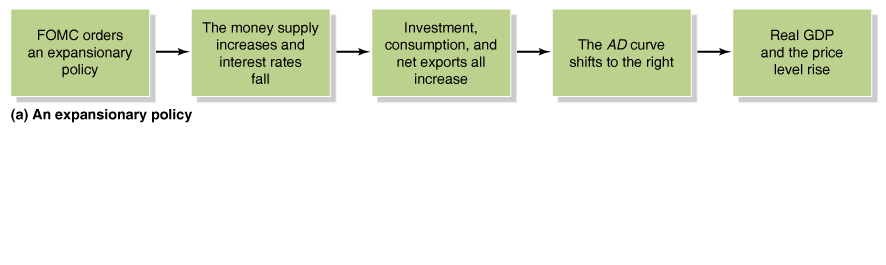
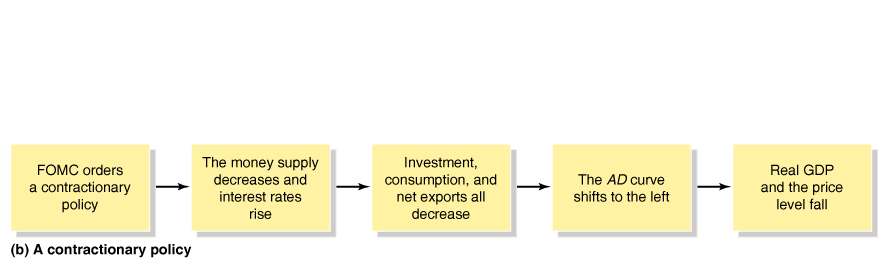
The Federal Open Market Committee (FOMC) can implement either expansionary or contractionary monetary policy to achieve macroeconomic goals such as high employment and price stability.
Expansionary Policy: Used during recessions to stimulate the economy by increasing the money supply and lowering interest rates.
Contractionary Policy: Used when the economy is overheating to reduce inflation by decreasing the money supply and raising interest rates.
The Effects of Monetary Policy on Real GDP and the Price Level
Monetary policy shifts the aggregate demand (AD) curve:
Expansionary Policy: Shifts AD to the right, increasing real GDP and the price level.
Contractionary Policy: Shifts AD to the left, decreasing real GDP and the price level.
Current Interest Rates and Policy Tools
Discount Rate and Federal Funds Rate
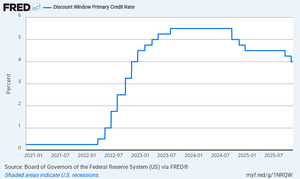
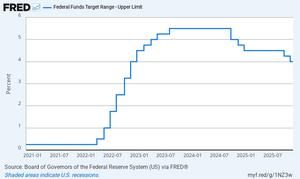
The discount rate is the interest rate the Fed charges banks for short-term loans. The federal funds rate is the rate banks charge each other for overnight loans. Both are key tools for implementing monetary policy.
Quantitative Easing and the Fed’s Balance Sheet
Unconventional Monetary Policy
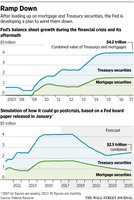
During and after the 2007-2009 financial crisis, the Fed used quantitative easing (QE)—large-scale purchases of financial assets—to lower long-term interest rates and support the economy. This led to a significant expansion of the Fed’s balance sheet.
QE contributed to historically low interest rates, with some countries experiencing negative nominal rates.
The Fed later developed plans to reduce its balance sheet as the economy recovered.
Timing and Targets of Monetary Policy
Challenges in Policy Implementation
Effective monetary policy requires accurate timing. Delays in recognizing economic conditions or in the effects of policy changes can lead to suboptimal outcomes. The Fed must choose between targeting the money supply or the interest rate, but cannot control both simultaneously due to the equilibrium condition in the money market.
Monetarism: Some economists, notably Milton Friedman, argue for targeting the money supply rather than interest rates, advocating for a steady growth rule.
The Quantity Theory of Money
Long-Run Effects of Money Supply Changes
The quantity theory of money states that in the long run, changes in the money supply lead to proportional changes in the price level, with no effect on real output. This is summarized by the equation:
M: Money supply
V: Velocity of money
P: Price level
Y: Real output
Milton Friedman famously stated, “Inflation is always and everywhere a monetary phenomenon.”
The Financial Crisis of 2008-2009
Causes and Consequences
The financial crisis was triggered by a collapse in the housing market, driven by risky lending practices, the proliferation of subprime mortgages, and the packaging of these loans into complex financial products like collateralized debt obligations (CDOs). When defaults rose, the value of these assets plummeted, leading to a freeze in lending and widespread financial instability.
Government-sponsored enterprises (Fannie Mae and Freddie Mac) played a role by purchasing large quantities of risky mortgages.
Credit default swaps were used as insurance against defaults, but the scale of exposure was underestimated.
Government Response
The U.S. government and the Fed responded with emergency measures, including bailouts of major financial institutions and the $700 billion Troubled Asset Relief Program (TARP) to stabilize the banking system. New regulations were introduced to address weaknesses in the financial system, though some underlying issues remained unaddressed.
Should You Buy a House During a Recession?
During recessions, the Fed often lowers interest rates, making borrowing cheaper. If your employment is secure, buying a house during a recession can be advantageous due to lower mortgage rates. However, the risk of unemployment should be carefully considered before making a long-term financial commitment.
Summary Table: Expansionary vs. Contractionary Monetary Policy
Policy Type | Money Supply | Interest Rates | Aggregate Demand | Real GDP & Price Level |
|---|---|---|---|---|
Expansionary | Increases | Falls | Shifts Right | Rise |
Contractionary | Decreases | Rises | Shifts Left | Fall |
