 Back
BackMonetary Policy: Tools, Goals, and Economic Impact
Study Guide - Smart Notes
 Tailored notes based on your materials, expanded with key definitions, examples, and context.
Monetary Policy
Introduction to Monetary Policy
Monetary policy is a central topic in macroeconomics, focusing on how the Federal Reserve (the Fed) manages the money supply and interest rates to achieve key macroeconomic objectives. The Fed's actions are crucial for stabilizing the economy, especially during crises such as the 2007–2009 financial crisis and the Covid-19 pandemic.
Definition and Role of the Federal Reserve
- Monetary policy: The actions the Federal Reserve takes to manage the money supply and interest rates to pursue macroeconomic policy objectives. - The Fed was established in 1913 to prevent bank panics and later given broader responsibilities, including promoting maximum employment, stable prices, and moderate long-term interest rates.
Goals of Monetary Policy
The Fed pursues four main goals:
Price stability: Preventing high inflation, which erodes the purchasing power of money.
High employment: Ensuring maximum employment, production, and purchasing power.
Stability of financial markets and institutions: Providing liquidity to banks during crises to maintain confidence.
Economic growth: Encouraging stable long-run investment and growth.
Price Stability
- High inflation reduces the value of money. - The Fed uses monetary policy to control inflation, as seen in the 1970s and again in 2021. 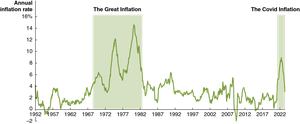
High Employment
- The Employment Act of 1946 established the federal government's responsibility to promote maximum employment. - Price stability and high employment are often referred to as the dual mandate of the Fed.
Stability of Financial Markets and Institutions
- The Fed acts as a lender of last resort, providing funds to banks and, during crises, to investment banks and other financial institutions.
Economic Growth
- Stable economic growth encourages investment and is necessary for long-term prosperity.
The Federal Funds Rate and Conducting Monetary Policy
The Fed influences aggregate demand primarily through interest rates, especially the federal funds rate.
Federal Funds Rate
- Federal funds rate: The interest rate banks charge each other for overnight loans. - The Fed sets targets for the federal funds rate and uses various tools to influence it.
Controlling the Federal Funds Rate
- The Fed uses tools such as interest on reserve balances (IORB), the discount rate, and open market operations to control the federal funds rate. 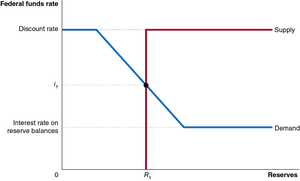
Ample-Reserves Regime
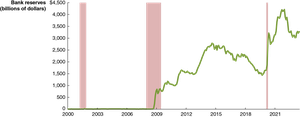
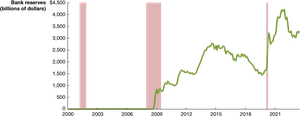
- When banks hold excess reserves, the federal funds rate equals the IORB. - The Fed can adjust the IORB to influence the federal funds rate. 

Administered Rates and Floor Operating System
- The Fed uses administered rates (IORB and ONRRP) to tightly control the federal funds rate, establishing a floor operating system.
Quantitative Easing and Forward Guidance
- Quantitative easing: The Fed buys long-term securities to lower long-term interest rates and increase aggregate demand, especially when the federal funds rate is at the zero lower bound. - Forward guidance: The Fed communicates its future policy intentions to influence expectations and long-term rates. 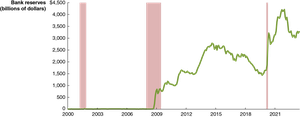
Summary of Monetary Policy Tools
Interest on reserve balances (IORB): Manages the federal funds rate.
Interest rate on overnight reverse repurchase agreements (ONRRP): Sets a lower bound for the federal funds rate.
Quantitative easing: Used when the federal funds rate is at the zero lower bound.
Forward guidance: Signals future policy intentions.
Open market operations: Buying and selling Treasury securities to adjust reserves.
Discount rate: The rate charged for discount loans.
Reserve requirements: Minimum reserves banks must hold (not actively used since 2020).
Monetary Policy and Economic Activity
The Fed uses aggregate demand and supply models to analyze the effects of monetary policy on real GDP and the price level.
Interest Rates and Aggregate Demand
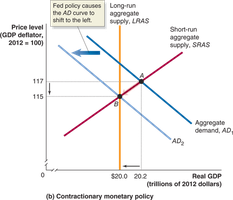
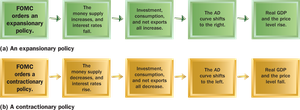
- Lower interest rates increase consumption, investment, and net exports, raising aggregate demand. - Higher interest rates decrease these components, reducing aggregate demand.
Expansionary and Contractionary Monetary Policy
- Expansionary monetary policy: Decreases interest rates to increase real GDP when it is below potential. - Contractionary monetary policy: Increases interest rates to reduce inflation when real GDP exceeds potential. 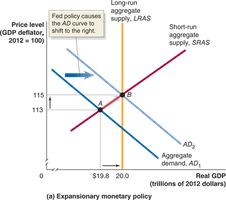
Limitations of Monetary Policy
- The Fed cannot perfectly offset recessions due to lags in data and policy implementation. - Poorly timed policy can lead to excessive inflation or more severe recessions. 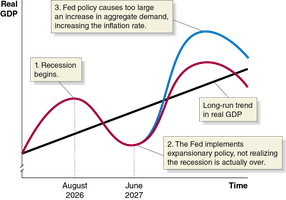
Forecasting Challenges
- Accurate forecasts are essential for effective policy, but economic variables are often revised, complicating decision-making. 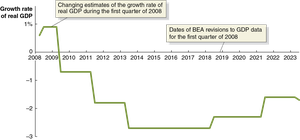
Expansionary vs. Contractionary Policy
Dynamic Aggregate Demand and Aggregate Supply Model
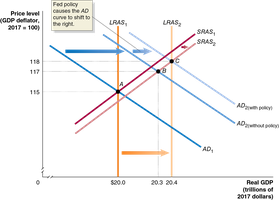
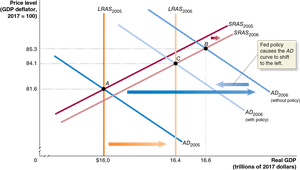
The dynamic AD-AS model accounts for annual increases in potential GDP and inflation.
Expansionary Policy in the Dynamic Model
- The Fed uses expansionary policy when aggregate demand growth is insufficient, keeping real GDP at potential but increasing inflation. 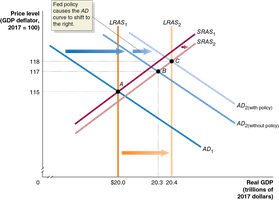
Contractionary Policy in the Dynamic Model
- The Fed uses contractionary policy when aggregate demand growth is excessive, reducing inflation but lowering real GDP. 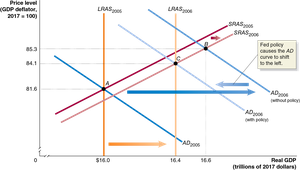
Setting Monetary Policy Targets
Money Supply vs. Interest Rate Targeting
- Monetarists advocated targeting the money supply, but the relationship between money supply and real GDP broke down, so the Fed now targets interest rates.
The Taylor Rule
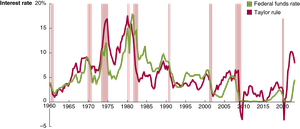
- The Taylor rule links the federal funds rate target to economic variables: equilibrium real rate, inflation gap, and output gap. - Formula: 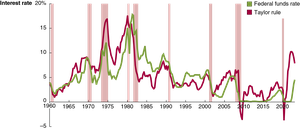
Inflation Targeting
- The Fed announced a 2% average inflation target in 2012, allowing flexibility during severe recessions. - Arguments for: clarity, improved planning, accountability. - Arguments against: reduced flexibility, reliance on accurate forecasts, less focus on other goals.
Average-Inflation Targeting
- The Fed aims for inflation to average 2% over time, adjusting policy to compensate for periods of below-target inflation.
Nominal GDP Targeting
- Some economists propose targeting nominal GDP growth, but as of 2023, no central banks have adopted this approach.
Inflation Measures Used by the Fed
- The Fed uses the "core PCE" (Personal Consumption Expenditures index excluding food and energy) for its inflation target, as it is more stable than CPI.
Fed Policies During the 2007–2009 and 2020 Recessions
Financial Crises and Bubbles
- Asset bubbles occur when prices are too high relative to underlying value, often due to herding behavior and speculation. - The housing bubble burst led to widespread defaults and a credit crunch.
Mortgage Market Changes
- The creation of Fannie Mae and Freddie Mac enabled a secondary market for mortgages, increasing funds available for home loans. - Investment banks packaged mortgages into securities, increasing risk exposure.
Fed Responses to Crises
- During the 2007–2009 crisis, the Fed provided liquidity to banks and other institutions, sometimes facing criticism for moral hazard. - During the Covid-19 recession, the Fed cut rates to zero and introduced new lending facilities to prevent a credit crunch.
Online Appendix: The Money Market and the Fed
Money Market Model
- The money market model explains how the Fed can affect short-term interest rates by controlling the money supply. - Higher interest rates reduce the quantity of money demanded, as alternatives become more attractive.
Shifts in Money Demand
- Money demand increases with higher real GDP or price level, and decreases with lower values.
Managing the Money Supply
- The Fed uses open market operations to buy or sell Treasury securities, affecting the money supply and short-term interest rates.
Interest Rate Effects
- Increasing the money supply lowers short-term interest rates; decreasing it raises rates.
Interest Rate Models
- Loanable funds model: Long-term real interest rates, relevant for investment. - Money market model: Short-term nominal interest rates, directly affected by the Fed.
Monetary Policy Targeting
- The Fed cannot target both the money supply and interest rate simultaneously, as they are linked through the money demand curve.
Monetary Policy Tool | Main Purpose |
|---|---|
Interest on Reserve Balances (IORB) | Manage federal funds rate |
Overnight Reverse Repurchase Agreements (ONRRP) | Set lower bound for federal funds rate |
Quantitative Easing | Lower long-term rates at zero lower bound |
Forward Guidance | Signal future policy intentions |
Open Market Operations | Adjust reserves and money supply |
Discount Rate | Lender of last resort |
Reserve Requirements | Minimum reserves (not actively used) |
Conclusion
Monetary policy is a complex and dynamic tool for managing the economy. The Fed uses a variety of instruments to achieve its goals, but faces challenges in forecasting, implementation, and balancing multiple objectives. Understanding these mechanisms is essential for macroeconomics students preparing for exams and real-world analysis.
