 Back
BackMonetary Policy: Tools, Goals, and Macroeconomic Impact
Study Guide - Smart Notes
 Tailored notes based on your materials, expanded with key definitions, examples, and context.
Monetary Policy
Introduction to Monetary Policy
Monetary policy refers to the actions undertaken by a nation's central bank—in the United States, the Federal Reserve (the Fed)—to manage the money supply and interest rates in pursuit of macroeconomic objectives. These objectives include price stability, high employment, stability of financial markets and institutions, and economic growth. The Fed's role has evolved since its creation in 1913, expanding from preventing bank panics to actively managing the economy.

The Goals of Monetary Policy
Price Stability: Maintaining low and stable inflation preserves the purchasing power of money and supports economic planning. High inflation, as seen in the 1970s and again in 2021, erodes money's value and can destabilize the economy.
High Employment: The Employment Act of 1946 established the federal government's responsibility to promote maximum employment, production, and purchasing power. The Fed aims to minimize cyclical unemployment, forming the "dual mandate" with price stability.
Stability of Financial Markets and Institutions: The Fed acts as a lender of last resort, providing liquidity to banks and, in crises, to other financial institutions to maintain confidence and prevent systemic collapse.
Economic Growth: Stable economic growth encourages long-term investment. While the Fed can influence growth by achieving the other three goals, fiscal policy may be more effective for long-run growth.
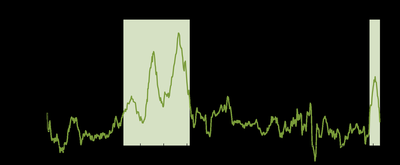
The Federal Funds Rate and Conduct of Monetary Policy
The Federal Funds Rate
The federal funds rate is the interest rate banks charge each other for overnight loans. It is a key short-term interest rate that the Fed targets to influence broader economic activity. While the Fed cannot directly set this rate, it uses policy tools to keep it within a target range (e.g., 5.25–5.50% in October 2023).
Monetary Policy Types and Tools
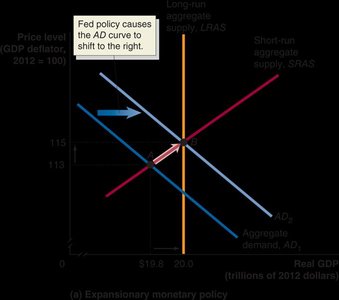
Expansionary Monetary Policy: Lowering the federal funds rate to stimulate aggregate demand, real GDP, and employment.
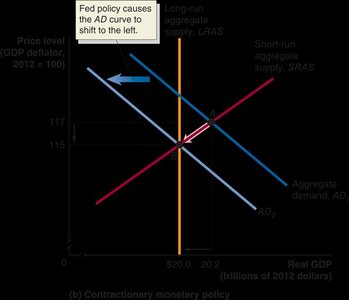
Contractionary Monetary Policy: Raising the federal funds rate to slow aggregate demand, reduce inflation, and prevent the economy from overheating.
Type of Policy | Purpose | Method |
|---|---|---|
Expansionary | Increase aggregate demand, real GDP, employment | Lower federal funds rate |
Contractionary | Decrease aggregate demand, real GDP, employment | Raise federal funds rate |
Regimes for Controlling the Federal Funds Rate
Scarce-Reserves Regime: The Fed adjusts the supply of reserves to control the rate.
Ample-Reserves Regime: The Fed adjusts the interest rate on reserve balances (IORB).
Key Monetary Policy Tools
Interest on Reserve Balances (IORB): Sets a floor for the federal funds rate.
Overnight Reverse Repurchase Agreements (ON RRP): Provides a lower bound for the federal funds rate by allowing financial firms to invest funds overnight with the Fed.
Open Market Operations: Buying and selling Treasury securities to adjust reserves and influence the federal funds rate.
Discount Rate: The rate charged by the Fed for loans to banks; acts as a ceiling for the federal funds rate.
Reserve Requirements: Minimum reserves banks must hold; rarely used since March 2020.
Quantitative Easing: Large-scale asset purchases when rates are near zero.
Forward Guidance: Communicating future policy intentions to influence expectations.
Monetary Policy and Economic Activity
Transmission Mechanism
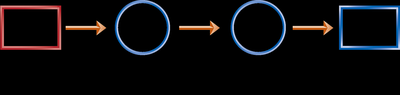
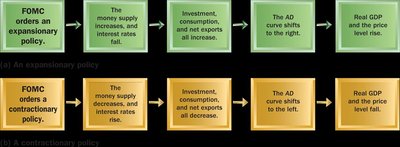
The Fed influences aggregate demand primarily through interest rates. Lower interest rates encourage consumption (especially of durable goods), investment (by making borrowing cheaper and stocks more attractive), and can affect net exports by influencing the exchange rate.
Expansionary vs. Contractionary Policy in the AD-AS Model
Expansionary Policy: Used when real GDP is below potential GDP. The Fed lowers interest rates, shifting aggregate demand right, increasing output and employment.
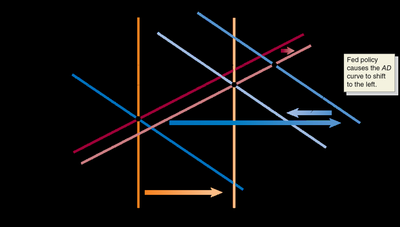
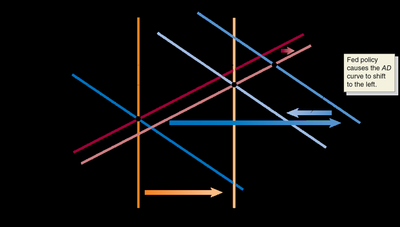
Contractionary Policy: Used when the economy is above potential GDP and inflation is a concern. The Fed raises interest rates, shifting aggregate demand left, reducing inflationary pressures.
Limitations and Timing Issues
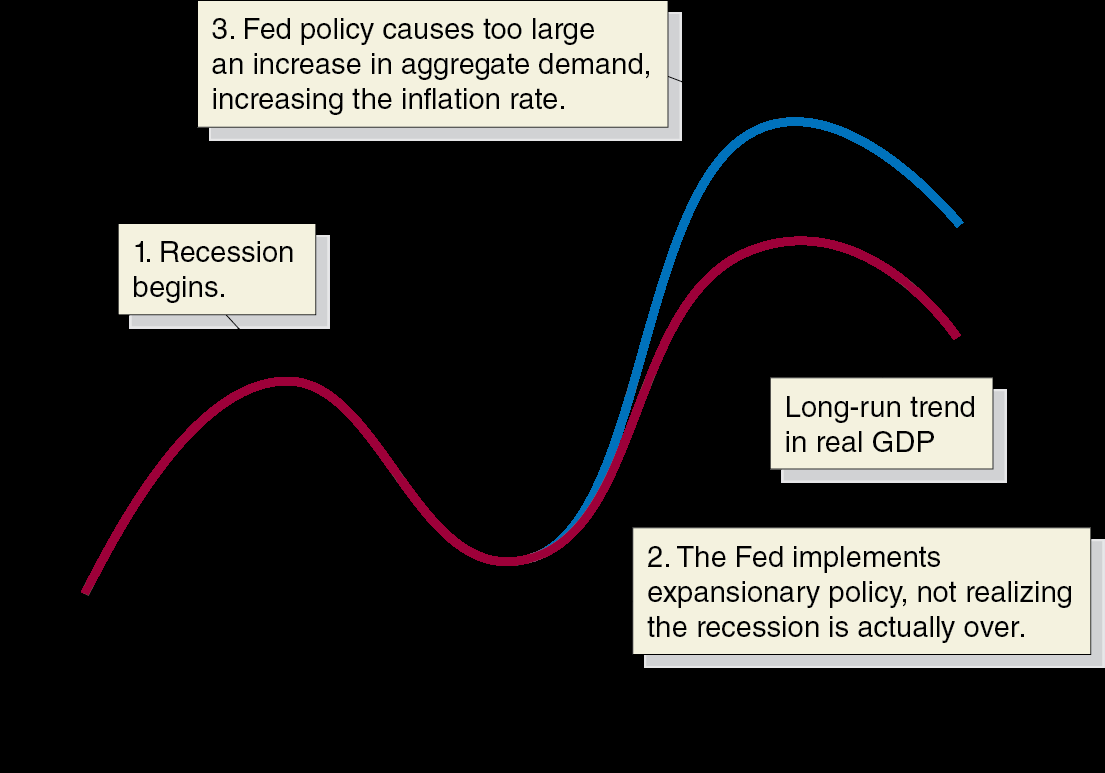
Monetary policy is subject to information lags and forecasting errors. The Fed may not know the current state of the economy in real time, making it difficult to time policy actions perfectly. Poorly timed policy can exacerbate economic fluctuations, such as causing inflation if expansionary policy is implemented after a recession has already ended.
Summary Table: Expansionary vs. Contractionary Policy Effects
Policy | Money Supply | Interest Rates | AD Curve | Real GDP & Price Level |
|---|---|---|---|---|
Expansionary | Increases | Falls | Shifts right | Rise |
Contractionary | Decreases | Rises | Shifts left | Fall |
Monetary Policy in the Dynamic Aggregate Demand and Aggregate Supply Model
Dynamic AD-AS Model
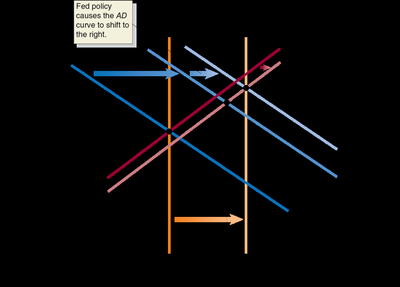
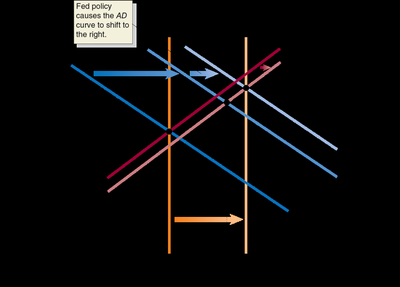
The dynamic AD-AS model incorporates annual increases in potential GDP (long-run aggregate supply), aggregate demand, and the price level. The Fed uses monetary policy to keep real GDP close to potential GDP and to manage inflation over time.
Expansionary Policy Example
If the Fed forecasts that aggregate demand will not rise fast enough, it can use expansionary policy to shift AD right, keeping real GDP at potential but resulting in higher inflation than otherwise.
Contractionary Policy Example
If the Fed expects aggregate demand to rise too quickly, risking excessive inflation, it can raise the federal funds rate (contractionary policy), resulting in lower real GDP and less inflation than would otherwise occur.
Key Equations and Concepts
Federal Funds Rate: The target rate set by the FOMC for overnight interbank loans.
Aggregate Demand (AD): The total demand for goods and services in the economy at different price levels.
Aggregate Supply (AS): The total supply of goods and services that firms in an economy plan on selling during a specific time period.
Interest Rate Transmission: Lower interest rates → higher consumption/investment → higher AD → higher real GDP and price level.
Example Equation:
Money Multiplier (for reserve requirements):
Additional info: The effectiveness of monetary policy depends on the reliability of the transmission mechanism and the accuracy of economic forecasts. The Fed's actions can be constrained by the zero lower bound on interest rates, requiring unconventional tools like quantitative easing and forward guidance.
