 Back
BackMonetary Policy Tools: Mechanisms and Effects
Study Guide - Smart Notes
 Tailored notes based on your materials, expanded with key definitions, examples, and context.
Monetary Policy: Tools and Mechanisms
Introduction to Monetary Policy
Monetary policy refers to the actions and communications by a central bank, such as the Federal Reserve (the Fed), aimed at achieving macroeconomic objectives like full employment and price stability. The Fed manages the money supply and influences interest rates using several key tools, which in turn affect economic activity.
The Three Main Tools of Monetary Policy
Overview of Policy Tools
Forward Guidance
Administered Interest Rates
Open Market Operations (OMO) / Quantitative Easing
Each tool serves a distinct function in influencing the money supply, interest rates, and overall economic conditions.
Tool #1: Forward Guidance
Definition and Purpose
Forward guidance is the communication strategy used by the Federal Reserve, especially after Federal Open Market Committee (FOMC) meetings, to inform the public about the Fed’s economic outlook and intended policy actions. This includes setting a target range for the federal funds rate, which is the interest rate banks charge each other for overnight loans of reserves.
Influence: Shapes expectations and financial decisions of households and businesses.
Transmission: Affects lending, borrowing, and ultimately the money supply.
The Federal Funds Rate
The federal funds rate is a key benchmark for short-term interest rates in the U.S. It is not directly set by the Fed but is influenced by the Fed’s policy actions and communications. The Fed announces a target range (e.g., 3.5% to 3.75%) and uses its other tools to keep the market rate within this range.
Tool #2: Administered Interest Rates
Types of Administered Rates
The Fed directly sets three main interest rates to influence market-determined rates:
Interest on Reserve Balances (IORB): Paid to banks on reserves held at the Fed.
Overnight Reverse Repurchase Rate (ON RRP): Paid to eligible nonbank financial institutions for overnight loans to the Fed.
Discount Rate: Charged to banks for short-term borrowing from the Fed.
Interest on Reserve Balances (IORB)
Introduced in 2008, the IORB is the primary tool for influencing short-term interest rates. By adjusting the IORB, the Fed can encourage or discourage banks from lending in the money market:
Lower IORB: Encourages banks to lend more, increasing the money supply (used to fight recession).
Higher IORB: Encourages banks to hold reserves, reducing the money supply (used to fight inflation).
If the IORB is set above market rates, banks prefer to keep reserves at the Fed, reducing lending and raising market interest rates. This slows borrowing and spending, shifting aggregate demand (AD) left and reducing inflation and GDP growth.
Overnight Reverse Repurchase Rate (ON RRP)
The ON RRP is the rate paid to nonbank financial institutions for overnight loans to the Fed, secured by Treasury securities. By adjusting this rate, the Fed can influence the willingness of these institutions to lend in the money market:
High ON RRP: Attracts funds to the Fed, reducing money market lending and raising interest rates (fights inflation).
Low ON RRP: Encourages lending in the money market, increasing the money supply and lowering interest rates (fights recession).
The combination of IORB and ON RRP rates establishes a "floor" for money market rates, giving the Fed indirect control over the broader interest rate environment.
Discount Rate
The discount rate is the interest rate at which banks can borrow directly from the Fed, typically as a last resort. It is set above the IORB to prevent arbitrage (borrowing at the discount rate and depositing at the higher IORB). This tool provides emergency liquidity to banks but is not the primary means of influencing market rates.
Effectiveness of Administered Rates
The close alignment between the IORB and the federal funds rate demonstrates the effectiveness of the Fed’s tools in guiding market rates.
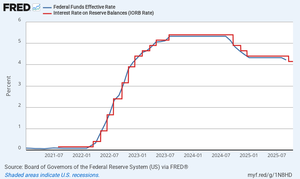
Additional info: The chart shows the Federal Funds Effective Rate and the Interest Rate on Reserve Balances (IORB) closely tracking each other, indicating the Fed's ability to influence market rates through administered rates.
Tool #3: Open Market Operations (OMO) / Quantitative Easing
Definition and Mechanism
Open market operations (OMO) involve the buying and selling of government securities (mainly U.S. Treasury bonds) in the open market. These transactions are conducted by the New York Fed’s trading desk through primary dealers. OMO is used to influence long-term interest rates and the money supply, especially when reserves are ample and short-term rates are less responsive.
OMO: The Fed Buys Bonds
When the Fed buys bonds:
Increases demand for bonds, raising their price and lowering their yield (interest rate).
Injects new money into the economy, increasing the money supply.
Lowers long-term interest rates, encouraging borrowing and investment.
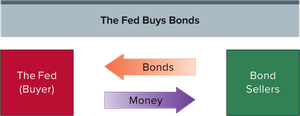
Example: During a recession, the Fed may buy bonds to stimulate economic activity by lowering interest rates and increasing the money supply.
OMO: The Fed Sells Bonds
When the Fed sells bonds:
Increases the supply of bonds, lowering their price and raising their yield (interest rate).
Removes money from the economy, decreasing the money supply.
Raises long-term interest rates, discouraging borrowing and spending.
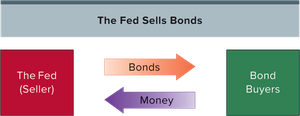
Example: To combat inflation, the Fed may sell bonds to reduce the money supply and increase interest rates.
Summary Table: Effects of Open Market Operations
Fed Action | Bond Prices | Interest Rates | Money Supply |
|---|---|---|---|
Buys Bonds | Increase | Decrease | Increase |
Sells Bonds | Decrease | Increase | Decrease |
Key Terms and Formulas
Federal Funds Rate: The interest rate at which depository institutions lend reserve balances to other depository institutions overnight.
Interest on Reserve Balances (IORB): The rate paid by the Fed on reserves held by banks.
Overnight Reverse Repurchase Rate (ON RRP): The rate paid by the Fed to nonbank financial institutions for overnight loans.
Discount Rate: The rate at which banks can borrow from the Fed.
Open Market Operations (OMO): The buying and selling of government securities to influence the money supply and interest rates.
Bond Price and Interest Rate Relationship
The relationship between bond prices and interest rates is inverse. When the Fed buys bonds, prices rise and yields fall; when it sells bonds, prices fall and yields rise.
Formula for Bond Yield:
Conclusion
The Federal Reserve uses a combination of forward guidance, administered interest rates, and open market operations to achieve its macroeconomic goals. Understanding these tools is essential for analyzing how monetary policy influences the broader economy, including interest rates, inflation, and economic growth.
