 Back
BackMoney and the Financial System: Functions, Types, and Money Creation
Study Guide - Smart Notes
 Tailored notes based on your materials, expanded with key definitions, examples, and context.
Money and the Financial System
Introduction to Money
Money is a fundamental component of modern economies, serving as a medium that facilitates exchange, measures value, and stores wealth. Before the invention of money, societies relied on barter, which required a double coincidence of wants—each party had to have what the other desired. The development of money solved this inefficiency and enabled more complex economic activity.
What Can Serve as Money?
Not all items are suitable to serve as money. Economists identify several criteria that a good must meet to function effectively as a medium of exchange:
Acceptability: The good must be widely accepted by people in exchange for goods and services.
Standardized Quality: Units of the good must be identical so that each is interchangeable.
Durability: The good must not spoil or degrade quickly, preserving value over time.
Valuable Relative to Weight: It must be easy to transport significant value in reasonable quantities.
Divisibility: The good must be easily divided into smaller units to accommodate transactions of varying sizes.
Historically, various items have served as money, including cowrie shells, precious metals, beaver pelts, and even cigarettes in prisons. Today, most economies use fiat money, which has no intrinsic value but is accepted as legal tender by government decree.

Commodity Money vs. Fiat Money
Commodity Money: Has intrinsic value independent of its use as money (e.g., gold, silver, shells).
Fiat Money: Has no intrinsic value but is accepted as money because of government regulation or law.
While commodity money can be inefficient due to its reliance on physical resources, fiat money allows for greater flexibility in the money supply.
The Functions of Money
For an item to be considered money, it must fulfill four key functions:
Medium of Exchange: Used to buy and sell goods and services, eliminating the need for barter.
Unit of Account: Provides a standard measure of value, making it easier to compare prices.
Store of Value: Maintains value over time, allowing individuals to save purchasing power for future use.
Standard of Deferred Payment: Facilitates borrowing and lending by serving as a standard for future payments.
Modern Money: Currency and Beyond
When most people think of money, they imagine coins and paper currency. However, the money supply includes more than just physical currency. It also encompasses checking accounts, savings deposits, and other liquid assets.

Is Bitcoin Money?
Bitcoin and other cryptocurrencies have emerged as alternative forms of money. To be considered money, Bitcoin must fulfill the four functions listed above. While it can serve as a medium of exchange and a store of value, its acceptance as a unit of account and standard of deferred payment is limited compared to traditional currencies.

Measuring the Money Supply
Definitions of the Money Supply
Economists use two main measures to define the money supply in the United States:
M1 (Narrow Definition): Includes currency (not held by banks or the government), checking account deposits, and travelers' checks.
M2 (Broader Definition): Includes all of M1 plus savings deposits, small-denomination time deposits (certificates of deposit, or CDs), and money market fund shares.
For example, if you withdraw money from your checking account to buy a CD, M1 decreases but M2 remains unchanged because the funds are still part of the broader money supply.
Credit Cards and Debit Cards
Credit Cards: Not considered money; they are a means of obtaining a loan. The transaction is only complete when the credit card bill is paid using money from a checking account or other liquid asset.
Debit Cards: Provide access to money in checking accounts but are not money themselves.
Important Distinction: Money is not the same as income or wealth. Wealth is the value of assets minus debts, income is earnings over a period, and money is what is held in currency and checking accounts.
How Banks Create Money
The Role of Banks and Financial Institutions
Banks and other financial institutions play a crucial role in the economy by channeling funds from savers (lenders) to borrowers. Through accepting deposits and making loans, banks are able to create money within the financial system.
Fractional Reserve Banking
Modern banks operate under a fractional reserve banking system, where they keep only a fraction of deposits as reserves and lend out the rest. Typically, this reserve ratio is around 10%–15%, though the Federal Reserve can adjust this requirement. In March 2020, the reserve requirement was set to 0% for checking account deposits.
Bank Balance Sheets and T-Accounts
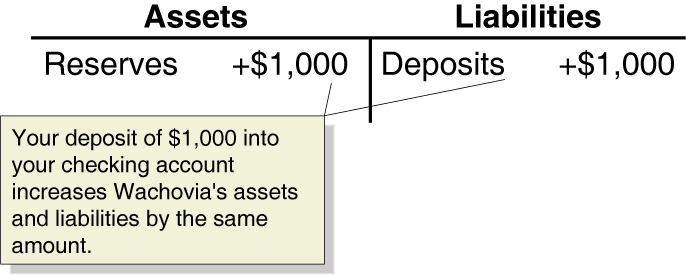
A bank's balance sheet shows its assets and liabilities. When a deposit is made, both assets (reserves) and liabilities (deposits) increase by the same amount. Excess reserves (reserves above the required minimum) can be loaned out to borrowers, creating new money in the process.
The Process of Money Creation
When a bank makes a loan, the funds are typically deposited in another bank, which can then lend out a portion of those funds, and the process repeats. This cycle leads to the creation of new deposits and expands the money supply.
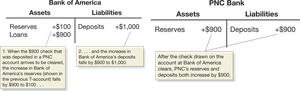
For example, if a bank receives a $1,000 deposit and loans out $900, the recipient of the loan deposits the $900 in another bank, which then loans out $810, and so on. This process multiplies the initial deposit throughout the banking system.
The Money Multiplier
The money multiplier quantifies the maximum potential increase in the money supply from an initial deposit. It is calculated as the reciprocal of the reserve ratio:
For example, with a 10% reserve ratio (), the money multiplier is $10$:
This means that an initial deposit of could potentially increase the money supply by up to through repeated lending and depositing.
Interest on Reserve Balances
Since October 2008, the Federal Reserve has paid interest on reserve balances held by banks. This policy encourages banks to hold more reserves than the minimum required, shifting the system from a scarce-reserves regime to an ample-reserves regime. The interest rate paid is known as the Interest on Reserve Balances (IORB).
Summary Table: Types of Money and Their Characteristics
Type of Money | Intrinsic Value | Examples | Modern Use |
|---|---|---|---|
Commodity Money | Yes | Gold, Silver, Cowrie Shells | Rare |
Fiat Money | No | U.S. Dollar, Euro | Common |
Cryptocurrency | No (digital) | Bitcoin, Ethereum | Emerging |
Additional info: The notes above expand on the basic textbook content by clarifying the distinction between money, income, and wealth, and by providing context for the role of cryptocurrencies in the modern financial system. The summary table is inferred for clarity and exam preparation.
