 Back
BackChapter 12 for final exam studying
Study Guide - Smart Notes
 Tailored notes based on your materials, expanded with key definitions, examples, and context.
Money and Bonds
Functions and Characteristics of Money
Money is defined as anything that is widely accepted as payment for goods and services. It serves three primary functions in the economy:
Medium of Exchange: Money solves the barter problem of the double coincidence of wants by providing a universally accepted means of payment.
Unit of Account: Money provides a standard measure for pricing goods and services, making economic calculation possible.
Store of Value: Money allows individuals to transfer purchasing power from the present to the future, enabling saving and deferred spending.
The interest rate is the price of holding or borrowing money. It represents:
The opportunity cost of holding money instead of interest-bearing assets like bonds.
The cost paid when borrowing money.
Bonds and Loanable Funds
A bond is a financial asset in which the borrower promises to repay the original value at a specific future date and make regular fixed payments. Bonds are the most common form of loanable funds—financial assets for lending and borrowing that pay interest.
Money is the most liquid asset but pays no interest.
Bonds pay interest but are less liquid than money.
Individuals choose between holding money (for liquidity) and bonds (for interest income) based on their needs and the prevailing interest rate.

Interest Rates and the Loanable Funds Market
Determination of Interest Rates
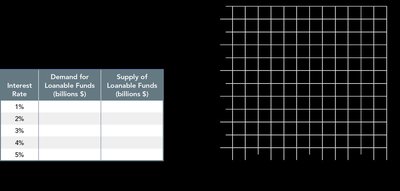
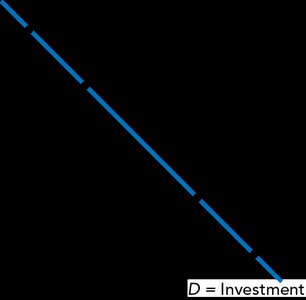
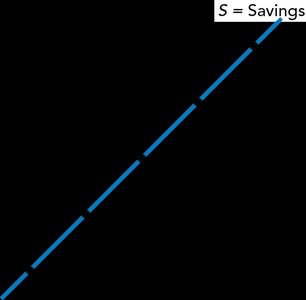
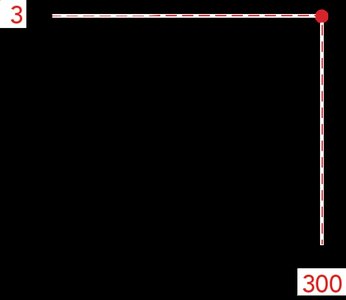
Long-run interest rates are determined in the loanable funds market, where savers supply funds and borrowers demand them. The interaction between the supply of savings and the demand for borrowing determines the equilibrium interest rate.
Suppliers: Savers who deposit funds in bank accounts or buy bonds.
Demanders: Borrowers, including consumers, businesses, and governments.
Money Supply and the Banking System
Forms of Money
Money can take several forms:
Commodity Money: Saleable products with alternative uses (e.g., gold, silver).
Convertible Paper Money: Paper money that can be exchanged for a commodity like gold.
Fiat Money: Government-issued currency with no intrinsic value, accepted by decree.
Deposit Money: Balances in bank accounts that can be withdrawn on demand.
The Bank of Canada and Money Supply
The Bank of Canada is the central bank, responsible for supervising commercial banks, regulating the money supply, and conducting monetary policy. Its roles include:
Issuing currency
Acting as banker to commercial banks and the government
Lender of last resort
Managing foreign currency reserves and national debt
Conducting monetary policy to achieve steady growth, full employment, and stable prices

Creation of Money by Commercial Banks
Commercial banks create money through the process of making loans. When a bank issues a loan, it creates a demand deposit in the borrower's account, increasing the money supply. The total supply of money in Canada consists of:
M1+: Currency in circulation plus demand deposits
M2+: M1+ plus other less liquid deposits


Monetary Policy and the Bank of Canada
Objectives and Tools of Monetary Policy
The Bank of Canada uses monetary policy to achieve price stability, steady growth, and full employment. The main objective is to keep inflation within a target range (1–3% annually, aiming for 2%). The main tool is the overnight rate—the interest rate banks charge each other for one-day loans.
Deposit Rate: Interest earned by banks for deposits at the Bank of Canada (lower bound of the operating band).
Bank Rate: Interest paid by banks for borrowing from the Bank of Canada (upper bound of the operating band).
Operating Band: The range between the deposit rate and the bank rate.

How the Bank of Canada Adjusts Interest Rates
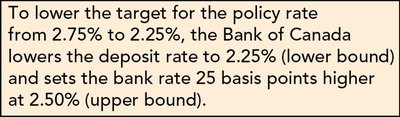
The Bank of Canada adjusts the policy rate by moving the operating band. For example, to lower the policy rate by 0.5%, both the deposit rate and the bank rate are reduced by 0.5%.



Arbitrage and the Overnight Rate
Arbitrage ensures that the overnight rate stays close to the deposit rate. If the overnight rate rises above the deposit rate, banks withdraw funds from the Bank of Canada and lend in the overnight market, increasing supply and lowering the rate. If the overnight rate falls below the deposit rate, banks borrow in the overnight market and deposit funds at the Bank of Canada, increasing demand and raising the rate.
Transmission Mechanisms of Monetary Policy
Domestic Transmission Mechanism
Changes in the Bank of Canada’s target interest rates affect aggregate demand (AD = C + I + G + X – IM) through the domestic monetary transmission mechanism:
Lower interest rates increase consumption (C) and investment (I), acting as a positive demand shock.
Higher interest rates decrease consumption and investment, acting as a negative demand shock.
International Transmission Mechanism
Interest rate changes also affect the exchange rate and net exports:
Lower interest rates lead to a depreciating Canadian dollar (C$), increasing net exports (X – IM) and inflation.
Higher interest rates lead to an appreciating C$, decreasing net exports and inflation.

Expansionary and Contractionary Monetary Policy
Monetary policy can be used to moderate the economy:
Expansionary Policy: Lowering interest rates to correct a recessionary gap, increasing aggregate demand, reducing unemployment, and increasing inflation.
Contractionary Policy: Raising interest rates to correct an inflationary gap, decreasing aggregate demand, increasing unemployment, and reducing inflation.
Summary Table: Effects of Monetary Policy
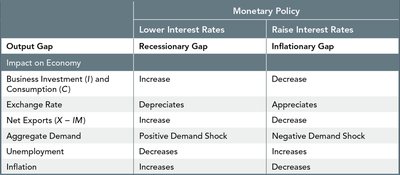
The table below summarizes the effects of monetary policy on key economic variables:
Output Gap | Monetary Policy | |
|---|---|---|
Lower Interest Rates (Recessionary Gap) | Raise Interest Rates (Inflationary Gap) | |
Business Investment (I) and Consumption (C) | Increase | Decrease |
Exchange Rate | Depreciates | Appreciates |
Net Exports (X – IM) | Increase | Decrease |
Aggregate Demand | Positive Demand Shock | Negative Demand Shock |
Unemployment | Decreases | Increases |
Inflation | Increases | Decreases |
Key Equations
Aggregate Demand:
Money Supply (M1+):
Money Supply (M2+):
