 Back
Backchapter 11 Midterm 2
Study Guide - Smart Notes
 Tailored notes based on your materials, expanded with key definitions, examples, and context.
The Money Market and Monetary Policy
Overview of Fiscal and Monetary Policy
Fiscal and monetary policies are central tools used by governments and central banks to influence aggregate spending and economic activity. Fiscal policy involves changes in government spending and taxation, while monetary policy involves changes in the money supply and interest rates.
Fiscal Policy: Adjusts aggregate expenditure (AE) through government spending (G) and taxes (T).
Monetary Policy: Alters the money supply, affecting interest rates and aggregate spending.


The Federal Funds Market
The federal funds market is where banks lend reserves to each other overnight. The equilibrium interest rate is determined by the supply and demand for reserves.
Federal Funds Rate: The interest rate at which depository institutions lend balances to each other overnight.
Open Market Operations: The Federal Reserve uses these to adjust the supply of reserves and influence the federal funds rate.
The Market for Money
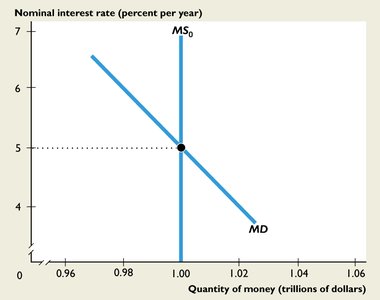
The money market determines the nominal interest rate based on the supply and demand for money.
Money Demand (Md): The amount of money people wish to hold, influenced by the nominal interest rate (negative relationship), real GDP (positive), price level (positive), and financial innovation.
Money Supply (Ms): Set by the central bank, typically vertical in the short run.
Shifts in Money Supply and Interest Rates
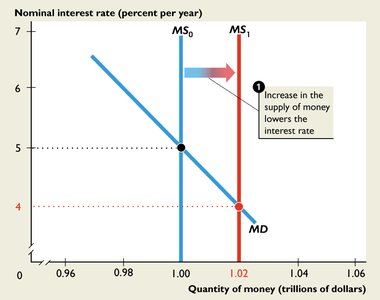
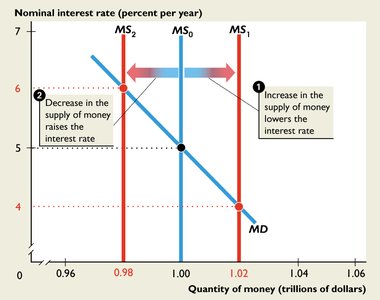
Changes in the money supply shift the supply curve, affecting the equilibrium interest rate.
Increase in Money Supply: Lowers the interest rate, stimulating investment and aggregate spending.
Decrease in Money Supply: Raises the interest rate, reducing investment and aggregate spending.
The Federal Reserve and Monetary Policy
Tight vs. Easy Monetary Policy
Tight Monetary Policy: Contracts the money supply to restrain the economy and control inflation.
Easy Monetary Policy: Expands the money supply to stimulate the economy and reduce unemployment.
Interest Rate Changes and Transmission
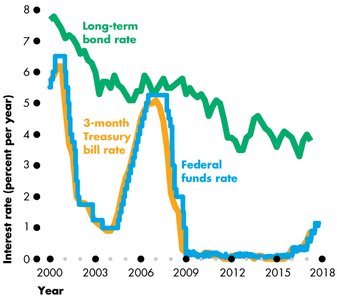
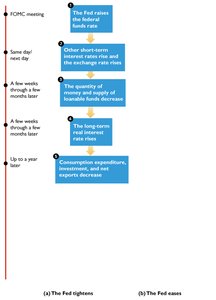
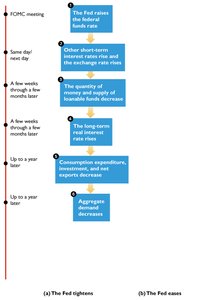
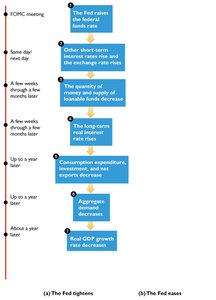
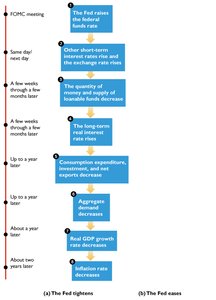
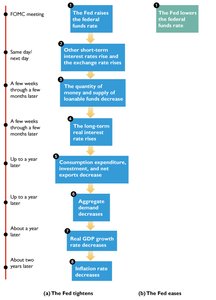
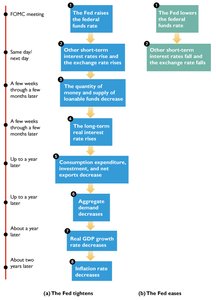
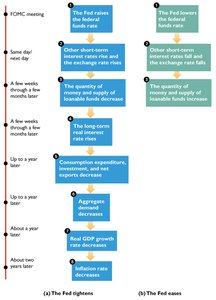
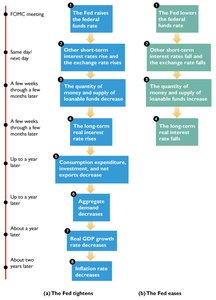
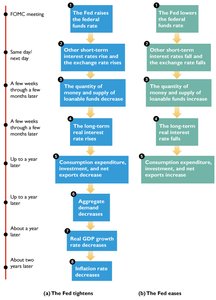
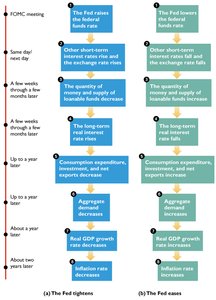
The Federal Reserve influences short-term and long-term interest rates, which affect investment, consumption, and aggregate demand.
Federal Funds Rate: Targeted by the Fed to influence other interest rates.
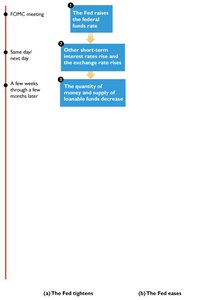
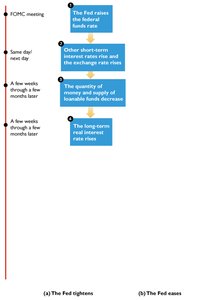
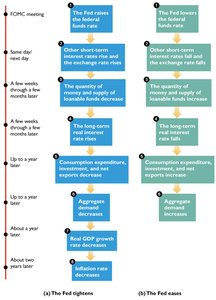
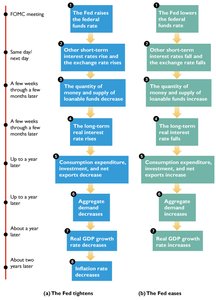
Transmission Mechanism: Changes in the federal funds rate affect other rates, investment, and ultimately aggregate output.
Links Between the Goods Market and the Money Market
Key Links
The goods market and money market are interconnected through three main channels:
Income and Money Demand: Higher income increases the demand for money.
Interest Rate and Investment: Lower interest rates stimulate investment spending.
Price Level and Money Demand: Higher price levels increase money demand, affecting aggregate expenditure.
Monetary Policy Effects: Expansionary and Contractionary
Expansionary Policy
Expansionary monetary and fiscal policies aim to increase aggregate output and reduce unemployment.
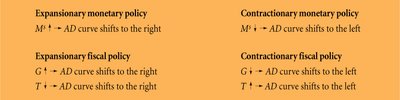
Expansionary Monetary Policy: Increase in money supply (), AD curve shifts right.
Expansionary Fiscal Policy: Increase in government spending () or decrease in taxes (), AD curve shifts right.
Contractionary Policy
Contractionary policies aim to reduce aggregate output and control inflation.
Contractionary Monetary Policy: Decrease in money supply (), AD curve shifts left.
Contractionary Fiscal Policy: Decrease in government spending () or increase in taxes (), AD curve shifts left.
Aggregate Expenditure and Aggregate Demand
Equilibrium Condition
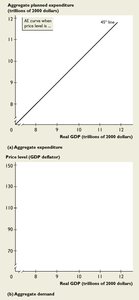
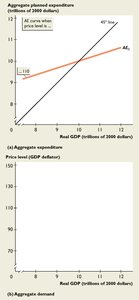
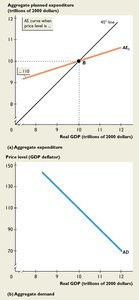
At equilibrium, aggregate planned expenditure equals aggregate output:
Formula:
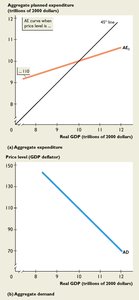
Aggregate Demand Curve: Shows the relationship between the price level and the quantity of real GDP demanded.
Why is the Aggregate Demand Curve Downward Sloping?
Real Wealth Effect: Higher price levels reduce real wealth, decreasing consumption.
Interest Rate Effect: Higher price levels increase money demand, raising interest rates and reducing investment.
International Substitution Effect: Higher domestic prices increase demand for foreign goods, reducing net exports.
Review: Crowding-Out Effect and Policy Impacts
Crowding-Out Effect
Definition: Increased government spending can reduce private investment by raising interest rates.
Expansionary Fiscal Policy: First round increases output, but higher income raises money demand and interest rates, partially offsetting the effect.
Expansionary Monetary Policy: Lower interest rates stimulate investment and consumption, increasing output.
Contractionary Policy Effects
Contractionary Fiscal Policy: Decreases government spending or increases taxes, reducing aggregate output.
Contractionary Monetary Policy: Decreases money supply, raising interest rates and reducing aggregate output.
Summary Table: Policy Effects on Aggregate Demand
Policy | Effect on AD Curve |
|---|---|
Expansionary Monetary Policy () | AD curve shifts right |
Contractionary Monetary Policy () | AD curve shifts left |
Expansionary Fiscal Policy ( or ) | AD curve shifts right |
Contractionary Fiscal Policy ( or ) | AD curve shifts left |
Monetary Policy Since 1970
Historical Perspective
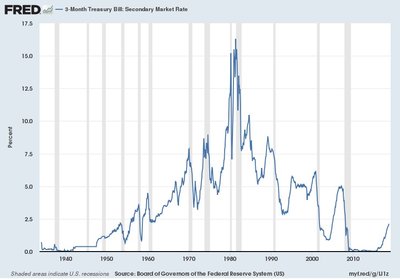
The Federal Reserve has adjusted interest rates in response to inflation and recessions, with notable periods such as the "Volcker recession" and the zero interest rate bound era.
1979–1983: Fed raised rates to combat inflation, causing recession.
1990–1991, 2001: Fed lowered rates to stimulate recovery.
2008–2015: Zero interest rate bound period.
Key Formulas and Relationships
Bond Price and Yield
Inverse Relationship: When bond prices fall, yields (interest rates) rise, and vice versa.
Example: If a bond's price drops from $1,000 to $900, its yield increases.
Aggregate Expenditure Formula
Formula:
Equilibrium:
Money Market Equilibrium
Formula:
Interest Rate: Determined where money supply equals money demand.
Aggregate Demand Curve
Downward Slope: Due to real wealth, interest rate, and international substitution effects.
Conclusion
Understanding the interplay between fiscal and monetary policy, the money market, and aggregate demand is essential for analyzing macroeconomic outcomes. These tools are used to stabilize the economy, control inflation, and promote growth. Additional info: Academic context and formulas were expanded for clarity and completeness.
