 Back
BackMoney Supply, the Monetary Base, and the Money Multiplier: Mechanisms and Historical Case Study
Study Guide - Smart Notes
 Tailored notes based on your materials, expanded with key definitions, examples, and context.
Money Supply and the Monetary Base
Definition and Components
The monetary base (also known as M0) is the foundation of the money supply in an economy. It consists of two main components:
Currency in circulation: Physical cash held by the public.
Reserves: Deposits that commercial banks hold at the Federal Reserve (central bank).
The Federal Reserve (Fed) directly controls the monetary base through its balance sheet operations.
Formula: Monetary Base = Currency + Reserves
Fed's Control Over Money
Directly Controlled: Currency, Reserves, Monetary Base (M0)
Not Directly Controlled: Checking deposits, Savings deposits, Broader money aggregates (M1, M2)
Central Question: How does the monetary base, which the Fed controls, relate to the broader money supply (which includes deposits)?
Connecting the Monetary Base to the Money Supply
A Simplified World: No Currency
To understand the relationship, consider a world with no physical currency—only electronic deposits exist. In this scenario:
Money Supply = Deposits
Monetary Base = Reserves
In reality, deposits are much larger than reserves at every bank, due to the process of lending and deposit creation.
The Bank Balance Sheet Perspective
Assets: Reserves, Loans, Securities
Liabilities: Deposits
The reserve ratio is the fraction of deposits that banks hold as reserves. Typically, total deposits (money supply) are much larger than total reserves (monetary base).
Understanding the Money Multiplier
The Multiplier Effect
Banks use reserves to make loans, which creates new deposits in the banking system. This process is known as multiple deposit creation and leads to a money multiplier effect:
Money Supply = Monetary Base × Multiplier
The multiplier shows how much the money supply increases for each dollar of monetary base.
Money Multiplier Formula
Multiplier = \( \frac{1}{RR} \), where RR is the reserve ratio.
For example, if RR = 0.1 (10%), the multiplier is 10.
Multiple Deposit Creation: Example
Initial new reserves: $10M
Bank 1 lends 90%: $9M
Bank 2 lends 90% of $9M: $8.1M
Bank 3 lends 90% of $8.1M: $7.29M
...and so on
Each round, banks keep a fraction as reserves and lend out the rest, creating new deposits elsewhere.
The Role of Open Market Operations
Definition and Mechanism
Open Market Operations (OMOs) are the Fed's primary tool for influencing the monetary base:
Open Market Purchase: Fed buys securities from banks, increasing bank reserves and the monetary base.
Open Market Sale: Fed sells securities to banks, decreasing bank reserves and the monetary base.
Key Insight: Open market purchases increase the monetary base; open market sales decrease it.
Factors Affecting the Money Multiplier
Reserve Ratio and Currency Holdings
Reserve Ratio (RR): Higher RR means a smaller multiplier; lower RR means a larger multiplier.
Currency Holdings: If the public holds more cash (rather than deposits), the multiplier decreases.
Trust in the banking system is crucial—when confidence falls, people hold more cash, reducing the multiplier.
The Multiplier During Economic Stress
Recession and Financial Crisis Effects
During recessions, banks lend less, increasing the reserve ratio and decreasing the multiplier.
During financial crises, bank runs and increased cash withdrawals by the public further reduce the multiplier.
Result: The money supply can fall even if the monetary base remains unchanged.
Case Study: The Great Depression (1929-1933)
Collapse of the Money Supply
During the Great Depression, the monetary base remained relatively stable, but the money supply (M1) fell sharply due to a collapse in the money multiplier.
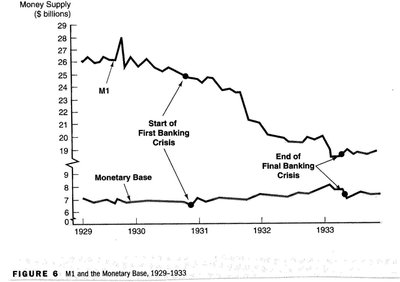
Key Observation: The Fed did not significantly change the monetary base, yet the money supply collapsed, contributing to deflation and economic depression.
What Happened to the Multiplier?
Two key ratios explain the collapse:
Currency Ratio (C): The ratio of currency to deposits rose as people withdrew deposits during banking crises.
Excess Reserves Ratio (E): Banks held more reserves than required, especially after 1932, further reducing the multiplier.
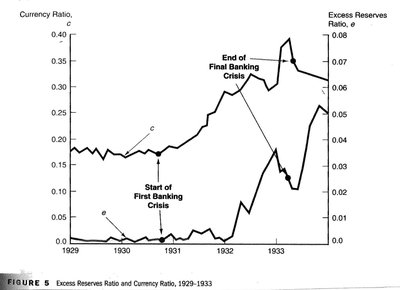
Timing: First, public panic increased the currency ratio; then, banks increased excess reserves.
Consequences: Deflation and the Great Depression
Money supply falls
Money becomes more scarce and valuable
Prices fall (deflation)
People delay purchases, expecting lower prices
Aggregate demand collapses
Great Depression ensues
The Fed's Mistake: The Fed could have increased the monetary base to offset the collapse in the multiplier but failed to act, leading to deflation and depression.
Lesson: The Fed does not fully control the money supply, but it can and should respond to changes in the multiplier to stabilize the economy.
