 Back
BackMonitoring Jobs and Inflation: Key Concepts in Macroeconomics
Study Guide - Smart Notes
 Tailored notes based on your materials, expanded with key definitions, examples, and context.
Monitoring Jobs and Inflation
Introduction
This section explores how economists monitor employment, unemployment, and inflation—three critical indicators of macroeconomic health. Understanding these concepts is essential for analyzing the overall performance of an economy and for formulating effective economic policies.
Employment and Unemployment
Labor Market Definitions and Measurement
Working Age Population: All individuals aged 16 and older who are not institutionalized.
Labor Force: The sum of employed and unemployed individuals.
Unemployed: Individuals not working but actively seeking work within the past four weeks, waiting to return to a job after a layoff, or waiting to start a new job within 30 days.
Not in Labor Force: Population minus employed and unemployed individuals.
Unemployment is a significant problem because it leads to lost incomes and lost human capital, making it harder for the unemployed to re-enter the workforce.
Recent Employment Data
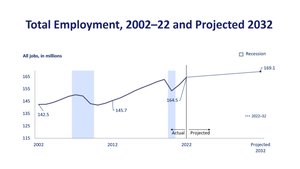
Full-time employment (Dec 2025): 135.2 million
Part-time employment (Dec 2025): 28.7 million
Unemployment rate (Dec 2025): 4.4%
Number of unemployed (Dec 2025): 6.1 million
Key Labor Market Indicators
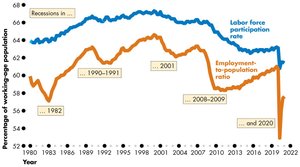
Employment-to-Population Ratio: Percentage of the working-age population that is employed. Formula:
Labor Force Participation Rate: Percentage of the working-age population in the labor force. Formula:
Limitations of Official Unemployment Measures
Marginally Attached Workers: Not working or looking for work but want and are available for work, and have looked for work recently.
Discouraged Workers: Marginally attached workers who have stopped searching due to repeated failure.
Part-Time for Economic Reasons: Part-time workers who want full-time jobs.
Other measures focus on the duration of unemployment.
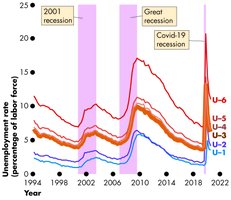
Alternative Unemployment Measures (U-1 to U-6)
U-1: Unemployed for 15 weeks or longer
U-2: Unemployed job losers
U-3: Official unemployment rate
U-4: U-3 plus discouraged workers
U-5: U-4 plus other marginally attached workers
U-6: U-5 plus part-time workers who want full-time jobs
All these measures tend to rise during recessions. Economists focus on trends rather than single data points.
Types of Unemployment
Frictional Unemployment: Normal labor market turnover as workers move between jobs or enter/re-enter the labor force. Increases with higher labor force mobility and unemployment benefits.
Structural Unemployment: Caused by technological changes or foreign competition that alter required job skills or job locations. Typically lasts longer than frictional unemployment.
Cyclical Unemployment: Results from economic fluctuations—rises during recessions and falls during expansions.
Natural Rate of Unemployment
Consists of frictional and structural unemployment; excludes cyclical unemployment.
Associated with stable inflation and full employment output.
Affected by age distribution, structural changes, real wage rates, and unemployment benefits.
Employment, Unemployment, and Output
Output Gap
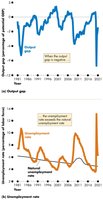
Output Gap: The difference between actual GDP and potential GDP.
Potential GDP: The level of output when the economy is at full employment (unemployment equals the natural rate).
If unemployment is above the natural rate, actual GDP is below potential GDP (negative output gap, typical in recessions).
If unemployment is below the natural rate, actual GDP exceeds potential GDP (positive output gap, typical in expansions).
Price Level, Inflation, and Deflation
Definitions and Economic Impact
Price Level: The average level of prices in the economy, determining the real value of money.
Inflation: Persistent increase in the price level.
Deflation: Persistent decrease in the price level.
Disinflation: A decrease in the rate of inflation (still positive, but slowing).
Unexpected inflation or deflation redistributes income and wealth, impacts real GDP and employment, and increases resource allocation costs due to uncertainty.
Measuring Inflation
Consumer Price Index (CPI): Measures the average price paid by urban consumers for a fixed basket of goods and services. The reference base period (1982–1984) is set to 100.
Formula for CPI:
Formula for Inflation Rate:
In December 2025, the CPI was 326.03, indicating prices were 226.03% higher than in the base period.
Constructing the CPI
Selecting the CPI basket (based on the Consumer Expenditure Survey)
Conducting a monthly price survey (80,000 items in 30 metropolitan areas)
Calculating the CPI using the cost of the market basket
Biases in the CPI
Quality Change Bias: Fails to distinguish between price increases due to quality improvements and pure price increases.
Commodity Substitution Bias: The fixed basket does not account for changes in consumer purchasing patterns.
Outlet Substitution Bias: Does not account for changes in where consumers shop.
New Goods Bias: Difficulty in tracking prices for new or obsolete goods.
Bias tends to overstate inflation; in 1996, it was estimated at about 1.1%.
Tax brackets, Social Security, and many government programs are indexed to the CPI.
Other Price Indexes
Chained CPI: Uses current and prior period quantities to better account for substitution and new goods.
Personal Consumption Expenditure (PCE) Index: Broader basket, preferred by the Federal Reserve.
GDP Deflator: Measures prices of all final goods and services produced in the economy.
Headline Inflation: Includes all prices in the index.
Core Inflation: Excludes food and fuel prices due to their volatility.
