 Back
Pearson Edexcel International Advanced Level Economics: Specification Study Guide
Study Guide - Smart Notes
 Tailored notes based on your materials, expanded with key definitions, examples, and context.
Overview of the Pearson Edexcel International Advanced Level in Economics
This study guide summarizes the structure, content, and key academic expectations of the Pearson Edexcel International Advanced Subsidiary (IAS) and Advanced Level (IAL) in Economics. The guide is designed to help students understand the scope of the course, the main topics covered, and the skills they are expected to develop.
Course Structure and Assessment
Qualification Structure
IAS (International Advanced Subsidiary): Comprises Units 1 and 2, externally assessed.
IAL (International Advanced Level): Comprises all four units (Units 1, 2, 3, and 4), externally assessed.
Each unit is assessed through written examinations, including multiple-choice, short-answer, data response, and essay questions. Calculators are permitted in all assessments.
Assessment Objectives
AO1: Demonstrate knowledge of terms, concepts, theories, and models.
AO2: Apply knowledge and understanding to various economic contexts.
AO3: Analyse issues and evidence, showing understanding of their impact.
AO4: Evaluate economic arguments and use evidence to support judgements.
Main Topics and Content Overview
Unit 1: Markets in Action
Introductory concepts: nature of economics, positive vs. normative statements, scarcity, production possibility frontiers, specialisation, and economic systems.
Consumer behaviour and demand: rational decision-making, demand curves, elasticity, and factors influencing demand.
Supply: supply curves, elasticity of supply, and factors influencing supply.
Price determination: market equilibrium, consumer and producer surplus, price mechanism, and the impact of taxes and subsidies.
Market failure: externalities, public goods, imperfect information, moral hazard, and market bubbles.
Government intervention: methods and purposes, and government failure.
Unit 2: Macroeconomic Performance and Policy
Measures of economic performance: GDP, GNI, inflation, unemployment, and balance of payments.
Aggregate demand and supply: components, determinants, and shifts in AD/AS curves.
National income: circular flow, injections and withdrawals, equilibrium, and the multiplier effect.
Economic growth: causes, benefits, costs, and output gaps.
Macroeconomic objectives and policies: growth, inflation, unemployment, balance of payments, fiscal and monetary policy, and supply-side policies.
Unit 3: Business Behaviour
Types and sizes of businesses: private/public sector, growth, mergers, and business objectives.
Revenue, costs, and profits: cost curves, economies of scale, and profit types.
Market structures and contestability: perfect competition, monopoly, oligopoly, monopolistic competition, and contestable markets.
Labour markets: demand and supply of labour, wage determination, and market failure.
Government intervention: regulation, competition policy, and labour market interventions.
Unit 4: Developments in the Global Economy
Globalisation: characteristics, causes, and effects.
Trade and the global economy: specialisation, comparative advantage, trade patterns, terms of trade, and protectionism.
Balance of payments, exchange rates, and international competitiveness.
Poverty and inequality: definitions, measurements, causes, and impacts.
The role of the state: public expenditure, taxation, borrowing, and macroeconomic policy.
Growth and development: measures, constraints, and strategies for development in different economies.
Quantitative Skills
Calculating ratios, percentages, index numbers, elasticity, and interpreting data in various forms.
Constructing and interpreting diagrams and graphs.
Understanding and applying composite indicators and seasonally adjusted figures.
Transferable Skills Developed
Critical thinking, problem solving, and analysis.
Communication, collaboration, and teamwork.
Personal responsibility, adaptability, and self-direction.
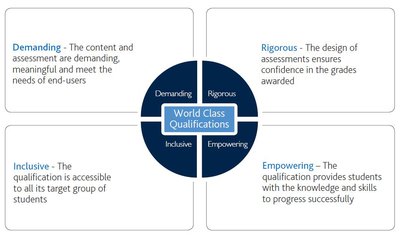

Assessment and Grading
Each unit is graded out of 80 marks, with uniform mark scales applied for final grades.
IAS is graded A–E; IAL is graded A*–E.
Assessment includes a mix of question types, with a focus on both knowledge and higher-order skills.
Progression and Further Study
The qualification supports progression to higher education in economics and related fields, as well as a wide range of careers in finance, business, and public policy.
