 Back
Production Possibility Curves, Scarcity, and Economic Growth: Foundations of Macroeconomics
Study Guide - Smart Notes
 Tailored notes based on your materials, expanded with key definitions, examples, and context.
Production Possibility Curves (PPC) and the Scarcity Paradigm
Introduction to the Production Possibility Curve
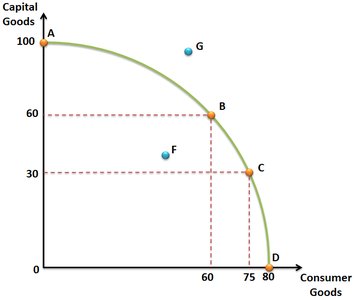
The Production Possibility Curve (PPC) is a fundamental model in macroeconomics that illustrates the concept of scarcity, trade-offs, and opportunity costs. It represents the maximum combinations of two goods or services that an economy can produce given its available resources and technology.
Scarcity: Resources are limited, so societies must make choices about what to produce.
Trade-offs: Choosing more of one good means producing less of another.
Opportunity Cost: The value of the next best alternative forgone when a choice is made.
Determinants of a Nation's Productive Capabilities
A nation's ability to produce goods and services depends on the quantity and quality of its factors of production:
Labor (including Labor Force Participation Rate, LFPR)
Natural Resources
Physical Capital (machines, equipment, infrastructure)
Human Capital (education, skills, health)
Entrepreneurial Abilities
Land
Technological Development
Institutions (rules, property rights, stability)
Productivity of these factors determines the standard of living (measured by GDP per capita).
The Role of Institutions
Institutions are the formal and informal rules that shape economic behavior. They influence:
Market development and scope
Protection of property rights (including intellectual property)
Support for education and financial systems
Government honesty and stability
Absence of civil conflict
Strong institutions are essential for economic growth and higher productivity.

Measuring Output and Economic Growth
Gross Domestic Product (GDP)
The output of a nation is commonly measured by its Real GDP, which reflects the value of all final goods and services produced within a country, adjusted for inflation. While not perfect, it is a widely used indicator of economic performance.
Factors Influencing Economic Growth
Economic growth is driven by increases in:
Productive resources (labor, capital, land, etc.)
Human capital (education, skills)
Physical capital (machines, infrastructure)
Technological change (innovation, new methods)
Better institutions (property rights, rule of law)
Long-run differences in living standards are primarily explained by differences in labor productivity ().
The Production Possibility Frontier (PPF) in Depth
Understanding the PPF
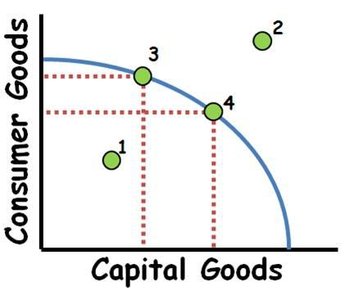
The PPF shows all possible combinations of two goods that can be produced using all available resources efficiently. Points on the curve represent efficient production, points inside are inefficient, and points outside are unattainable with current resources.
Opportunity Cost and Trade-offs
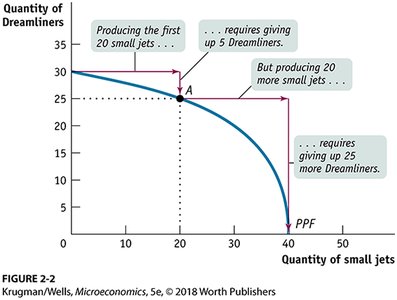
Moving along the PPF involves shifting resources from one good to another, which incurs an opportunity cost. The opportunity cost is the amount of one good that must be given up to produce more of the other good.
Example: If producing more consumer goods means producing fewer capital goods, the opportunity cost is the number of capital goods forgone.
Increasing Opportunity Costs
As production of one good increases, the opportunity cost of producing additional units typically rises. This is because resources are not equally efficient in all uses, leading to a concave PPF.
Some resources are better suited for producing one good than another.
This results in diminishing returns as more resources are devoted to one product.
Economic Growth and Shifts in the PPF
Economic growth is illustrated by an outward shift of the PPF, indicating an increase in a nation's productive capacity. This can result from:
Increases in labor or human capital (e.g., higher population, immigration, better education)
Capital accumulation (more machines, infrastructure)
Technological advancements
Improved institutions

Sources of Economic Growth
Expanding Resources
Growth can occur through increases in the quantity or quality of resources:
Labor: Higher birth rates, increased immigration, or greater labor force participation expand the workforce.
Human Capital: Education, training, and health improvements make workers more productive.
Physical Capital: Investment in machines, equipment, and technology increases output per worker.

Technological Change
Technological innovation increases productivity and shifts the PPF outward. Examples include the steam engine, electricity, the internet, and modern machinery. Technological change can impact specific industries or the entire economy.
The Role of Institutions and Property Rights
Institutions that protect property rights, enforce contracts, and maintain stability are crucial for encouraging investment and innovation. Intellectual property rights incentivize the creation of new ideas and technologies, which drive long-term growth.
Summary Table: Factors Affecting the PPF and Economic Growth
Factor | Effect on PPF | Example |
|---|---|---|
Labor (Quantity/Quality) | Outward shift | Immigration, education |
Physical Capital | Outward shift | Investment in machinery |
Technological Change | Outward shift | Internet, automation |
Institutions | Outward shift | Property rights, rule of law |
Resource Depletion | Inward shift | Population decline, war |
Key Equations
General production function:
Labor productivity:
GDP per capita:
Conclusion
The Production Possibility Curve is a foundational tool for understanding scarcity, opportunity cost, and the sources of economic growth. By analyzing the factors that shift the PPF, economists can better understand the drivers of national prosperity and the challenges of world poverty.
