 Back
Resource Market and Labor Market in Macroeconomics
Study Guide - Smart Notes
 Tailored notes based on your materials, expanded with key definitions, examples, and context.
Resource Market in Macroeconomics
Overview of Macroeconomic Markets
The macroeconomy is composed of several interconnected markets that together determine national income, employment, and price levels. The four main macroeconomic markets are:
Resource Market: Where firms demand and households supply productive resources.
Credit Market (Loanable Funds Market): Where funds are borrowed and lent.
Foreign Exchange Market (Forex Market): Where currencies are traded.
Product Market (Goods and Services Market): Where final goods and services are bought and sold.
Additional info: The product market is often modeled using the Aggregate Demand/Aggregate Supply (AD/AS) framework.
Macroeconomic Goals and Policy
Macroeconomic policy aims to achieve several desirable goals:
Full Employment: Maximizing the use of available labor resources.
Price Stability: Minimizing inflation and deflation.
Economic Growth: Increasing the economy's productive capacity over time.
Fiscal Policy: The use of government spending and taxation to influence macroeconomic outcomes. Monetary Policy: The deliberate control of interest rates and money supply by the central bank. Key Assumption: In this module, fiscal and monetary policies are assumed to be unchanging.
Resource Market
Definition and Components
The resource market is a highly aggregated market where firms demand resources and households supply them. The main types of resources are:
Labor: Includes both unskilled labor and human capital (knowledge and skills acquired through education and training).
Physical Capital: Tools, machines, buildings, and other equipment used in production.
Natural Resources: "Gifts of nature" such as land, minerals, and energy sources.
Entrepreneurship: The human skill of organizing and combining other resources to produce goods and services.
The labor market is the largest component of the resource market.
Examples of Resource Use
To illustrate the resource market, consider the production of a university lecture:
Capital: Lecture hall, classroom furniture, projector, instructor's laptop.
Labor: Instructor's human capital.
Natural Resources: Natural gas used to generate electricity for classroom equipment.
Additional info: Entrepreneurship is involved in organizing these resources to deliver education services.
Demand and Supply in the Resource Market
Derived Demand and Supply
Resource demand and supply are fundamental concepts in macroeconomics:
Demand for Resources: Firms demand resources to produce goods and services that households want. This is called derived demand because it depends on the demand for final products.
Supply of Resources: Households supply resources (mainly labor) to firms in exchange for income, which they use to purchase goods and services or save.
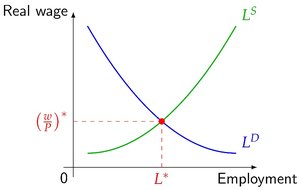
Demand Curve: Downward sloping, indicating that as the price of a resource falls, firms demand more of it.
Supply Curve: Upward sloping, indicating that as the price of a resource rises, households are willing to supply more.
Equilibrium in the Labor Market
The labor market reaches equilibrium when the quantity of labor demanded by firms equals the quantity supplied by households. The equilibrium wage and employment level are determined at the intersection of the labor demand and supply curves.
Equilibrium Wage: The wage rate at which labor supply equals labor demand.
Equilibrium Employment: The quantity of labor employed at the equilibrium wage.
The equilibrium can be represented mathematically:
Let be the labor demand curve and be the labor supply curve.
Equilibrium occurs where .
The equilibrium real wage is and equilibrium employment is .
Labor Market in the News
Current Events Example
Recent news reports can illustrate the functioning and importance of the labor market. For example, a decline in hiring or job losses may signal economic weakness and impact macroeconomic goals such as full employment.
Example: "U.S. Hiring Slumps, a Worrying Sign for the Economy" (The New York Times, Aug 9, 2026) – Employers shed 23,000 jobs in July, and previous gains were revised down, indicating a weaker labor market.
Summary Table: Types of Resources
Resource Type | Description | Example |
|---|---|---|
Labor | Work time and effort; includes human capital | Instructor's teaching skills |
Physical Capital | Tools, machines, buildings used in production | Projector, classroom furniture |
Natural Resources | "Gifts of nature" used in production | Natural gas for electricity |
Entrepreneurship | Organizing and combining resources | University administration |
Key Terms and Concepts
Resource Market
Labor Market
Derived Demand
Equilibrium Wage
Fiscal Policy
Monetary Policy
Full Employment
Price Stability
Economic Growth
