 Back
Supply and Demand: Foundations of the Goods Market
Study Guide - Smart Notes
 Tailored notes based on your materials, expanded with key definitions, examples, and context.
Supply and Demand
Introduction to Supply and Demand
The concepts of supply and demand are fundamental to understanding the goods market in macroeconomics. These principles explain how prices and quantities of goods are determined in a market economy.
Demand: The quantity of a good that consumers are willing and able to purchase at various prices.
Supply: The quantity of a good that producers are willing and able to sell at various prices.
Market Equilibrium: The point where the supply and demand curves intersect, determining the equilibrium price and quantity.
Key Features of the Supply and Demand Model
The supply and demand model is typically represented graphically, with price on the vertical axis and quantity on the horizontal axis. The intersection of the supply and demand curves indicates the equilibrium.
Surplus: Occurs when the quantity supplied exceeds the quantity demanded at a given price, leading to downward pressure on prices.
Shortage: Occurs when the quantity demanded exceeds the quantity supplied at a given price, leading to upward pressure on prices.
Law of Demand: As price decreases, quantity demanded increases (downward-sloping demand curve).
Law of Supply: As price increases, quantity supplied increases (upward-sloping supply curve).
Equilibrium Price and Quantity
The equilibrium price () and equilibrium quantity () are found where the supply and demand curves intersect. At this point, the market clears, and there is neither a surplus nor a shortage.
Mathematical Representation:
Example: Market for a Good
Suppose the demand and supply equations for a product are:
Setting :
Thus, the equilibrium price is 4, and the equilibrium quantity is 30.
Graphical Representation
The following image illustrates the supply and demand curves, showing areas of surplus and shortage, and the equilibrium point:
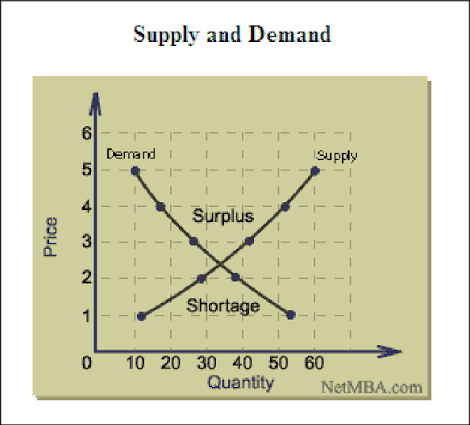
Surplus occurs above the equilibrium price, while shortage occurs below it. The intersection marks the market-clearing price and quantity.
Applications in Macroeconomics
Understanding supply and demand is essential for analyzing the goods market, which is covered in Chapter 3 of most macroeconomics textbooks. These concepts underpin more advanced models such as the IS-LM model and are foundational for studying market dynamics, price determination, and policy impacts.
