 Back
BackThe Economic Basis for Trade: Comparative and Absolute Advantage
Study Guide - Smart Notes
 Tailored notes based on your materials, expanded with key definitions, examples, and context.
The Economic Basis for Trade
Introduction
International trade arises due to differences among nations in resource endowments, production technologies, and consumer preferences. These differences create opportunities for countries to specialize in the production of certain goods and exchange them for others, leading to increased overall economic welfare.
Resource Endowments: Nations possess varying quantities and qualities of land, labor, and capital.
Technological Differences: Efficient production of goods often requires different technologies or resource combinations.
Consumer Preferences: People may prefer imported goods over similar domestically produced goods due to quality, style, or other factors.
Comparative Advantage as the Basis for Trade
Specialization and International Trade
All nations, regardless of their resource base, can find niches in the global market by specializing in products where they have a comparative advantage. This specialization allows countries to export goods they produce efficiently and import those they do not, increasing the productivity of their resources and enabling higher total output.
Absolute Advantage: A country has an absolute advantage if it can produce more of a good with the same resources compared to other countries.
Comparative Advantage: A country has a comparative advantage if it can produce a good at a lower opportunity cost than others. This is the true basis for beneficial trade.
Specialization: Countries should specialize in goods where they have a comparative advantage and trade for others, even if they have an absolute advantage in all goods.
Example of Comparative and Absolute Advantage:
USA: Can produce 30 tons of coffee or 30 tons of wheat.
Brazil: Can produce 20 tons of coffee or 10 tons of wheat.
The USA has an absolute advantage in both goods, but the opportunity cost of producing wheat is lower in the USA, while Brazil has a lower opportunity cost for coffee.
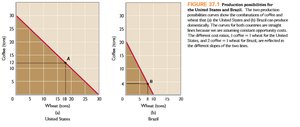
Figure: Production possibilities frontiers for the United States and Brazil. The graphs show the maximum combinations of wheat and coffee each country can produce, illustrating their respective opportunity costs and potential for specialization.
Gains from Trade: Autarky vs. Specialization
Before trade (autarky), each country produces and consumes only what it can make itself. After trade, specialization according to comparative advantage allows both countries to consume more of both goods.
Autarky Consumption:
USA: 12 tons coffee, 18 tons wheat
Brazil: 4 tons coffee, 8 tons wheat
World total: 16 tons coffee, 26 tons wheat
With Specialization and Trade:
USA specializes in wheat (30 tons), Brazil in coffee (20 tons)
World total: 20 tons coffee, 30 tons wheat (higher than autarky)
Through trade, both countries can consume more of both goods than before.
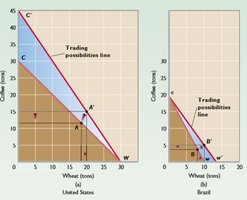
Figure: Trading possibilities lines for the United States and Brazil. The shaded areas show the increased consumption possibilities for both countries after specialization and trade, compared to autarky.
Opportunity Cost and Terms of Trade
The opportunity cost of producing one good in terms of the other determines comparative advantage and the range for mutually beneficial trade (terms of trade).
USA Opportunity Cost: 1 coffee = 1 wheat
Brazil Opportunity Cost: 2 coffee = 1 wheat (or 1 coffee = 0.5 wheat)
Terms of Trade: The agreed exchange rate for goods between countries must lie between their respective opportunity costs. In this example, 1 wheat = 1.5 coffee (or 1 coffee = 0.67 wheat).
Benefits: Both countries can now consume more than they could in autarky, as the terms of trade are favorable compared to their domestic opportunity costs.
Summary Table: Comparative and Absolute Advantage
Country | Max Coffee (tons) | Max Wheat (tons) | Opportunity Cost of 1 Wheat | Comparative Advantage |
|---|---|---|---|---|
USA | 30 | 30 | 1 coffee | Wheat |
Brazil | 20 | 10 | 2 coffee | Coffee |
Key Equations
Opportunity Cost (General):
Terms of Trade (Range):
Additional info: The concepts of absolute and comparative advantage are foundational to international economics and explain why even countries with fewer resources can benefit from trade. The graphical analysis using production possibilities frontiers (PPFs) visually demonstrates the gains from specialization and exchange.
