 Back
BackThe Monetary and Financial System: Money, Currency, and Their Roles in Macroeconomics
Study Guide - Smart Notes
 Tailored notes based on your materials, expanded with key definitions, examples, and context.
The Monetary and Financial System
Introduction & Aggregation
The monetary system is a foundational element in macroeconomics, serving as the bridge between long-run economic growth and short-run business cycles. Aggregation in economics refers to the process of summing diverse goods and services—such as apples, cars, and lectures—into a single measure like GDP. This is made possible by expressing all values in terms of a common currency, highlighting the central role of money in economic measurement and analysis.
Aggregation Problem: Market prices allow for the summation of heterogeneous goods into economic aggregates denominated in currency units.
GDP Calculation: GDP is computed by valuing all final goods and services produced within a country using market prices, which are expressed in the national currency.
Visualizing Money: Lessons from History
Monetary design has evolved in response to practical economic constraints. Historical examples illustrate how the physical form of money was shaped by the need for efficiency and convenience in trade and transport.
British Malaya Square Coins: Square coins were designed to maximize packing efficiency during transport, minimizing wasted space compared to circular coins.
East Asian Holed Coins: Coins with holes allowed users to string them together for portability, especially before the widespread use of pockets.
Defining and Measuring Money
Money is defined as anything widely accepted as a standardized means of exchange or payment in market transactions. There are two main types of money: commodity money and fiat money.
Commodity Money: Money that has intrinsic value independent of its use as currency (e.g., gold, salt, rice).
Fiat Money: Currency without intrinsic value, established by government decree and accepted because it is required for payment of taxes and other obligations.
Etymology: Many currency names (e.g., pound, peso, shekel) originate from historical units of weight.
What Underpins the Value of Money?
The value of modern fiat currency is not derived from its physical properties but from shared institutional beliefs and strategic market expectations. The acceptance of money is based on the expectation that others will also accept it in the future.
Example: A $100 bill is valuable because it is widely accepted, not because of the paper itself.
Hyperinflation: In cases of hyperinflation, such as with a 10 billion dollar bill, the nominal value becomes meaningless due to loss of trust and acceptance.
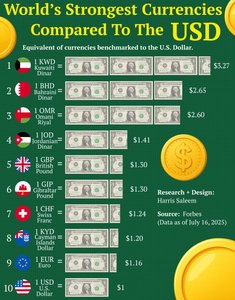
Additional info: The image above illustrates the relative value of various world currencies compared to the US dollar, reinforcing the concept that currency value is determined by market acceptance and institutional trust.
Commodity Money vs. Fiat Money
Commodity Money: Has intrinsic value (e.g., gold coins can be melted for their metal content).
Fiat Money: Value is derived from government decree and the requirement to pay taxes in that currency.
State Backing: The ultimate anchor for fiat money is state coercion, particularly the requirement to pay taxes in the national currency.
The Limits of State Decrees: The Laos Case Study
Government decree alone does not always ensure exclusive use of a national currency. In practice, people may use multiple currencies for convenience and liquidity.
Example: In Luang Prabang, Laos, merchants price goods in four currencies: Kip (local), Baht (Thai), Euros, and US Dollars.
Economic Lesson: Market participants prioritize convenience and liquidity over sovereign mandates when choosing which currency to use.
Measuring the Money Supply: Monetary Aggregates
The money supply is measured using monetary aggregates, which reflect the liquidity of different types of assets. Liquidity refers to how easily an asset can be converted into money without loss of value.
Liquidity Spectrum: Money exists on a spectrum of liquidity, from the most liquid (cash) to less liquid assets (savings accounts, CDs).
M1 (Narrow Money): Includes currency in circulation and checking accounts (demand deposits).
Formula:
M2 (Broad Money): Includes all of M1 plus savings accounts, short-term certificates of deposit (CDs ≤ 6 months), and retail money market mutual fund shares.
Formula:
The Classical Functions and Core Properties of Money
Money serves three primary functions in the economy and must possess certain physical properties to be effective.
Medium of Exchange: Facilitates trade by eliminating the need for a double coincidence of wants.
Unit of Account: Provides a standard measure for pricing goods and services.
Store of Value: Maintains purchasing power over time.
Durable: Resistant to spoilage or degradation.
Divisible: Can be broken into smaller units for fractional payments.
Portable: Easy to transport relative to its value.
Easy to Recognize: Difficult to counterfeit, with recognizable features (e.g., gold luster, watermarks).
Barter Bottlenecks and Specialization
Barter systems require a double coincidence of wants, which creates friction in trade. Money solves this problem by acting as a universally accepted intermediary, enabling greater economic specialization and efficiency.
Double Coincidence of Wants: In barter, both parties must want what the other offers at the same time.
Monetary Solution: Money allows producers to sell their goods or services for money, which can then be used to purchase anything else, decoupling production from consumption.
Macro Impact: Money enables workers to specialize in a single productive task, increasing overall economic efficiency and output.
