 Back
BackThe Monetary System: Money, Inflation, and the Federal Reserve
Study Guide - Smart Notes
 Tailored notes based on your materials, expanded with key definitions, examples, and context.
The Monetary System
Introduction to Money
Money is a fundamental concept in macroeconomics, serving as the backbone of modern economies. It is defined as assets that are widely used to make and receive payments for goods and services. The forms of money have evolved over time, from commodity money like gold coins to modern fiat currencies.
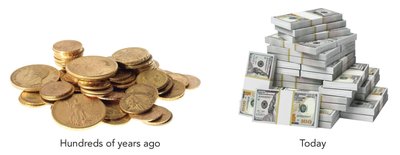
Definition: Money is any asset that is widely accepted as payment for goods and services.
Examples: Shells, gold, cigarettes (historically); U.S. dollars, euros (today).
Functions of Money
Money serves three primary functions in a modern economy:
Medium of Exchange: Money facilitates trade by eliminating the inefficiencies of barter, such as the double coincidence of wants. This allows for greater specialization and efficiency in the economy.
Unit of Account: Money provides a common measure for valuing goods and services, making price comparisons straightforward.
Store of Value: Money allows individuals to transfer purchasing power into the future, although it may not always yield high returns compared to other assets.


Types of Money: Commodity vs. Fiat Money
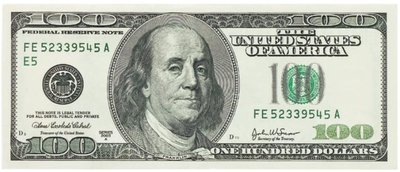
Modern economies use fiat money, which is declared legal tender by governments but is not backed by a physical commodity like gold.
Fiat Money: Value is derived from government decree and public trust.
Commodity Money: Value is based on the material from which it is made (e.g., gold, silver).
Measuring the Money Supply
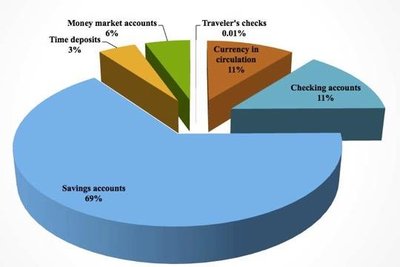
The money supply is measured using monetary aggregates:
M1: The narrowest measure, including currency in circulation, traveler's checks, and checking account balances.
M2: Includes all of M1 plus savings deposits, small time deposits, and money market deposit accounts.
Money, Prices, and GDP
Gross Domestic Product (GDP)
GDP measures the market value of all final goods and services produced within a country during a specific period. It is a key indicator of economic activity.
Nominal GDP: Calculated using current prices.
Real GDP: Calculated using constant base-year prices to account for inflation.
Relationship:
Growth rate of nominal GDP = Growth rate of real GDP + Inflation rate
The Quantity Theory of Money
The quantity theory of money links the money supply, velocity of money, price level, and real GDP. It assumes that the velocity of money is constant in the long run.
Velocity (V): The rate at which money circulates in the economy.
Equation:
Quantity Theory Equation:
Therefore,
Inflation
Definition and Causes
Inflation is a sustained increase in the general price level of goods and services. According to the quantity theory, inflation occurs when the growth rate of the money supply exceeds the growth rate of real GDP.
Deflation: A decrease in the general price level (negative inflation).
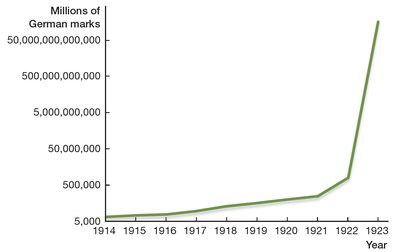
Hyperinflation: Extremely high inflation, where prices double within three years or less.
Winners and Losers from Unexpected Inflation
Winners: Borrowers with fixed-rate loans, firms paying non-indexed wages.
Losers: Lenders with fixed-rate loans, workers with non-indexed wages, retirees with non-indexed pensions.
Social Costs and Benefits of Inflation
Benefits: Generates government revenue (seigniorage), can stimulate economic activity by lowering real wages.
Costs: Inflation tax (loss of purchasing power), menu costs (frequent price changes), distorted relative prices, and potential for counterproductive policies like price controls.
Real Interest Rate and the Fisher Equation
The real interest rate adjusts the nominal interest rate for inflation, reflecting the true cost of borrowing.
Fisher Equation:
Historical Example: German Hyperinflation (1922–1923)
Germany experienced hyperinflation after World War I due to excessive money printing to pay reparations, leading to a collapse in the value of the currency.
The Federal Reserve and Monetary Policy
The Role of the Central Bank
The Federal Reserve (the Fed) is the central bank of the United States. It is responsible for regulating financial institutions, controlling key interest rates, and indirectly managing the money supply through monetary policy.
Dual Mandate: Low and predictable inflation, and maximum sustainable employment.
Key Functions of the Federal Reserve
Regulation: Audits banks, monitors equity, and requires stress tests.
Interbank Transfers: Oversees payments between banks using reserves held at the Fed.
Management of Macroeconomic Fluctuations: Manipulates the quantity of bank reserves to influence interest rates, money supply, and inflation.
Bank Reserves and the Plumbing of the Monetary System
Bank Reserves
Bank reserves are deposits that private banks hold at the central bank plus cash in their vaults. They provide liquidity, allowing banks to meet withdrawal demands and settle interbank transactions.
The Federal Funds Market
The federal funds market is where banks lend and borrow reserves overnight. The federal funds rate is the interest rate charged in this market and is a key target for monetary policy.
Supply and Demand for Reserves
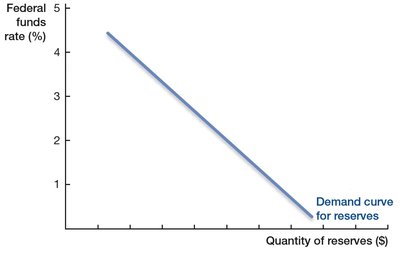
Demand Curve: Shows the quantity of reserves banks want to hold at each federal funds rate. It slopes downward because lower rates make holding reserves less costly.
Supply Curve: Determined by the Fed through open market operations. It is vertical because the Fed sets the supply based on policy goals, not profit.
Shifts in the Demand Curve for Reserves
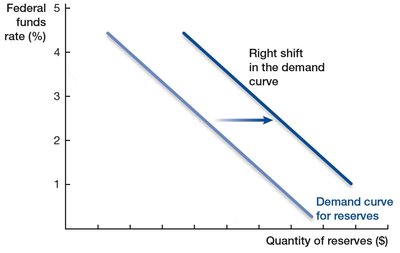
Economic expansion (right shift): Banks need more reserves to support increased lending.
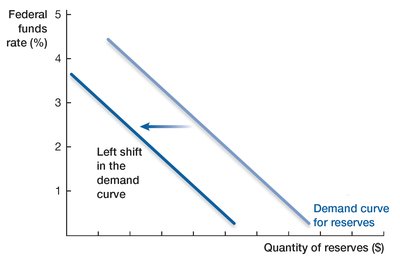
Economic contraction (left shift): Banks need fewer reserves as lending declines.
Open Market Operations
The Fed conducts open market operations to adjust the supply of reserves:
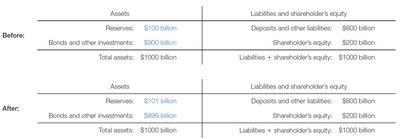
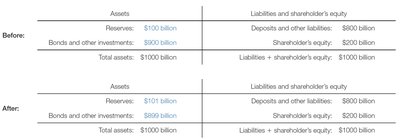
Open Market Purchase: Fed buys government bonds, increasing bank reserves.
Open Market Sale: Fed sells government bonds, decreasing bank reserves.
Equilibrium in the Federal Funds Market
The intersection of the supply and demand curves for reserves determines the equilibrium federal funds rate.
Fed Strategies: Targeting Reserves vs. Targeting the Federal Funds Rate
The Fed can keep reserves fixed and let the federal funds rate fluctuate, or it can adjust reserves to keep the rate constant.
In practice, the Fed targets the federal funds rate to achieve its dual mandate.
From Reserves to Inflation
By increasing the supply of reserves, the Fed lowers the federal funds rate, which decreases long-term interest rates, stimulates borrowing, increases the money supply, and raises inflation. The opposite occurs when the Fed reduces reserves.
Controlling the Money Supply and Inflation
The Fed can influence, but not directly control, the money supply and inflation rate due to the role of private banks and the public in money creation.
Tools include changing reserve requirements, open market operations, and adjusting interest paid on reserves.
Long-Term Interest Rates and Inflation Expectations
Investment decisions depend on expected real interest rates over long periods. The Fed can influence these rates through monetary policy and by shaping inflation expectations.
Expected Real Interest Rate:
Key Ideas Summary
Money serves as a medium of exchange, store of value, and unit of account.
The quantity theory of money links money supply, velocity, prices, and real GDP.
Inflation is determined by the gap between money supply growth and real GDP growth.
The Federal Reserve manages monetary policy to achieve low inflation and maximum employment, primarily by targeting the federal funds rate through open market operations.
