 Back
BackThe Simplest Short-Run Macro Model: Consumption, Investment, and Aggregate Expenditure
Study Guide - Smart Notes
 Tailored notes based on your materials, expanded with key definitions, examples, and context.
6a Desired Consumption Expenditure
Autonomous and Induced Expenditures
In macroeconomics, expenditures are classified based on their dependence on national income (Y). Understanding this distinction is crucial for analyzing how changes in income affect overall spending in the economy.
Autonomous expenditures: These do not depend on the level of national income. Examples include basic consumption needs or fixed investments.
Induced expenditures: These do depend on the level of national income. As income rises, induced expenditures increase.
Disposable Income and the Consumption Function
Disposable income (YD) is the income available to households after taxes:
The consumption function models desired consumption as a linear function of disposable income:
a = autonomous consumption (consumption when income is zero)
b = marginal propensity to consume (MPC)
Example:
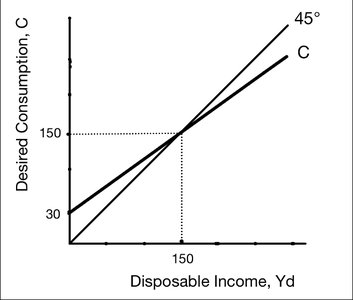
Marginal Propensity to Consume (MPC)
The MPC is the proportion of additional disposable income that consumers spend:
The MPC is the slope of the consumption function.
Movements and Shifts in the Consumption Function
Movement along the function: Caused by changes in disposable income.
Shifts of the function: Caused by changes in wealth, interest rates, or expectations.
Savings and the Marginal Propensity to Save (MPS)
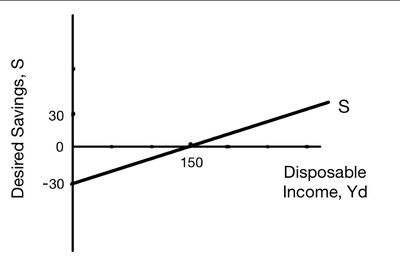
Disposable income not spent is saved:
The marginal propensity to save (MPS) is:
6b Desired Investment Expenditure
Autonomous Nature of Investment
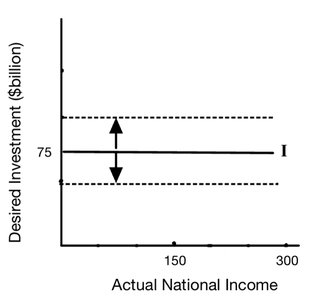
Investment is the most volatile component of GDP and is typically modeled as autonomous—independent of current national income. This is because investment decisions are based on long-term planning and expectations.
Investment is strongly associated with short-run economic fluctuations.

The Investment Function
The investment function is usually depicted as a horizontal line, indicating that desired investment does not change with current income:
Shifts in the investment function can be caused by:
Changes in the real interest rate (opportunity cost of investment)
Changes in the level of sales (affecting desired inventory levels and capacity utilization)
Business confidence (forward-looking expectations)
6c The Aggregate Expenditure Function
Definition and Construction
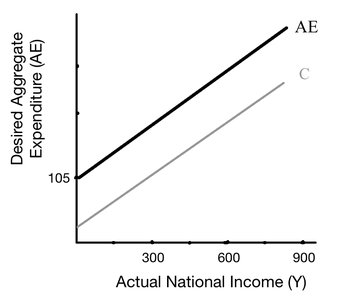
The aggregate expenditure (AE) function relates total desired spending in the economy to actual national income (Y). In the simplest model (no government, no trade, constant prices):
Where is a function of (not in this simplified case), and is autonomous.
Example: ,
Marginal Propensity to Spend (z)
The marginal propensity to spend (z) is the extra desired AE induced by an additional $1 of national income:
In this simple model (no taxes),
6d Equilibrium National Income
Determination of Equilibrium
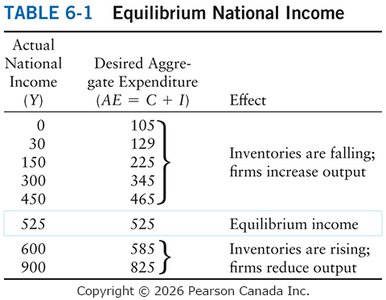
Equilibrium national income occurs where desired aggregate expenditure equals actual national income:
If , inventories fall and firms increase output.
If , inventories rise and firms reduce output.
Table: Equilibrium National Income
The following table illustrates how equilibrium is achieved:
Actual National Income (Y) | Desired Aggregate Expenditure (AE = C + I) | Effect |
|---|---|---|
0 | 105 | Inventories are falling; firms increase output |
30 | 129 | Inventories are falling; firms increase output |
150 | 225 | Inventories are falling; firms increase output |
300 | 345 | Inventories are falling; firms increase output |
450 | 465 | Inventories are falling; firms increase output |
525 | 525 | Equilibrium income |
600 | 585 | Inventories are rising; firms reduce output |
900 | 825 | Inventories are rising; firms reduce output |
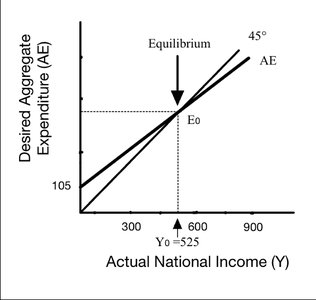
Graphical Representation of Equilibrium
Equilibrium is found where the AE curve intersects the 45-degree line (where AE = Y):
Example: Solving for equilibrium:
6e The Simple Multiplier
Definition and Calculation
The simple multiplier (SM) measures the change in equilibrium national income resulting from a change in autonomous expenditure:
The larger the marginal propensity to spend (z), the larger the multiplier.
A change in autonomous expenditure causes a parallel shift in the AE curve, leading to a multiplied change in equilibrium income.
Example: If and increases by 10, calculate the change in using the multiplier formula.
Additional info: The multiplier effect is a central concept in Keynesian economics, illustrating how initial changes in spending can have amplified effects on total output and income.
